The development history of SDIC Power can be categorized into the following key stages, illustrating its transformation from a regional power utility into an international clean energy giant:
Stage 1: Initiation and Listing (2002 – mid-2000s)
- Asset Restructuring and Incorporation: SDIC Power was officially established in 2002. It was listed on the Shanghai Stock Exchange (600886) following an asset swap with Hubei Xinghua.
- Early Development: During this period, the company focused on establishing its business structure. Based primarily on thermal power projects, it began integrating the power assets under the State Development & Investment Corp (SDIC), solidifying its position as the group’s flagship listed entity for power operations.
Stage 2: Core Expansion and Hydropower Focus (Late 2000s – mid-2010s)
- Establishing Core Competitiveness: The company established a development strategy centering on hydropower. It successfully acquired controlling stakes in hydropower development along the Yalong River and gradually developed major power stations such as Dachaoshan and Xiaosanxia. This significantly increased the proportion of hydropower in its total installed capacity and secured its leading position in China’s hydropower industry.
- Scale Growth: Business operations expanded from a regional level to multiple provinces, including Sichuan, Tianjin, Guangxi, and Yunnan, while the energy mix began shifting toward clean energy.
Stage 3: Green Transformation and Internationalization (Late 2010s – 2022)
- Clean Energy Shift: In response to the “Dual Carbon” goals, SDIC Power significantly expanded its wind, solar, and energy storage portfolios while continuing to optimize its efficient thermal power structure, committing firmly to green transformation.
- International Footprint: The company actively expanded into overseas markets, investing in energy projects along the “Belt and Road” and in OECD countries. It also issued Global Depositary Receipts (GDRs) on the London Stock Exchange (LSE), enhancing its influence in global capital markets.
Stage 4: High-Quality Development and Capital Operations (2023 – Present)
- Integrated Energy Bases: Leveraging the Yalong River basin, the company is developing a “Hydro-Wind-Solar Integrated” demonstration base, which has been incorporated into national energy planning.
- Governance and Capital Innovation: The company has further improved its ESG management system and utilized capital operations, such as private placements, to attract strategic investors like the National Social Security Fund, thereby strengthening its financial position. As of the end of 2024, the company stands as one of China’s most competitive comprehensive energy firms, with clean energy accounting for over 70% of its total installed capacity.
Sources:
SDIC Group – Company Introduction
SDIC Power Business Model
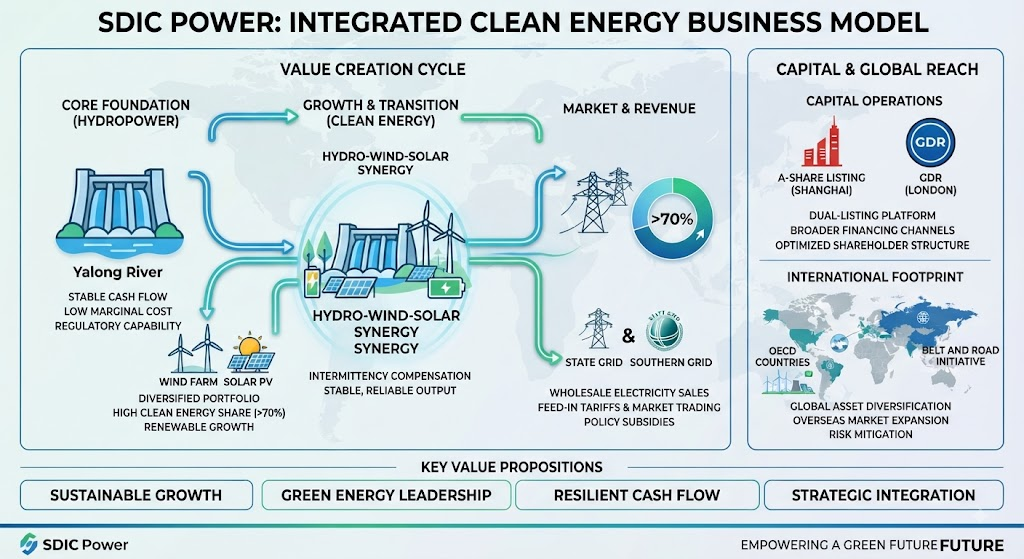
As a leading integrated energy enterprise in China, SDIC Power operates on a core business model built upon hydropower as a foundational cornerstone, supplemented by diversified clean energy growth, large-scale operations, and integrated asset management. Through capital market operations and asset integration, the company has constructed an operational framework characterized by robust cash flow and strong defensive capabilities:
1. Core Power Generation and Electricity Sales
- Primary Revenue Sources: The company generates revenue primarily by constructing, operating, and selling electricity from hydropower, wind power, solar photovoltaic, and high-efficiency thermal power plants to major grid buyers such as the State Grid and China Southern Power Grid.
- Pricing Mechanism: Domestic electricity pricing and revenues are realized through feed-in tariffs approved by the National Development and Reform Commission (NDRC) and local energy authorities, market-oriented power trading prices, and the implementation of national policy subsidies.
2. Hydropower Moat and Cash Flow Advantages
- River Basin Development Model: The company centers its core strategy on hydropower development along the Yalong River basin in Sichuan. By executing cascading development and long-term controlling stakes across the entire river basin, it maximizes water resource utilization and optimizes operating costs.
- Financial Moat: Hydropower operations feature low marginal generation costs and stable cash flows, providing the company with a continuous source of funding to support the further expansion of its other clean energy businesses.
3. Hydro-Wind-Solar Integration and Green Transition
- Synergistic Effects: Leveraging existing hydropower bases, the company actively promotes “Hydro-Wind-Solar Integrated” demonstration projects. It utilizes the exceptional peak-shaving and rapid-regulation capabilities of hydropower to perfectly offset the intermittency and instability of wind and solar power generation.
- Asset Portfolio Optimization: By continuously expanding wind and solar capacity to push the proportion of clean energy above 70%, the company aligns with global ESG investment trends and “Dual Carbon” policies, mitigating profit risks caused by fuel price volatility (such as coal) in traditional thermal power.
4. Capital Operations and International Footprint
- Dual-Wheel Capital Drivers: As the listed power flagship of the State Development & Investment Corp (SDIC), the company utilizes A-share financing alongside the issuance of Global Depositary Receipts (GDRs) on the London Stock Exchange, effectively broadening its financing channels and optimizing its shareholder structure.
- Global Expansion: The company actively participates in overseas power project investments under the Belt and Road Initiative and in OECD countries, achieving geographic asset diversification and reducing single-market policy risks.
Back to SDIC Power