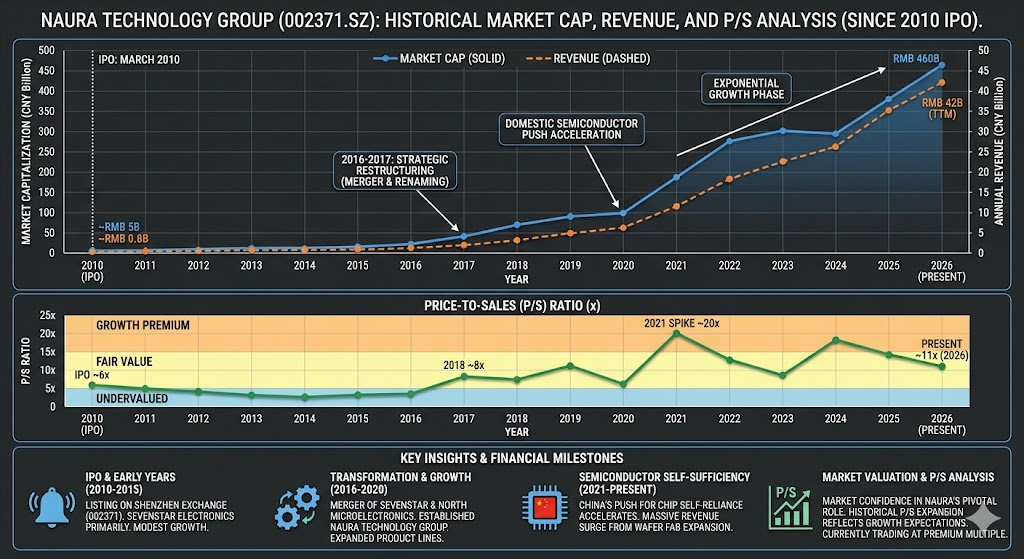
The development history of NAURA Technology Group can be divided into three main stages, evolving from a single-business entity into a diversified semiconductor equipment platform:
Stage 1: State-Owned Integration and Foundation (Before 2016)
During this period, Sevenstar Electronics and North Microelectronics, both under the Beijing Electronics Holding umbrella, operated independently.
- 2001: The Beijing Microelectronics Equipment Process Research Center (predecessor to North Microelectronics) was established, focusing on the R&D of integrated circuit equipment.
- 2010: Sevenstar Electronics was listed on the Shenzhen Stock Exchange (002371.SZ), entering the capital market and increasing R&D investment in 12-inch wafer processing equipment.
- Characteristics: Individual entities accumulated foundational technologies, focusing on RF technology, electronic components, and basic semiconductor process equipment.
Stage 2: Strategic Restructuring and Platform Building (2016-2017)
This marked a turning point in the company’s development through resource integration via capital operations.
- 2016: Sevenstar Electronics and North Microelectronics underwent a major asset restructuring, merging to lay the foundation for a platform-based enterprise.
- 2017: The company was officially renamed “NAURA Technology Group,” integrating its business into three core sectors: semiconductor equipment, vacuum and lithium battery equipment, and electronic components. This strengthened the company’s comprehensive competitiveness in the pan-semiconductor field.
Stage 3: Rapid Growth and Domestic Substitution (Post-2017)
Benefiting from the demand for semiconductor localization in China and external expansion, the company entered a period of high-speed growth.
- Technological Breakthroughs: The company’s products have gradually advanced from mature processes to 28nm, 14nm, and more advanced nodes, with mass supply achieved in etching, thin-film deposition (PVD/CVD/ALD), and cleaning equipment.
- External Expansion: Through acquisitions such as Akrion (cleaning equipment) in the U.S., Beiguang Technology (RF technology), and Beijing Danpu (coating equipment), the company continuously completed its technological puzzle.
- Economies of Scale: In 2024, the company’s revenue exceeded 30B RMB. With continuous capacity expansion and increased R&D investment, the company has become one of the largest semiconductor equipment platform enterprises in China with the most comprehensive product lines, occupying a core position in the process of domestic substitution.
The competitive analysis of NAURA Technology Group (002371.SZ) can be observed primarily through the global competitive landscape corresponding to its business segments:
Global and Chinese Semiconductor Equipment Market Landscape
In the global semiconductor equipment market, NAURA faces a competitive environment with extremely high technical barriers. Its competitors are primarily categorized into two groups: international giants and domestic Chinese peers.
Major Competitor Classification
- International Leading Equipment Manufacturers (Tier 1)
- Applied Materials (AMAT): A global leader in multiple process areas including PVD, CVD, etching, and ion implantation, directly competing with NAURA’s core thin-film and etching product lines.
- Lam Research (LRCX): Holds a global leading position in etching technology (especially high-aspect-ratio etching) and cleaning equipment.
- Tokyo Electron (TEL): Possesses significant market share in coater/developers, etching, and thin-film deposition equipment.
- ASML: While primarily focused on lithography, there is indirect competition between its lithography-related peripheral equipment and NAURA’s process solutions.
- Domestic Chinese Peers (Tier 2 & Emerging Players)
- Advanced Micro-Fabrication Equipment (AMEC): Boasts strong technical expertise in etching equipment (particularly CCP etching) and is NAURA’s most formidable domestic competitor in the etching machine market.
- ACM Research (Shanghai): Deeply rooted in wet cleaning equipment and advanced packaging-related equipment, competing with NAURA in the cleaning technology segment.
- Piotech: Focuses on thin-film deposition equipment (e.g., PECVD, ALD), directly benchmarking against NAURA’s thin-film product segment.
Comparative Analysis of Core Competitiveness
| Dimension | NAURA Technology | International Tier 1 | Domestic Peers |
| Product Breadth | Extremely High (Platform) | High (Vertical Depth) | Medium (Focus on niche) |
| Technology Level | Catching up (Mature edge) | Leading (Advanced nodes) | Catching up |
| Cost/Service | Local price/response edge | High cost, distant supply chain | Local cost/service edge |
| Domestic Priority | Highest (State priority) | Low (Trade restrictions) | High |
SWOT Analysis
- Strengths
- Most Comprehensive Product Matrix: As one of the few domestic equipment suppliers with platform capabilities, its product portfolio covers etching, deposition, cleaning, and furnace equipment, offering a one-stop process platform for customers.
- National Strategic Dividends: Benefiting from robust domestic substitution demand driven by China’s wafer fab expansion.
- Weaknesses/Threats
- Advanced Process Bottlenecks: Technical gaps remain compared to international Tier 1 manufacturers in terms of equipment reliability and yield efficiency for ultra-high-end processes (<7nm).
- Core Component Reliance: While localization is accelerating, supply chain flexibility for certain key components and precision control systems remains affected by the international trade environment.
- Geopolitical Constraints: Current operations are heavily concentrated in China, and global market expansion faces significant challenges due to geopolitical factors.
Source:
- https://www.etnet.com.hk/www/tc/ashares/quote_ci_brief.php?code=002371
- https://zh.wikipedia.org/zh-tw/北方華創
- https://www.lamresearch.com/
- https://www.appliedmaterials.com/
Back to Naura page