
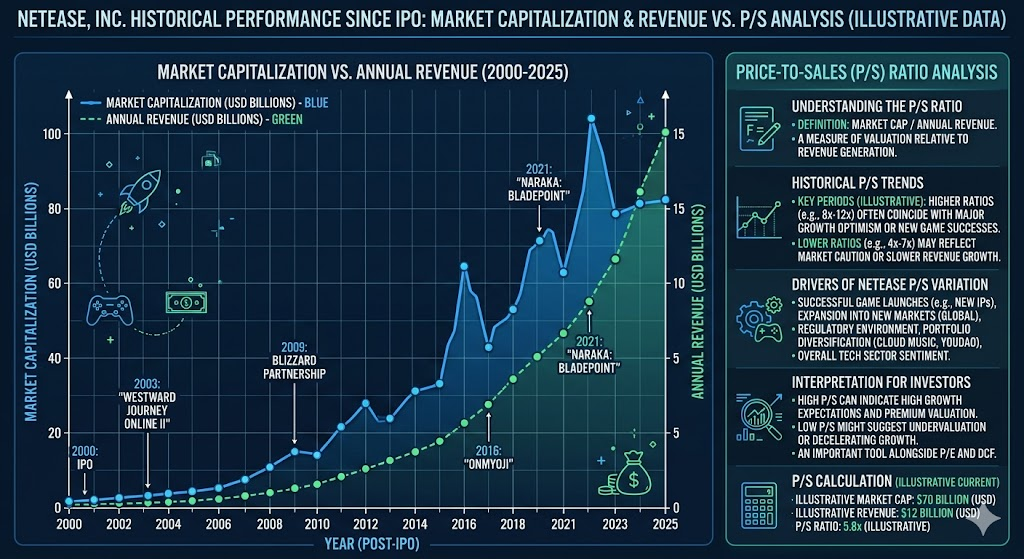
The development history of NetEase can be divided into four main stages:
Founding and Portal Era (1997-2000)
Ding Lei founded NetEase in 1997, initially starting with a Chinese search engine and free email service, before transitioning into a comprehensive portal website. During this stage, NetEase became a hub for online communities and successfully listed on the NASDAQ in 2000, establishing its position in the early era of the internet.
Rise of the Gaming Business (2001-2010)
Facing the challenges of the dot-com bubble, NetEase pivoted toward the gaming industry, launching its self-developed MMORPG Westward Journey Online in 2001. The subsequent success of Fantasy Westward Journey cemented NetEase’s deep foundation in the MMORPG sector, providing a stable source of cash flow and transforming the company into a gaming-technology-driven enterprise.
Diversification and Mobile Transformation (2011-2017)
NetEase began expanding into the mobile internet, launching NetEase Cloud Music, which quickly broke through in the streaming media market via unique social attributes and personalized recommendations. Simultaneously, the company established NetEase Youdao to enter online education and demonstrated its R&D and operational prowess in developing hit mobile games, such as Onmyoji.
AI and Global Expansion (2018-Present)
In this current phase, NetEase is dedicated to deeply integrating AI and big data technologies into its gaming R&D and various business sectors. By continuously expanding overseas studios and its global research layout, NetEase is not only accelerating its internationalization process but is also committed to comprehensive innovation in intelligent hardware and digital entertainment, continuously solidifying its competitiveness in the global tech industry.
In the 2026 market landscape, NetEase remains the second-largest giant in China’s gaming market, maintaining a long-standing duopoly with Tencent. The following is an analysis of its core competitive dynamics and strategic advantages:
Core Competitive Landscape
- Duopoly Competition: Tencent holds an absolute advantage in user reach and traffic acquisition due to the massive social ecosystem of WeChat and QQ. In contrast, NetEase leverages a strategy of boutique content and long-term operations, maintaining exceptionally high user stickiness and ARPU (Average Revenue Per User) through enduring IPs like Fantasy Westward Journey and Westward Journey Online.
- Challenges from New Players: Content-driven developers like miHoYo are rapidly capturing market share among young, high-spending demographics with open-world and ACG titles such as Genshin Impact and Honkai: Star Rail. This has forced NetEase to accelerate its development of high-quality cross-platform and AAA projects, such as Project Mugen.
Key Competitive Factors
- Technology and R&D Advantages: NetEase possesses proprietary engines like Messiah and NeoX, enabling optimized cross-platform experiences. The company consistently invests approximately 15% of its revenue into R&D and is actively integrating AI technology into its production pipelines to address the intense competition in content output.
- Global Footprint: NetEase continues to establish first-party studios in North America and Japan. Through acquisitions—such as Quantic Dream—and a global publishing strategy, the company is committed to reducing reliance on a single market and enhancing its international influence via a diversified product portfolio.
- Category Expansion: With the shooter game segment showing strong growth (accounting for over 18% of domestic popular game revenue), both NetEase and Tencent are aggressively betting on this category, utilizing cross-platform synergy (PC and mobile integration) to expand their audience base. Additionally, both companies have begun quietly entering the mini-game track to explore new traffic acquisition channels.
Risks and Challenges
- Acquisition Costs and Talent Competition: As Tencent, miHoYo, and ByteDance compete for user attention, Customer Acquisition Costs (CAC) are rising, and the battle for top-tier development talent is intensifying.
- Policy and Regulation: Regulatory policies regarding game licensing and anti-addiction measures for minors continue to impact product launch schedules and monetization models.
- Reliance on Hits: Revenue is highly concentrated in a few long-standing IPs; if new projects fail to meet expectations, the company faces higher risks of earnings volatility.
Source:
- https://matrixbcg.com/blogs/competitors/corp
- https://portersfiveforce.com/blogs/competitors/corp
- https://www.kavout.com/market-lens/did-netease-s-q1-2026-earnings-deliver-a-knockout-blow
- https://m.36kr.com/p/3657777718518400
- https://finance.sina.com.cn/roll/2026-01-05/doc-inhfhavn6780245.shtml
Back to NetEase page