The development history of China Petroleum & Chemical Corporation (Sinopec Corp., 600028.ss) can be summarized into the following four main stages:
Stage 1: Precursor Formation and Institutional Establishment (1983–1998)
In July 1983, the China Petrochemical Corporation was officially established to centralize the management and strategic planning of the nation’s dispersed oil refining, petrochemical, chemical fiber, and fertilizer enterprises. The focus of this stage was the integration of domestic oil and gas resources and industrial layout, laying the foundation for subsequent large-scale market-oriented operations.
Stage 2: Joint-Stock Reform and International Layout (1998–2000)
In March 1998, the China Petrochemical Corporation was reorganized into the Sinopec Group. Subsequently, in February 2000, Sinopec Group exclusively initiated the establishment of China Petroleum & Chemical Corporation (Sinopec Corp.). In October of the same year, the company was listed simultaneously in Hong Kong, New York, and London, formally entering international capital markets and beginning a new chapter in capital operations and modern corporate governance.
Stage 3: Rapid Expansion and Industrial Integration (2001–2015)
During this stage, the company significantly expanded its refining and petrochemical production capacity through various acquisitions and asset injections (such as the acquisition of Zhenhai Refining & Chemical and other subsidiaries). Simultaneously, the company actively built its domestic gas station retail network, establishing a dominant market position in the refined oil sales sector. Furthermore, through international investments and overseas exploration projects, Sinopec gradually transformed into a comprehensive energy and chemical enterprise with international competitiveness.
Stage 4: Green Transition and High-Quality Development (2016–Present)
Facing the global energy transition trend, Sinopec has clarified a strategic direction of “Base Energy + New Materials/New Technologies.” The company is increasing its investment in hydrogen energy, geothermal energy, Carbon Capture, Utilization, and Storage (CCUS), and high-end new materials, driving the industrial chain toward green and low-carbon upgrades. It is committed to becoming a clean energy and chemical giant with core technological competitiveness.
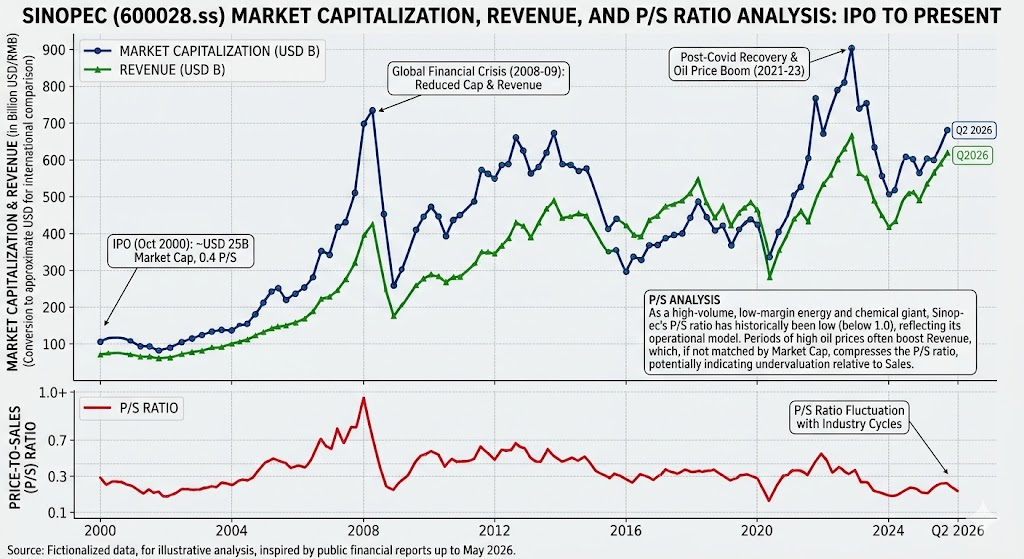
As an energy and chemical giant in China, Sinopec (600028.ss) operates in a competitive environment that can be analyzed from both domestic and international dimensions. Its core competitive advantage lies in its vertically integrated industrial chain, though it simultaneously faces dual challenges from energy transition and market competition.
Domestic Market Competition
The domestic market is dominated by state-owned oil giants, forming an oligopolistic structure:
- Main Competitors: PetroChina (CNPC) and CNOOC.
- PetroChina: Possesses scale advantages in oil and gas exploration, development, and pipeline operations, exerting pressure on Sinopec’s natural gas sales business.
- CNOOC: Leverages technological advantages in offshore drilling and vast Liquefied Natural Gas (LNG) import resources, remaining competitive in energy supply economics.
- Market Positioning: Sinopec holds an absolute advantage in refining capacity and retail networks, owning over 30,000 gas stations, which secures its position as the domestic leader in the terminal refined oil market.
International Market Competition
On the global stage, Sinopec faces competition from international oil majors that possess long-term technological accumulation and global capital allocation capabilities:
- Main Competitors: ExxonMobil, Shell, BP, TotalEnergies, Chevron, etc.
- Areas of Competition:
- High-end Chemicals: Global giants lead in high-performance polymers and fine chemicals, continuously capturing share in the high-end market.
- Petrochemical Profit Margins: Entities like Saudi Aramco influence the cost structure and gross margins of China’s refining and chemical industry through joint ventures and crude oil supply advantages.
- Regional Pricing Power: Regional competitors such as South Korean refiners (e.g., SK, S-Oil) and India’s Reliance affect crack spreads in the Asia-Pacific region through refined oil and aromatics exports.
Core Challenges and Transition Pressures
- Declining Demand for Refined Oil: With the rapid penetration of New Energy Vehicles (NEVs) in China, demand for gasoline and diesel from traditional internal combustion engine vehicles is falling, directly challenging the base of Sinopec’s core retail revenue.
- Overcapacity in Petrochemicals: The global petrochemical market faces supply-demand imbalances, putting price pressure on basic products like olefins and aromatics, thereby compressing profit margins.
- Green Energy Transition: To meet climate goals and electrification trends, Sinopec is transitioning from traditional energy and increasing investments in hydrogen, geothermal energy, Carbon Capture, Utilization, and Storage (CCUS), and EV charging/swapping networks. In these fields, it faces competition not only from traditional peers but also from new energy startups.
Summary of Competition
Sinopec’s competitive advantage is built upon its massive scale, integrated supply chain synergy, and extensive sales channels. However, its future competitiveness depends on whether it can optimize its cost structure and overcome the limitations of relying solely on basic refining products through product structure upgrades (high-value-added new materials) and energy infrastructure transformation (hydrogen and charging networks) during industry cycles.
Source:
- https://www.sse.com.cn/assortment/stock/list/info/company/index.shtml?COMPANY_CODE=600028
- http://www.sinopec.com/listco/000/000/041/41974.shtml
- http://www.sinopecgroup.com/group/000/000/041/41703.shtml
- https://www.sinopecgroup.com/group/000/000/042/42167.shtml
- https://pestel-analysis.com/blogs/brief-history/sinopecgroup
- https://en.wikipedia.org/wiki/Sinopec
Back to Sinopec page