
The development history of Xiaomi Corporation can be divided into the following four main phases based on its strategic focus:
Phase 1: Inception and Smartphone Rise (2010–2013)
Founded in April 2010 by Lei Jun and his partners, Xiaomi initially focused on developing the MIUI operating system, rapidly building a loyal user base through community engagement. The launch of the Xiaomi Phone 1 in 2011, leveraging exceptional price-to-performance value and an online-only sales model (utilizing flash sales and direct-to-consumer strategies), allowed the company to quickly establish a firm foothold in the Chinese market and disrupt traditional mobile distribution channels.
Phase 2: Ecosystem Expansion and AIoT Development (2014–2017)
Xiaomi began expanding its product portfolio by investing in and incubating numerous hardware startups to build the Xiaomi Ecosystem, launching IoT products such as power banks, smart bands, and air purifiers. During this period, the foundation of its AIoT platform was established, transitioning the business from a single smartphone brand into a smart living platform, while also expanding into overseas markets such as India starting in 2015.
Phase 3: IPO and Premium Positioning (2018–2020)
Xiaomi listed on the Hong Kong Stock Exchange in 2018, marking its entry into the capital markets. This phase focused on premium brand positioning, attempting to move beyond price-centric perceptions by launching high-end models in its flagship series. Simultaneously, the company strengthened its global footprint—particularly achieving significant market share in Europe—and solidified its core smartphone + AIoT strategy, accompanied by a substantial increase in research and development investment.
Phase 4: Human-Car-Home Full Ecosystem (2021–Present)
In 2021, Xiaomi officially announced its entry into the automotive industry, marking a major strategic transformation. Following three years of R&D, Xiaomi’s first electric vehicle, the SU7, was launched in 2024 to strong market reception. Currently, Xiaomi’s core strategy has upgraded to the Human-Car-Home full ecosystem, dedicated to achieving deep integration between smartphones, smart home hardware, and electric vehicles to provide a comprehensive technological lifestyle experience.
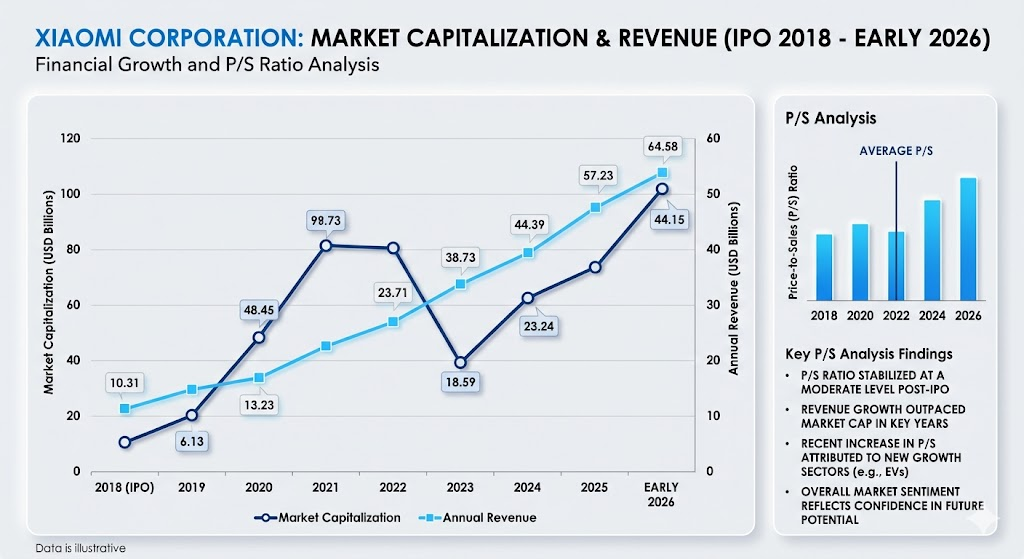
Xiaomi Corporation is currently pursuing a Human-Car-Home full ecosystem strategy, facing competition from international and domestic giants across several highly competitive sectors. The following is a competitive analysis as of May 2026:
1. Smartphone Market
- Key Competitors: Samsung, Apple, and the BBK Electronics group (OPPO, vivo, realme, OnePlus).
- Competitive Landscape:
- Premiumization Pressure: Xiaomi is striving to increase its average selling price (ASP) to counter rising memory costs, yet it faces challenges from Samsung’s hardware manufacturing and brand loyalty, as well as Apple’s long-standing dominance in the premium segment.
- Low-to-Mid Range Squeeze: Brands like realme target younger demographics through aggressive price-to-performance ratios, while Transsion Holdings poses a threat to Xiaomi’s low-end market share in emerging markets across Africa and South Asia.
- Software Experience: Motorola and Google Pixel attract users who prefer a near-stock Android experience over the pre-installed software (bloatware) common in MIUI/HyperOS.
2. Smart Electric Vehicle (EV) Market
- Key Competitors: Tesla, BYD, Huawei-affiliated automakers (e.g., AITO), and the New Force trio (NIO, XPeng, Li Auto).
- Competitive Landscape:
- Market Positioning: The Xiaomi SU7 has performed strongly in the pure electric sedan market priced above 200,000 RMB, directly challenging entry-level models from traditional luxury brands (e.g., BMW, Mercedes-Benz) and the primary offerings of other EV startups.
- Ecosystem Integration: Similar to Huawei, Xiaomi’s advantage lies in incorporating cars into its Human-Car-Home ecosystem, leveraging AIoT connectivity and software integration to increase user stickiness. However, this also faces severe challenges related to production capacity ramping and supply chain cost volatility.
3. AIoT and Smart Home Ecosystem
- Key Competitors: Huawei (HarmonyOS ecosystem), Samsung (SmartThings), and Amazon (Echo/Alexa).
- Competitive Landscape:
- Differentiation: With over 1.1 billion connected IoT devices, Xiaomi possesses an extremely high ecosystem barrier. Competitors like Samsung are accelerating the integration of their SmartThings platform to benchmark against Xiaomi, while Huawei competes head-on in high-end appliances and cross-device connectivity through the HarmonyOS system.
Comprehensive Strategy Analysis
- Moat: Xiaomi’s Human-Car-Home ecosystem has become its most significant moat, with multi-engine drivers (smartphones, AIoT, EVs, and internet services) mitigating risks associated with business-specific fluctuations.
- Key Risks: Rising costs driven by global memory chip shortages, increasingly intense price competition within the domestic Chinese market, and immense pressure on production capacity and profitability for the EV business, which is targeting 550,000 unit deliveries for the year.
- Strategic Pivot: Xiaomi is transforming AI into a core asset, heavily investing in AI large models (e.g., the MiMo series) to empower its entire product line, attempting to navigate industry cycles through technological integration.
Source:
- https://eu.36kr.com/en/p/3827245075042944
- https://autonews.gasgoo.com/articles/news/xiaomi-ev-q1-results-revenue-of-19-billion-yuan-loss-of-31-billion-yuan-2059596503981813760
- https://face.meei.harvard.edu/competitors-of-xiaomi
- https://www.minichart.com.sg/2026/05/28/xiaomi-2026-earnings-resilient-margins-lower-smartphone-ev-outlook-strong-overseas-iot-growth-1/
Back to Xiaomi page