Development History of Zijin Mining
The development history of Zijin Mining can be summarized into the following four key stages:
Stage 1: Founding and Rise (1993–2000)
The company’s predecessor was the Shanghang County Mining Company, which began developing the Zijinshan gold mine in 1993. At the time, the deposit was considered a low-grade ore and extremely difficult to extract. However, by introducing heap leaching technology, the company successfully achieved large-scale production and turned a profit, establishing its foundation as a key backbone enterprise in China’s gold production industry.
Stage 2: Listing and Regional Expansion (2000–2007)
The company completed its joint-stock reform in 2000, listed on the Hong Kong Stock Exchange in 2003, and debuted on the Shanghai Stock Exchange in 2008. During this period, the company expanded beyond Fujian province by acquiring and integrating gold and copper resources across China, resulting in explosive growth in revenue and net profit and establishing a strategy for diversified metal operations.
Stage 3: Internationalization and Scaling Up (2008–2019)
The company actively pursued a globalization strategy, acquiring large-scale overseas mines and expanding its asset footprint to Australia, Africa, South America, and Central Asia. During this period, the company successfully integrated major overseas projects, significantly increasing its copper and gold output and transforming into an international mining giant with global influence.
Stage 4: Green Transformation and Global Leadership (2020–Present)
The company has entered a phase of high-quality development, focusing on the development of energy metals like lithium, while promoting digital intelligence and green mine construction. Currently, Zijin Mining has become one of the fastest-growing copper and gold producers globally, dedicated to building a high-tech, high-efficiency, globalized world-class mining group.
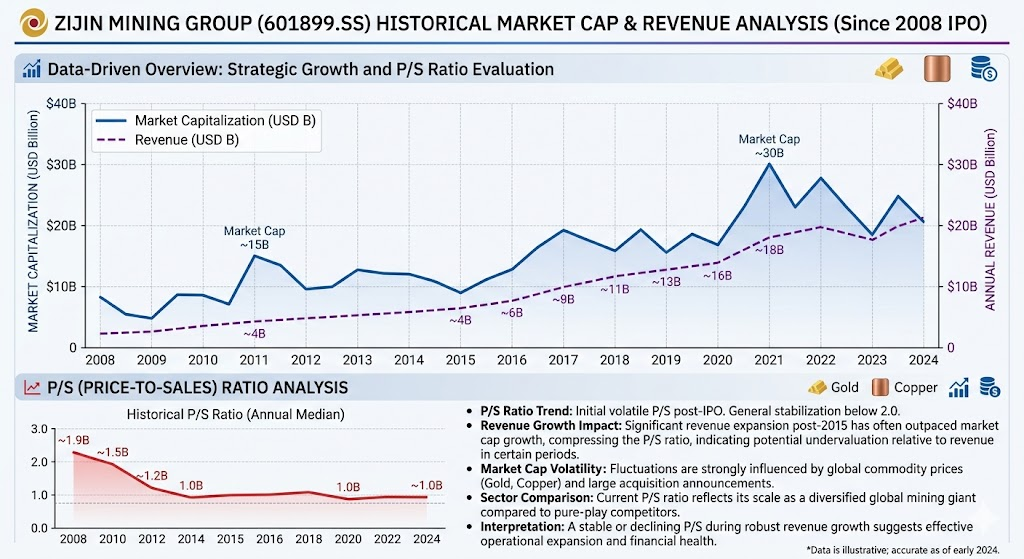
Competitive Analysis: Zijin Mining (601899.SS)
Zijin Mining maintains a competitive advantage in the global metal mining market, primarily by challenging major global mining giants through large-scale expansion, low-cost operations, and a cross-metal diversification strategy.
1. Market Positioning and Key Competitors
Zijin Mining is currently ranked among the top global mining giants (top five by market capitalization). Its competitors can be categorized into two groups based on business segments:
- Copper Business (Base Metals):
- Global Key Competitors: BHP, Freeport-McMoRan, Glencore, Rio Tinto.
- Competitive Landscape: Directly competes with these international giants in controlling large-scale copper assets (such as Grasberg and Escondida) and in total resource reserves.
- Gold Business (Precious Metals):
- Global Key Competitors: Newmont, Barrick Gold, Agnico Eagle.
- Competitive Landscape: Through the acquisition of overseas assets (such as Porgera), Zijin Mining is continuously narrowing the gap in production and extraction scale with leaders like Newmont.
- Domestic and Niche Competitors:
- CMOC (China Molybdenum): A direct competitor in copper-cobalt mining in the Democratic Republic of the Congo (DRC).
- Lithium and New Energy Materials: Competes with companies like Albemarle and Ganfeng Lithium in the upstream and downstream supply chains of the new energy industry and in lithium mine acquisitions.
2. Core Competencies of Zijin Mining
- Low-Cost Operations and Technological Advantages: Leveraging the Five-in-One engineering model and advanced heap leaching technology, the company is able to extract low-grade ore that Western giants often consider economically unviable, significantly boosting marginal efficiency.
- M&A Expansion Efficiency (The Zijin Speed): Compared to Western peers, Zijin’s project development and commissioning speed after acquisition is extremely fast (e.g., the Kamoa-Kakula project), allowing for rapid cash flow contribution.
- Diversification and Risk Resilience: The strategy of prioritizing both copper and gold balances the cyclical fluctuations of both metals. Copper benefits from the global energy transition, while gold provides hedging functions, enhancing overall financial stability.
- Cost Control and Financing Channels: Backed by domestic resources and policy-driven financial support in China, the company possesses a relatively lower cost of capital and stronger project acquisition capabilities compared to pure market-based competitors that rely entirely on market financing.
3. Current Competitive Challenges
- Resource Nationalism: Business expansion in South America and Africa faces pressures from local government tax policy changes or restrictions on development rights, forcing the company to adopt joint venture models with local entities.
- Alignment with International ESG Standards: Compared to Western giants (such as Newmont and BHP), Zijin must invest more resources to meet international ESG disclosure and environmental regulatory requirements, which is key to maintaining competitiveness in international markets.
- Scarcity of High-Quality Assets: As high-quality mining rights globally become increasingly depleted, the barrier to participating in large-scale M&A has risen. Competitors are mostly capital-intensive global enterprises, leading to rising M&A premiums and integration complexities.
Source:
- https://matrixbcg.com/blogs/competitors/zjky
- https://companiesmarketcap.com/mining/largest-mining-companies-by-market-cap/
- https://discoveryalert.com.au/zijin-mining-sp-positive-outlook-bbb-upgrade-2026/
Back to Zijin page