
The development history of PDD Holdings can be divided into four main stages:
1. Inception and Social Commerce Exploration (2015–2017)
- Origin and Positioning: Founded by Colin Huang in September 2015, Pinduoduo pioneered the “social group-buying” model. By leveraging the WeChat ecosystem for viral growth, the platform integrated social interaction with online retail.
- Market Breakthrough: The company initially targeted lower-tier city markets and focused on direct-to-consumer (C2M) agricultural supply chains, rapidly acquiring a massive user base sensitive to pricing.
- Strategic Merger: In 2016, Pinduoduo merged with Pinhaohuo, establishing the operational structure for subsequent rapid growth and securing early strategic investment from tech giants like Tencent.
2. Capitalization and Rapid Expansion (2018–2021)
- IPO: In July 2018, Pinduoduo went public on the Nasdaq, raising approximately 1.6B USD.
- Billion Subsidy Program: The 2019 launch of the “Billion Subsidy” program attracted premium brands, successfully helping the platform shed its image as a destination for low-end, cheap goods.
- Diversification: Deeply invested in fresh produce and supply chains, and in 2020, launched “Duoduo Maicai,” a community group-buying service that briefly surpassed Alibaba in active buyer count.
3. Corporate Restructuring and Global Transformation (2022–2023)
- Brand Evolution: In 2023, the company officially rebranded as PDD Holdings and relocated its operational headquarters to Ireland, signaling a strategic shift toward becoming a multinational corporation.
- Temu Launch: In September 2022, the company launched its cross-border e-commerce platform, Temu. It exported its efficient domestic supply chain model to international markets like the US and Europe, quickly becoming one of the most downloaded e-commerce apps globally.
- Governance Optimization: Management transition was completed, with Chen Lei taking over as Chairman and CEO, shifting the company’s focus toward “high-quality development” driven by technology.
4. Supply Chain Refinement and Localization Challenges (2024–Present)
- Model Iteration: Transitioned from the early “fully managed” model to a “semi-managed” model, encouraging merchants to utilize local overseas warehouses to improve fulfillment efficiency and reduce trade compliance risks.
- Addressing External Challenges: Faced with global geopolitical pressures and changes in tariff policies, PDD Holdings is now focused on enhancing its global logistics infrastructure and compliance review capabilities to maintain its price competitiveness and operational stability in international markets.
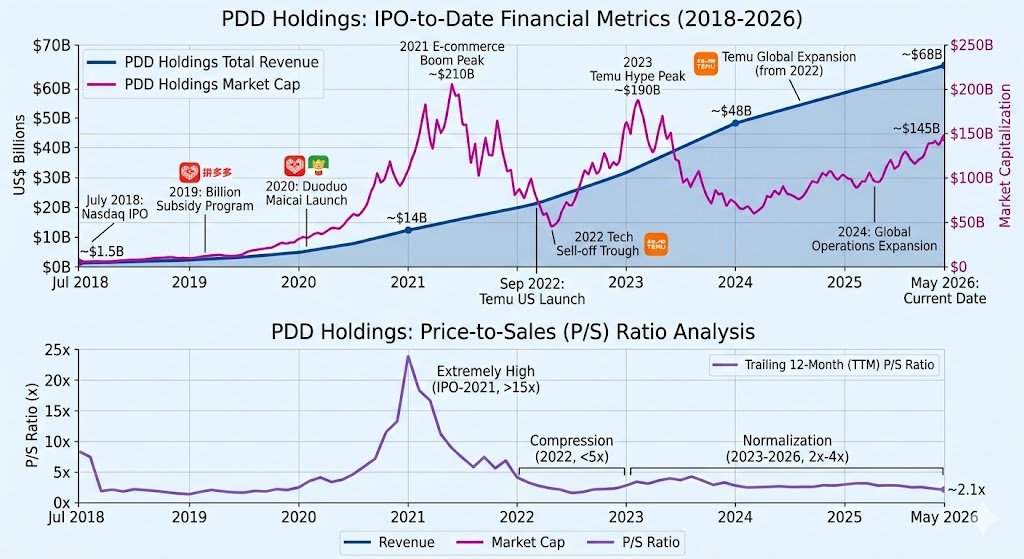
PDD Holdings currently faces a distinct competitive landscape in both domestic and international markets. As of 2026, the competitive analysis is as follows:
1. Domestic Chinese Market: Inventory-Based Competition and Service Upgrades
In China, PDD faces pressure from both integrated e-commerce platforms and content-driven e-commerce. The focus of competition has shifted from pure price wars to supply chain and fulfillment efficiency.
- Alibaba (Taobao/Tmall): Possesses the deepest merchant ecosystem and advertising monetization system. Through its Cainiao logistics network and continued dominance in brand merchants and high-end consumer segments, it remains PDD’s primary competitor in retail scale and category breadth.
- JD.com: Focuses on logistics speed and consumer trust in authenticity. Its robust direct-sales system and supply chain fulfillment capabilities are particularly attractive to PDD’s price-sensitive users when faster delivery is required.
- Douyin E-commerce (ByteDance): Leveraging its interest-based e-commerce model, it drives consumer traffic through live streaming, effectively converting impulsive purchases. This has diverted advertising budgets and captured significant consumer time and spending share from PDD.
2. International Market: Global Expansion and Compliance Challenges
In overseas markets, the rise of Temu has redefined cross-border e-commerce, though it faces increasingly complex external constraints.
- SHEIN: Possesses strong data-driven capabilities and production efficiency in the fast-fashion sector. While both rely on Chinese supply chains, SHEIN maintains stronger brand loyalty and vertical barriers in specific fashion categories, competing intensely with Temu on customer acquisition costs (CAC) and category market share.
- Amazon: As the global e-commerce leader, Amazon defends its position via its Prime membership system, fulfillment guarantees, and brand trust. While Temu challenges Amazon’s value-segment products, Amazon’s logistics service experience remains a barrier that PDD currently finds difficult to overcome.
- Emerging Platforms: Regional platforms like TikTok Shop, Mercado Libre, and Southeast Asia’s Shopee/Lazada continue to compress PDD’s growth space through localized operations and infrastructure deployment.
3. Core Strategic Differences and Challenges
- Differentiated Advantages: PDD maintains a leading position in price leadership and user stickiness in the global e-commerce sector. Through its factory-to-consumer (C2M) model, the company has a distinct advantage in cost control and responsiveness to consumer trends.
- Risks Faced:
- Strategic Hedge: PDD remains cautious regarding investments in on-demand fulfillment. In an environment where consumer expectations are shifting toward fast delivery and comprehensive services, this may result in a short-term competitive disadvantage.
- External Pressures: Global trade friction and adjustments to small-package duty-free policies in various countries (such as frequent changes in US tariff policies) have directly increased operational costs and uncertainty for PDD’s global business.
- Compliance Pressure: Past regulatory and public opinion challenges stemming from the “refund-only” policy, tax compliance, data security, and merchant relationship management continue to influence the capital market’s rating of the firm.
Summary
PDD Holdings is in a critical period of “growth versus regulatory gaming.” The core of competition in 2026 lies in whether PDD can maintain its price-performance advantage while investing resources to improve logistics speed and supply chain compliance. This is necessary to alleviate margin pressure and defend its core market share as competitors increasingly double down on the “low price + logistics” model.
Source:
- https://www.pddholdings.com/
- https://wealth.esunbank.com.tw/usstock/esun/basic0001.xdjhtm?a=PDD
- https://www.moomoo.com/hant/stock/PDD-US/company
Back to PDD page