
China Shenhua (601088.SS) Q1 2026 Financial Highlights
According to the first-quarter report released on April 24, 2026, the financial performance of China Shenhua is as follows:
Key Financial Data (in RMB)
| Item | Amount | YoY Change |
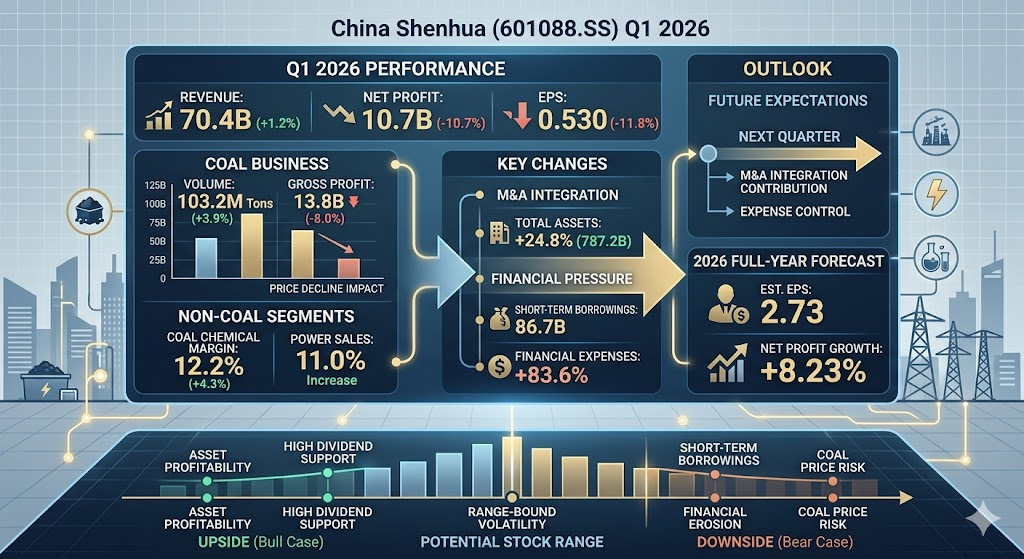
| Revenue | 70.397B | +1.2% |
| Net Profit Attributable to Shareholders | 10.667B | -10.7% |
| Net Profit (excl. non-recurring) | 10.712B | -8.5% |
| Earnings Per Share (EPS) | 0.530 | -11.8% |
Key Analysis
- Stable Revenue but Profit Pressure: Revenue maintained slight growth, primarily driven by an increase in power sales, which boosted the power segment’s revenue (22.1B, up 5.9%).
- Reasons for Profit Decline: The decrease in profit was mainly due to the decline in gross profit from the coal business. Although coal sales volume increased by 3.9% to 103.2M tons, the gross profit of self-produced coal fell from 15B to 13.8B due to lower selling prices, resulting in a 12.2% year-on-year drop in coal business profit to 8.9B.
- Asset Expansion: The company completed a major asset acquisition from its controlling shareholder this quarter, significantly increasing the total asset scale (up approximately 24.8% YoY), which also led to higher financing scales and increased capital expenditures.
- Operating Cash Flow: Net cash flow generated from operating activities was 17.4B, a decrease of 15.5% year-on-year.
China Shenhua (601088.SS) Operational Analysis and Outlook
Based on the Q1 2026 financial report and market research, the following key information is summarized:
I. Key Changes This Quarter
- Completion of Largest M&A to Date: The company completed the acquisition of 12 target companies from its controlling shareholder, causing total assets to surge 24.8% to 787.191B. This acquisition significantly altered the asset structure but also introduced financial pressure.
- Financial Structure Adjustment: To support the acquisition, short-term borrowings soared to 86.7B, causing financial expenses to increase by 83.6% YoY, which eroded a portion of the profits.
- Coal Business: Volume Increase vs. Price Decline: Although sales volume of self-produced coal increased by 3.9% YoY, the average selling price fell by 3.3%, suppressing gross margins and becoming the key reason for the decline in net profit.
- Strong Performance in Non-Coal Segments: The gross margin of the coal chemical segment jumped from 7.9% to 12.2%, with total profit surging by 95.3%; the power segment also saw an 11% increase in power generation sales.
II. Outlook for Next Quarter
- Contribution from M&A Integration: Market focus is on the integration progress of the newly acquired assets. Based on adjusted annual guidance, these assets are expected to contribute more significantly to revenue in the second half of the year (estimated annual revenue increment of approximately 80B), with revenue performance expected to trend higher toward the end of the year.
- Control of Financial Expenses: The market is closely monitoring the refinancing risks of massive short-term debt and the pressure of high interest expenses, which will be a key variable affecting profit margins in the coming quarter.
- Balance Between Coal Prices and Costs: While the improvement in self-produced coal costs (down 14.2%) helps offset price pressure, coal price trends remain a core challenge. Whether the divergence between electricity prices and sales volume continues during the off-season for power demand will directly impact profit space.
III. EPS Forecast for the Next Year (2026)
According to market consensus forecasts as of May 21, 2026:
- Earnings Per Share (EPS) Forecast: Market institutions generally project the full-year 2026 EPS to be approximately 2.73.
- Profit Growth Expectation: Full-year 2026 net profit attributable to shareholders is estimated to be approximately 57.196B, representing a YoY increase of approximately 8.23% compared to 2025.
Note: The data above includes forecasts from market analysts. Investment decisions should account for market volatility and the uncertainty of coal prices. Sources include financial information platforms such as Orange News, Futu, and 10jqka.com.
Potential Upside (Bull Case)
If subsequent financial reports prove that integration benefits exceed expectations, the stock has the potential to challenge previous highs:
- Release of Asset Profitability: If the newly acquired assets generate the expected 80B in revenue in the second half of the year and cost control exceeds expectations, net profit growth could outperform the current analyst consensus of 8.23%.
- High-Dividend Support: As a quintessential dividend stock, the market has high confidence in its ability to maintain a high payout ratio. In an uncertain interest rate environment, its feature of yielding higher than bond returns provides a strong downside buffer for the stock price.
- Coal Chemical and Power Synergy: The profit explosion in the coal chemical segment (gross margin surging to 12.2%) indicates that non-coal businesses are becoming self-sustaining. If this trend continues, it will enhance the company’s valuation multiple (P/E ratio).
Potential Downside (Bear Case)
If the macroeconomic environment and financial pressure are not alleviated, the stock price may face corrections:
- Erosion by Financial Expenses: If the short-term debt incurred from the acquisition cannot be effectively converted into long-term low-interest loans, high interest expenses will continue to squeeze EPS. If central bank policies lead to further increases in financing costs, it will directly impact profitability.
- Coal Price Downside Risk: The coal business remains the core of the company’s earnings. If domestic economic demand in China slows, leading to persistent weakness in thermal coal prices, sales volume growth will not compensate for the price gap, leading to risks of declining profits.
- Uncertainty of CapEx Returns: After a large-scale acquisition, if subsequent maintenance capital expenditure (CapEx) is higher than expected, it will affect free cash flow, thereby impacting future dividend capacity. This is the risk point most sensitive to long-term investors.
Expert Perspective
China Shenhua is currently at a transition point between “defensive growth” and “asset integration.”
- Key Indicators to Watch: You should closely monitor the “Balance Sheet” in the next two quarters, particularly the conversion ratio of “short-term borrowings” to “long-term liabilities,” as well as the profit stability of the “coal chemical division.”
- Valuation Range: Historically, the stock tends to fluctuate within a certain dividend yield range. When the price pulls back due to earnings pressure and the dividend yield climbs to an attractive level, it is usually a long-term buying opportunity. If the valuation becomes overly premium due to acquisition expectations, caution regarding risk is required.
In summary, the probability of a sharp surge or crash for China Shenhua is currently low, and it is more likely to exhibit range-bound volatility. Unless there is a collapse in coal prices or significant losses in the acquired assets, its stock price performance will be highly dependent on dividend policies and interest expense control.
Source:
- https://www.orangenews.hk/finance/1391084/%E4%B8%AD%E5%9C%8B%E7%A5%9E%E8%8F%AF-2026%E5%B9%B4%E4%B8%80%E5%AD%A3%E5%BA%A6%E7%87%9F%E6%94%B6703-97%E5%84%84%E5%85%83%E5%90%8C%E6%AF%94%E5%A2%9E1-2.shtml
- https://news.futunn.com/en/post/72017678/china-shenhua-net-profit-in-the-first-quarter-of-2026
- http://www.10jqka.com.cn/
Back to Shenhua Energy page