
The history of Interactive Brokers (IBKR) is marked by its evolution from a pioneer in automated market-making to a premier global electronic brokerage. Its journey can be divided into four key stages:
1. Foundation: The Pioneer of Automated Trading (1977-1992)
Founder Thomas Peterffy purchased a seat on the American Stock Exchange (AMEX) in 1977. This era focused on applying programming to trading to drive efficiency:
- 1979: Pioneered the use of “fair value pricing sheets” on the trading floor.
- 1982: Founded Timber Hill Inc. to expand market-making activities across exchanges.
- 1983: Developed the first handheld computer used on a trading floor.
- 1987: Created one of the first fully automated algorithmic trading systems.
2. Transition and Expansion: Building Electronic Brokerage (1993-2006)
Interactive Brokers LLC was established in 1993, separating the brokerage business from the market-making entity to offer global trade processing to outside clients:
- 1999: Launched SmartRouting technology to optimize order execution, setting an industry standard.
- Early 2000s: Expanded direct access to bond trading and institutional-grade forex services.
- 2006: Pioneered the implementation of “penny pricing” for options trading.
3. Public Offering and Globalization (2007-2018)
In 2007, the group completed its Initial Public Offering (IPO) on NASDAQ, securing capital for global infrastructure expansion:
- 2009: Launched mobile trading applications.
- 2011: Became the largest electronic broker in the U.S. by Daily Average Revenue Trades (DARTs).
- 2017: Strategically divested the Timber Hill market-making business to focus exclusively on electronic brokerage.
4. Digitalization and Multi-Asset Growth (2019-Present)
The company continues to drive platform innovation to adapt to the evolution of financial technology:
- 2019: Milan Galik succeeded as CEO and the firm launched the IBKR Lite commission-free model.
- 2021: Began offering cryptocurrency trading and expanded global product coverage.
- 2024-2025: Launched the IBKR Desktop platform and Forecast Contracts; the company was added to the S&P 500 Index in 2025.
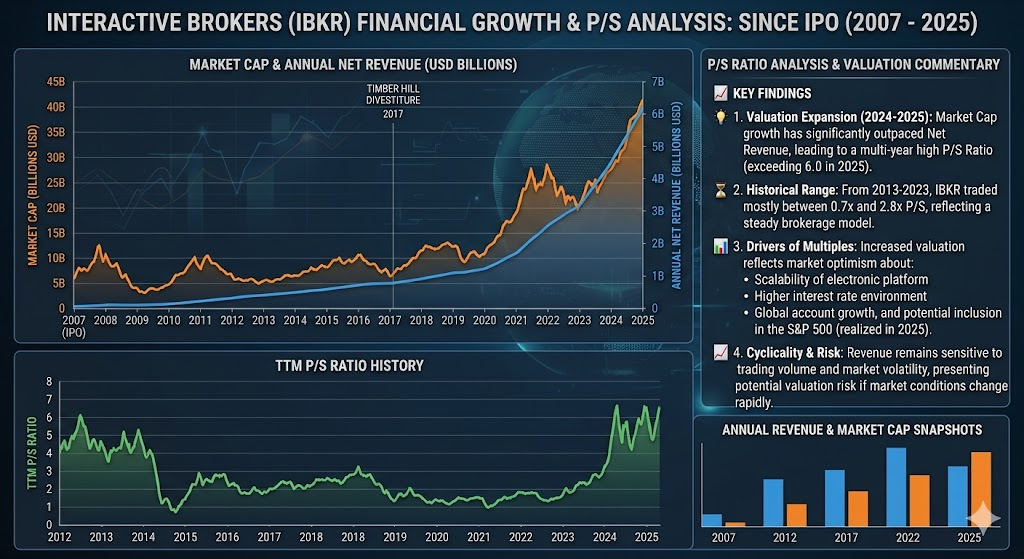
Interactive Brokers (IBKR) holds a unique market position as a specialized brokerage, with a competitive strategy that differs significantly from most retail-focused platforms.
Core Competitive Advantages
- Global Asset Coverage: IBKR allows clients to access over 170 markets worldwide through a single account, covering stocks, options, futures, bonds, and forex. This global footprint remains a leading differentiator.
- Best Execution: Its SmartRouting technology scans multiple exchanges and dark pools in real-time, ensuring clients receive the best possible market price rather than relying on a single order flow.
- Cost Efficiency and Net Interest: IBKR offers highly competitive margin rates and interest on idle cash. For professional and high-frequency traders, these structural cost advantages often outweigh the “zero-commission” marketing of retail platforms.
- Technological Moat: With deep roots in algorithmic trading, the firm continues to integrate AI tools (such as AI-driven investment scanners and voice-command analysis) to lower the barrier for complex trading.
Competitive Landscape
| Competitor Type | Representative Firms | Characteristics and Differences |
| Full-Service Brokers | Charles Schwab, Fidelity | Provide extensive research and advisory services; ideal for clients prioritizing wealth management, though they often lack IBKR’s trading depth and global reach. |
| Retail/Neo-Brokers | Robinhood, Public | Feature intuitive interfaces and strong social features. They attract large numbers of retail investors but often rely on Payment for Order Flow (PFOF), which may negatively impact execution quality. |
| Regional/Specialized Brokers | Futu (Moomoo) | Highly competitive in specific markets (e.g., US/HK stocks) with superior social engagement and UI. They often provide more localized support and flexible margin rates for specific regions. |
Challenges and Threats
- Revenue Cyclicality: Revenue is highly sensitive to trading volume and market activity, making the firm susceptible to periods of low market volatility.
- Learning Curve: While the firm is improving usability (e.g., the launch of IBKR Desktop), its professional-grade interface still presents a significantly higher barrier to entry compared to retail platforms like Robinhood.
- The Mass-Market Dilemma: As IBKR scales, it must balance its reputation as an elite professional tool with the need to simplify for a broader audience, which risks diluting its core value proposition.
In summary, Interactive Brokers has built a deep moat through technical efficiency and global asset access. While competitors excel in niche segments like social trading or user experience, IBKR remains the preferred platform for sophisticated traders and institutional clients who prioritize precision, execution quality, and cross-border capabilities.
Source:
- https://en.wikipedia.org/wiki/Interactive_Brokers
- https://www.interactivebrokers.com/en/general/about/info-and-history.php
- https://matrixbcg.com/blogs/brief-history/interactivebrokers
- https://www.forbes.com/advisor/investing/best-online-brokers/
- https://www.investing.com/news/swot-analysis/interactive-brokers-swot-analysis-stock-shows-momentum-amid-growth-93CH-4708038
- https://www.moneysmart.hk/zh-hk/investments/is-futu-or-ib-better-for-investing-ms
Back to Interactive Brokers page