
Constellation Energy (CEG) Q1 2026 earnings summary:
Financial Highlights
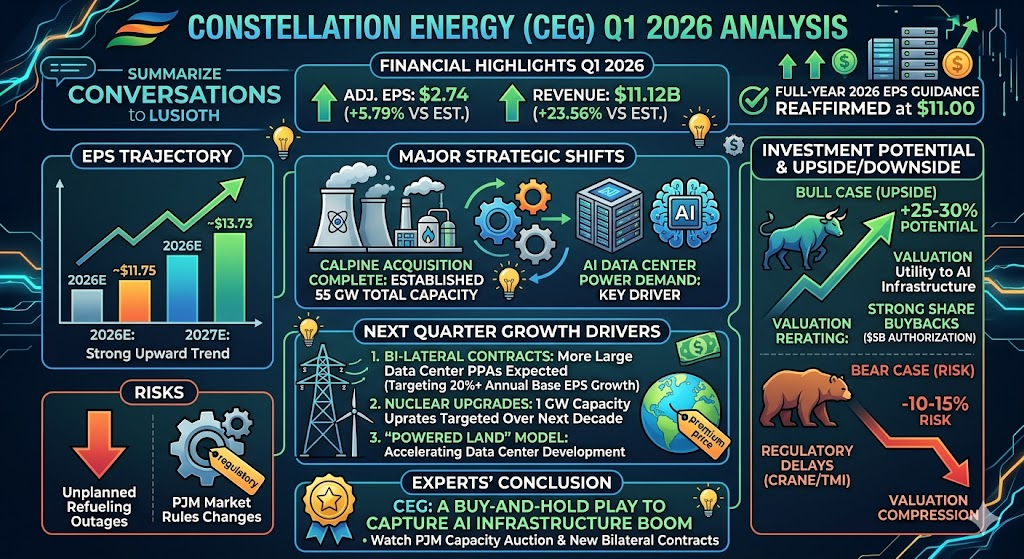
- Adjusted Earnings Per Share (EPS): 2.74 USD, exceeding market expectations by 5.79%.
- Revenue: 11.12B USD, beating market expectations by 23.56%.
- EPS Guidance: The company reaffirmed its full-year 2026 EPS guidance of 11.00 USD.
Operational Highlights
- Acquisition Impact: The acquisition of Calpine has contributed significantly to earnings growth.
- Operational Challenges: Despite strong financial performance, operations were impacted by nuclear refueling outages and costs related to winter storms.
Market Performance
According to the latest data, the company’s year-over-year (YoY) revenue growth for the most recent quarter was 63.85%. Market reaction to these results was reflected in subsequent stock price volatility.
Constellation Energy (CEG) experienced significant operational and strategic shifts in Q1 2026, primarily driven by its completed acquisition of Calpine and a strategic pivot toward serving the surging power demands of the data center and AI sectors.
1. Strategic Acquisition & Integration
- Calpine Acquisition Completion: As of January 7, 2026, Constellation completed its acquisition of Calpine Corporation. This merger creates the nation’s largest electricity producer, combining Constellation’s nuclear fleet with Calpine’s extensive natural gas and geothermal assets.
- Operational Scale: The combined company now boasts a 55-gigawatt (GW) capacity, strengthening its market footprint in high-demand regions like Texas and California.
2. Infrastructure Expansion
- Pin Oak Creek Facility: In early May 2026, Constellation brought its 460 MW Pin Oak peaking power plant in Central Texas online. This project is notable as the first Texas Energy Fund (TEF) loan-backed project to reach commercial operation, designed to provide dispatchable, reliable power during periods of peak demand.
- Renewable Projects: The company successfully placed the 105 MW Pastoria Solar project into service during the quarter.
3. Data Center & AI Partnerships
- CyrusOne Agreement: In February 2026, Constellation (via its Calpine unit) signed a major 380 MW agreement with CyrusOne to power a new data center adjacent to the Freestone Energy Center in Texas, with an additional 380 MW planned for a second phase.
- Total Contracted Capacity: Including previous agreements, Constellation now has over 1,100 MW under contract to support CyrusOne data centers in Texas. This underscores the company’s “Powered Land Capabilities” strategy, which integrates generation, land, and grid access to accelerate data center development.
4. Financial & Operational Context
- Strong Financial Beat: Revenue hit 11.12B USD (a 63.8% YoY increase), and adjusted EPS reached 2.74 USD, exceeding analyst forecasts.
- Operational Headwinds: The company navigated challenges including increased planned nuclear refueling outages (99 days vs 88 days in Q1 2025) and costs related to severe weather events like Winter Storm Fern.
- Capital Discipline: Constellation reaffirmed its full-year 2026 EPS guidance of 11.00 USD to 12.00 USD and continues to target long-term annual EPS growth of over 20% through 2029.
Constellation Energy’s (CEG) growth trajectory from Q2 2026 onwards is anchored by its evolution into a “clean energy infrastructure” titan, primarily driven by the intersection of AI-driven power demand and its unique 55 GW generation portfolio.
1. AI and Data Center Strategic Partnerships
The most significant near-term catalyst is the conversion of massive data center interest into firm, long-duration power purchase agreements (PPAs).
- Powered Land Capability: CEG is leveraging its “Powered Land” strategy—utilizing land adjacent to existing power plants (like the Freestone Energy Center) to offer data center developers immediate grid access and reliable, 24/7 carbon-free energy.
- Scalability: With over 1,100 MW currently contracted for major hyperscalers (such as CyrusOne), management estimates that every 1,000 MW of new capacity can add meaningful incremental EPS. The company is positioning itself as the primary partner for tech giants facing “net-zero” mandates and grid reliability concerns.
2. Nuclear Asset Monetization & Upgrades
Constellation holds the largest nuclear fleet in the U.S., which serves as a highly defensible, baseload “moat.”
- Production Tax Credits (PTC): The nuclear PTC, which is inflation-adjusted, provides a stable, guaranteed revenue floor for its 147 TWh of annual nuclear output, shielding the firm from volatile natural gas price fluctuations.
- Capacity Upgrades: The company is targeting 1 GW of cumulative nuclear power uprates over the next decade. These incremental gains are high-margin, effectively “free” capacity that requires minimal capital expenditure compared to building new plants.
3. Synergies from the Calpine Acquisition
Completed in early 2026, the integration of Calpine adds 23 GW of flexible natural gas and geothermal assets.
- Operational Flexibility: This provides the “dispatchable” generation needed to balance intermittent renewables, making CEG’s combined portfolio more attractive to industrial and institutional customers.
- Market Expansion: The merger deepens CEG’s footprint in the ERCOT (Texas) and California markets, which are currently experiencing some of the fastest-growing power demand in the country due to data center proliferation.
4. Financial Framework for 2026–2029
Management has provided a clear roadmap for value creation:
- Base EPS Growth: Targeting 20%+ annual growth through 2029.
- Cash Flow Generation: Projected free cash flow (FCF) before growth is expected to scale significantly, reaching between 11.5B USD and 13B USD for the 2028-2029 period.
- Capital Allocation: With a strengthened balance sheet, the company has increased its share buyback authorization to 5B USD, signaling confidence in its future earnings visibility and valuation.
5. Regulatory & Market Tailwinds
- PJM Market Reforms: Regulatory focus on improved load forecasting and reliability backstop auctions in the PJM market is expected to create more favorable long-term pricing environments, allowing Constellation to capture a premium for its firm, carbon-free power.
- Grid Reliability Directives: Government mandates (such as the extension of the Eddystone units) reflect a broader national imperative to keep existing, reliable generation online, effectively extending the revenue-generating lifespan of CEG’s older thermal assets.
Key Risks to Monitor: While the outlook is bullish, investors are tracking the potential for “insufficient premiums” in large-scale PPA contracts, the execution risk of data center infrastructure projects, and how regulatory changes in capacity markets might impact future pricing dynamics.
Constellation Energy (CEG) anticipates a robust earnings trajectory over the next year, supported by its expanded generation portfolio and the structural shift in power demand.
EPS Outlook Summary
- 2026 Full-Year Guidance: Constellation has reaffirmed its adjusted operating EPS guidance range of 11.00 USD to 12.00 USD.
- Analyst Consensus: Market estimates for 2026 generally hover around 11.72 USD to 11.76 USD, suggesting high confidence in the company’s ability to hit the upper end of its guidance.
- 2027 Projections: Looking ahead, consensus estimates for 2027 EPS trend significantly higher, reaching approximately 13.73 USD, which represents a projected year-over-year growth of roughly 16% to 17%.
Key Growth Drivers
The upward trajectory in earnings is expected to be fueled by several “high-visibility” drivers:
- The “Calpine Effect”: The full-year integration of Calpine’s 23 GW of natural gas and geothermal assets in 2026 will provide a broader earnings base and greater operational flexibility compared to previous periods.
- Nuclear PTC & Contract Premiums: The nuclear Production Tax Credit (PTC) serves as a stable revenue floor that scales with inflation. Combined with long-term, high-premium power purchase agreements (PPAs) tailored for data centers, the company is successfully capturing the scarcity value of “firm, carbon-free” electricity.
- Operational Leverage: Management has committed to a long-term goal of 20%+ annual growth in base EPS through 2029, bolstered by a disciplined capital allocation strategy that includes substantial share buybacks (a 5B USD authorization) and high-margin nuclear capacity uprates (targeting 1 GW of cumulative growth over the next decade).
Critical Considerations
While the outlook remains bullish, analysts monitor specific variables that could influence the earnings pace over the coming quarters:
- Operational Efficiency: The impact of planned nuclear refueling outages on short-term production volume.
- Regulatory Environment: Evolving rules within the PJM regional transmission organization regarding load forecasting and capacity auctions could influence future pricing power.
- Macro/Weather Risks: Potential cost pressures from extreme weather events (such as winter storms) and the need for continued investment in grid interconnection infrastructure.
Investment Thesis: The “AI-Utility” Transformation
The core of the bull case is that CEG is no longer just a power producer; it is a “clean-energy moat” for hyperscalers. With a 55 GW fleet dominated by nuclear power, it provides the 24/7, carbon-free, and dispatchable power that AI data centers require.
1. Potential Upside (Bullish Case)
- Target Price & Valuation: The analyst consensus median price target is approximately 380 USD, implying an upside potential of roughly 25-30% from the current trading range of ~290–295 USD. High-end estimates reach as high as 440 USD.
- The “Powered Land” Multiplier: CEG is uniquely positioned to monetize land adjacent to its existing plants (e.g., Freestone). By integrating grid connection and energy generation into a single offering for data center developers, they bypass long interconnection queues. Analysts see this as a high-margin, scalable business model that justifies a premium valuation over traditional utilities.
- Integration Synergies: The 2026 acquisition of Calpine adds significant “dispatchable” capacity (natural gas and geothermal). As the grid becomes more dependent on weather-reliant renewables, CEG’s ability to “balance the grid” becomes a high-value service that earns significant premiums in capacity markets.
2. Potential Downside/Risk (Bearish Case)
- Execution & Regulatory Drag: The stock has faced pressure due to delays in major projects like the Three Mile Island restart and transmission bottlenecks. If these “greenlight” projects for new data center connections face further regulatory or PJM-related delays, the market’s growth narrative could stall, potentially leading to a 10-15% pullback toward the ~260 USD support level.
- Valuation Compression: CEG currently trades at a forward P/E multiple that is aggressive for the utility sector. If the broader market experiences a “de-rating” of AI-related stocks, or if data center demand growth shows any signs of saturation, CEG’s premium valuation could compress rapidly.
- Operational Headwinds: While recent DOE orders to keep Eddystone units online provide a revenue “floor,” they also highlight the aging infrastructure burden. Unplanned refueling outages or cost overruns related to climate-induced weather events (like Winter Storm Fern) can create short-term earnings volatility.
Expert Summary & Outlook
- Consensus Rating: Strong Buy (with 17 Buy, 3 Hold, and 1 Sell ratings as of late May 2026).
- Strategic Verdict: CEG is a “buy-and-hold” play for investors looking to capture the infrastructure side of the AI boom. The company’s 5B USD share buyback program provides a strong floor for the stock, signaling that management views current price dips as opportunities.
- Key Trigger to Watch: Keep a close eye on PJM Interconnection’s capacity auction results (expected in September 2026) and any official announcements regarding new large-scale bilateral data center power contracts. These will be the primary catalysts for a move toward the 380 USD target.
Disclaimer: This analysis is for informational purposes only and does not constitute financial advice. Energy sector investments are subject to significant regulatory, political, and operational risks. Always conduct your own due diligence based on your personal risk tolerance.
Source:
- https://statementdog.com/analysis/CEG
- https://hk.investing.com/equities/constellation-energy-earnings
- https://www.zacks.com/stock/news/2919224/constellation-energys-q1-earnings-and-revenues-beat-estimates
- https://www.bridgepointgroup.com/about-us/news-and-insights/press-releases/2026/energy-capital-partners-ecp-completes-calpine-transaction
- https://gov.texas.gov/news/post/governor-abbott-celebrates-opening-of-460-mw-power-plant-in-central-texas
- https://www.constellationenergy.com/news/2026/02/constellation-and-cyrusone-announce-agreement-to-support-new-data-center-facility-at-freestone-energy-center-in-texas.html
- https://uk.investing.com/news/stock-market-news/earnings-call-transcript-constellation-energy-q1-2026-beats-forecasts-93CH-4667398
- https://simplywall.st/stocks/us/utilities/nasdaq-ceg/constellation-energy/news/constellation-energy-corporation-just-beat-eps-by-73-heres-w
- https://seekingalpha.com/symbol/CEG/earnings/estimates
Back to Constellation page