
Vertex Pharmaceuticals’ history can be categorized into four distinct phases:
1. Founding and Rational Drug Design (1989-2000)
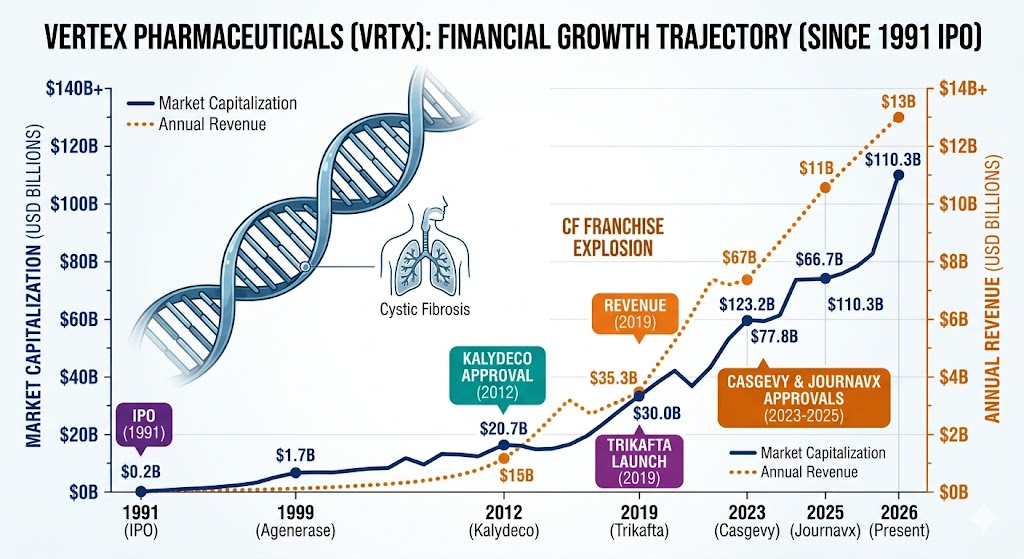
Founded in 1989 in Boston by Dr. Joshua Boger, the company was built on the premise of “rational drug design,” using structural biology and computational chemistry to target disease mechanisms directly rather than relying on traditional random screening. The company went public on the Nasdaq in 1991. During this period, Vertex focused on antiviral research, including HIV protease inhibitors, and launched its first product, Agenerase, in 1999.
2. Strategic Pivot and CF Foundations (2001-2011)
The 2001 acquisition of Aurora Biosciences was a turning point, enhancing the company’s high-throughput screening capabilities and laying the technical foundation for its future cystic fibrosis (CF) work. During this phase, Vertex initiated a long-term partnership with the Cystic Fibrosis Foundation. While the company saw short-term commercial success with its hepatitis C drug (Incivek), the period was defined by the strategic decision to concentrate R&D resources on becoming the global authority in CF.
3. CF Dominance and Commercial Explosion (2012-2019)
The 2012 approval of Kalydeco marked the beginning of a period of rapid commercial growth. Vertex subsequently developed a series of combination therapies (Orkambi, Symdeko), culminating in the 2019 approval of the breakthrough triple-combination therapy, Trikafta. This effectively turned CF from a fatal illness into a manageable chronic condition for approximately 90% of patients. Through this CF franchise, Vertex established a deep cash reserve and significant industry influence.
4. Diversification and Expansion of Innovative Therapies (2020-Present)
Following the appointment of Dr. Reshma Kewalramani as CEO in 2020, the company launched an ambitious cross-therapeutic transformation. The goal shifted to expanding its technical platforms beyond CF to address other serious diseases. Through its collaboration with CRISPR Therapeutics, Vertex successfully brought the gene-editing therapy Casgevy to market in 2023-2024. The company is now actively advancing a pipeline in pain management (Suzetrigine), type 1 diabetes (cell therapy), and APOL1-mediated kidney disease, aiming to transition from a single-disease leader to a multi-therapeutic global biotech powerhouse.
Vertex Pharmaceuticals is currently in a critical transition phase, shifting from a single-disease monopolist to a diversified innovation powerhouse. Below is a competitive analysis across its core business segments:
1. Cystic Fibrosis (CF): Absolute Market Dominance
Vertex holds over 90% market share in the CFTR modulator space. Trikafta/Kaftrio has established formidable barriers to entry, with no direct commercialized competitors currently challenging its market position.
- Competitive Threat: The primary long-term risk comes from “curative” modalities like gene editing and niche biotechnology firms (e.g., Eloxx) targeting the approximately 10% of patients—such as those with nonsense mutations—who remain uncovered by existing therapies.
2. Blood Disorders (Casgevy): Entering a High-Value Arena
With the approval of Casgevy, Vertex has entered the gene-editing market, directly competing with other gene therapy developers.
- Key Competitor: Bluebird Bio (Lyfgenia).
- Competitive Focal Points: Both companies offer treatments for Sickle Cell Disease (SCD) and Transfusion-Dependent Beta Thalassemia (TDT). Vertex holds an advantage due to its partnership with CRISPR Therapeutics and a favorable safety profile. The competition now pivots to long-term efficacy, durability of data, and the breadth of insurance coverage and reimbursement.
3. Pain Management: Challenging the Traditional Market
Vertex is entering the non-opioid pain management market, aiming to provide non-addictive alternatives.
- Key Competitors: Traditional opioid manufacturers, Pfizer, and Eli Lilly.
- Competitive Focal Points: While Suzetrigine offers a revolutionary mechanism, large pharmaceutical incumbents possess deeper primary care networks and broader distribution systems. Vertex must prove clinical superiority to displace long-standing prescribing habits and reliance on legacy opioid therapies.
4. Kidney Disease and Diabetes: Technical Leadership vs. Big Pharma
Vertex is developing therapies for APOL1-mediated kidney disease and cell-based treatments for Type 1 Diabetes (T1D).
- Key Competitors: Novartis, Novo Nordisk, and AstraZeneca.
- Competitive Focal Points: These giants possess economies of scale in cell therapy, global clinical networks, and manufacturing. Vertex’s defensive moat lies in its first-mover status and proprietary data in the APOL1 field, which establishes a strong technological barrier.
Competitive Summary
- Strengths: Robust cash flow fueling high R&D reinvestment, deep intellectual property protections, and premier brand recognition in precision medicine.
- Weaknesses: Ongoing revenue concentration in CF (though diluting); smaller sales and distribution footprint in primary care markets compared to established giants like Pfizer or Novartis.
- Potential Risks: Cross-sector competition from Big Pharma through M&A and the strain that high-cost, one-time gene therapies place on global insurance reimbursement systems.
Source:
- https://portersfiveforce.com/blogs/brief-history/vrtx
- https://matrixbcg.com/blogs/brief-history/vrtx
- https://www.vrtx.com/en-global/our-science/pipeline/
- https://www.zippia.com/vertex-pharmaceuticals-careers-12397/history/
- https://www.youtube.com/watch?v=D2YAvGg-Dvw
Back to Vertex page