
Newmont (NEM) reported its first-quarter 2026 financial results on April 23, 2026, delivering performance that exceeded market expectations. Driven by strong gold prices, the company achieved record free cash flow, despite a decline in production due to operational disruptions.
Financial Highlights
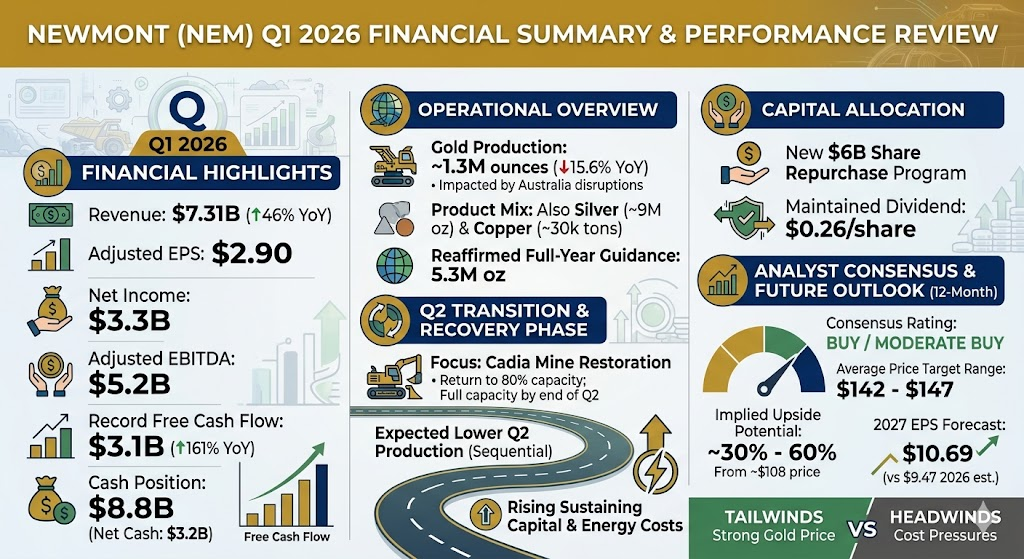
- Revenue: 7.31B, up 46% year-over-year, beating estimates.
- Adjusted EPS: 2.90.
- Net Income: 3.3B.
- Adjusted EBITDA: 5.2B.
- Free Cash Flow (FCF): 3.1B, a quarterly record, representing a 161% year-over-year increase.
- Cash Position: 8.8B in cash as of quarter-end, with a net cash position of 3.2B.
Operational and Market Performance
- Gold Production: Approximately 1.3M ounces, down 15.6% year-over-year, primarily due to operational disruptions at Australian mine sites (fire, extreme weather, etc.).
- Product Mix: In addition to gold, Q1 production included approximately 9M ounces of silver and 30 thousand tons of copper.
- Capital Allocation: The board approved an additional 6B share repurchase program and maintained a quarterly dividend of 0.26 per share.
- Cost Pressures: Although Q1 AISC (All-In Sustaining Cost) for gold dropped to 1029 per ounce, management cautioned that cost pressures are expected to intensify due to increased capital expenditures, lower by-product revenue, and higher taxes.
Outlook
- Full-Year Guidance: Reaffirmed full-year gold production target of 5.3M ounces.
- Operational Strategy: Q2 production is expected to account for 23% of the annual guidance, a decrease compared to Q1.
The following summarizes the significant changes and developments for Newmont in Q1 2026:
Operational and Production Challenges
- Operational Disruptions in Australia: Gold production (1.3M ounces) declined 15.6% year-over-year, primarily due to extreme weather events, fire, and seismic activity at the Cadia mine.
- Cadia Recovery: Following the seismic event, damage at Cadia was determined to be limited. Essential infrastructure such as power and drainage has been restored. The mine is expected to return to 80% capacity in Q2, with full operational capacity anticipated by the end of that quarter.
- Production Cadence: The full-year production target (5.3M ounces) remains unchanged. Management anticipates a seasonal dip in production during Q2, followed by a ramp-up in the second half of the year.
Financials and Cash Flow
- Record Free Cash Flow: Supported by strong gold prices, Q1 free cash flow hit 3.1B, the highest single-quarter figure in the company’s history.
- Capital Allocation Upgrades:
- The Board approved an additional 6B share repurchase program.
- The quarterly dividend was maintained at 0.26 per share.
- Divestiture Proceeds: The company realized 321M in post-tax proceeds during the quarter, primarily from the sale of equity investments in Greatland Gold and SolGold.
Forward-Looking Cost Pressure Warnings
- Rising Cost Expectations: Management cautioned that cost pressures are set to increase starting in Q2 due to:
- Higher Capital Expenditures (CapEx): Sustaining capital is expected to rise as development projects progress.
- By-product Revenue: The contribution from copper and silver by-products is expected to decrease, depending on metal price volatility.
- Taxation and Inflation: Increased tax burdens combined with higher energy prices are expected to push operating costs upward.
Strategic Execution
- Guidance Maintenance: Despite geopolitical and supply chain headwinds, the company reaffirmed its 2026 production and cost guidance.
- Portfolio Focus: The company remains focused on internal asset optimization and expanding existing brownfield projects, while maintaining a disciplined approach to capital expenditure and project development.
Newmont faces significant operational headwinds and seasonal factors in the second quarter (Q2 2026), making it a period of adjustment rather than immediate operational expansion. Management has explicitly framed this as a “recovery and transition phase.”
Operational Adjustments (Production Low Point)
- Cadia Mine Recovery: This is the primary operational focus for Q2. Following the seismic event in April, the mine is currently in a recovery phase. It is expected to return to 80% capacity during the quarter and achieve full operational capacity by the end of Q2. Consequently, production levels in Q2 are projected to be lower than in Q1.
- Annual Production Discipline: Despite the expected dip in Q2 production, management has reaffirmed its full-year guidance of 5.3M ounces, with productivity anticipated to rebound significantly in the second half of the year.
Financial Headwinds (Margin Compression Risks)
- Rising Cost Pressures: The company has signaled that sustaining capital expenditures will increase starting in Q2. Combined with recent volatility in energy prices (fuel costs), analysts expect general margin pressure across the mining sector during this period.
- Gold Price Volatility: While Q1 benefited from high realized gold prices (approx. 4900 per ounce), Q2 has seen increased price volatility, which may impact sequential revenue growth.
Core Growth Drivers (Long-Term and Strategic)
While Q2 is a cyclical low point for operational volume, the company’s long-term momentum is supported by the following:
- Capital Allocation and Shareholder Returns: The company recently announced a new 6B share repurchase program. Coupled with the quarterly dividend of 0.26 per share, capital returns remain a core pillar of shareholder value, especially during periods of temporary production constraints.
- Asset Portfolio Optimization: The focus remains on high-return brownfield projects such as Ahafo North and Tanami Expansion 2, which continue to serve as the foundation for future production growth.
- Disciplined Development: Newmont maintains high discipline regarding development capital expenditure, prioritizing the use of free cash flow for balance sheet management and share repurchases, which enhances financial resilience during uncertain periods.
Summary:
For Newmont, Q2 2026 represents a “pivot and adjustment” phase, with the primary focus on the full recovery of the Cadia mine and rigorous cost control. Growth momentum for the next quarter will be driven primarily by the EPS impact of capital allocation and the market’s anticipation of a production rebound in the second half of the year, rather than sequential operational growth in Q2 itself.
Newmont’s (NEM) EPS outlook over the next year is shaped by the dual influence of strong gold prices and rising operational cost pressures. Based on market analysis, the consensus expectation is for continued EPS growth.
EPS Growth Forecast
- Current Forecast: Market consensus estimates Newmont’s EPS for next year (2027) will grow from an estimated 9.47 in 2026 to 10.69, representing an expected growth rate of approximately 12.88%.
- Analyst Sentiment: Supported by sustained high gold prices and expected improvements in operational efficiency, multiple brokerage firms have raised their price targets, anticipating that EPS will gradually reflect the economies of scale following the anticipated recovery in production.
Key Factors Influencing EPS Trajectory
1. Tailwinds
- Gold Prices: As the primary revenue driver, the strong performance of gold prices serves as the strongest engine for EPS growth.
- Balance Sheet Management: The company is aggressively executing share repurchases (recently adding a 6B authorization), which reduces the number of shares outstanding and directly accretive to EPS.
- Production Rebound: With the Cadia mine expected to return to full capacity after Q2, production volume is projected to rebound significantly in the second half of the year, improving margins through scale.
- Long-term Expansion: The 2027 outlook anticipates production rising toward 6M ounces, with the integration of key projects like Ahafo North and Tanami Expansion 2 forming the foundation for long-term EPS growth.
2. Headwinds
- Operational Cost Pressures: Management has clearly indicated that cost pressures will persist over the coming quarters due to rising energy prices, inflation, and increased development and sustaining capital expenditures (CapEx).
- Taxation and Royalties: Additional costs, such as new royalty structures in regions like Ghana (approximately 25 per ounce), will directly impact unit profitability.
- Operational Seasonality and Disruptions: Periodic disturbances, such as the recovery efforts at Cadia and extreme weather events in Australia, may continue to cause short-term quarterly earnings volatility.
Summary
The market currently maintains a “cautiously optimistic” stance on Newmont. The EPS trajectory is expected to follow a “back-weighted” pattern—starting lower in the first half of the year due to operational disruptions and recovery costs, and strengthening in the second half as production normalizes and share buybacks provide support. Over the longer term, supported by the cyclical premium of the gold market and the company’s disciplined capital allocation, the EPS growth outlook remains attractive based on current analytical models.
Investment Sentiment and Consensus
Wall Street currently holds a “Moderate Buy” to “Buy” consensus rating on Newmont.
- Analyst Ratings: Out of approximately 26–29 analysts, the vast majority (23+) maintain “Buy” or “Strong Buy” ratings, with very few “Hold” ratings and zero “Sell” ratings.
- Price Targets: The consensus price target typically ranges between $142 and $147, with high-end estimates reaching up to $176. Trading at recent levels of approximately $107–$108, this implies an upside potential of roughly 30% to 60% over the next 12 months.
Upside Potential
The bullish case for Newmont is primarily built on three pillars:
- Gold Price Leverage: With projections for gold prices potentially exceeding $4,000 per ounce in the second half of 2026, Newmont—as the world’s largest gold producer—is a primary beneficiary.
- Operational Recovery & Scale: Following the Q1 operational disruptions (notably at the Cadia mine), the company is expected to ramp up production efficiency in the second half of 2026 and into 2027. Projects like Ahafo North and Tanami Expansion 2 are expected to contribute to a production target of 6M ounces by 2027.
- Capital Allocation: The company’s aggressive share repurchase programs (including a recent $6B authorization) and steady dividend payouts are viewed as highly accretive to EPS and supportive of the share price, especially during periods of market volatility.
- Valuation Discount: Some analysts point out that Newmont is trading at a significant discount to its historical valuation metrics (e.g., forward EV/EBITDA of ~7.3x compared to a 30-year average of ~18x).
Downside Risks
Investors should remain cognizant of the “rollercoaster” nature of the stock:
- Operational Execution: The key short-term risk is the full restoration of the Cadia mine. Any further setbacks in operational recovery or delays in production targets would likely lead to immediate downward pressure on the stock.
- Margin Compression: Management has signaled rising cost expectations for the remainder of 2026. Higher energy costs, labor inflation, and increased sustaining capital expenditure (CapEx) could squeeze profit margins even if gold prices remain elevated.
- Bearish Scenarios: In the event of a significant correction in long-term gold prices (e.g., dropping toward $2,500 per ounce), bearish models suggest the stock could face substantial downside, potentially revisiting levels significantly lower than current trading ranges.
Expert Summary
Newmont currently sits at a juncture where valuation fundamentals are strong, but short-term market sentiment is cautious due to cost and output concerns.
- For the long-term investor: The current price may represent an attractive entry point given the intrinsic discount and long-term production roadmap.
- For the tactical trader: The stock is experiencing heightened volatility. Success depends on monitoring the progress of the Cadia mine recovery and the company’s ability to demonstrate cost discipline in the upcoming Q2 and Q3 reports.
Disclaimer: This analysis is based on market data as of May 2026 and reflects analyst consensus. It is provided for informational purposes and does not constitute formal financial advice. Market investments carry inherent risks; please conduct your own due diligence before making investment decisions.
Source:
- https://s24.q4cdn.com/382246808/files/doc_earnings/2026/q1/earnings-result/Newmont-Q1-2026-Earnings-Release_Final.pdf
- https://www.tradingkey.com/analysis/stocks/us-stocks/261819317-newmont-q1-gold-prices-tradingkey
- https://www.marketbeat.com/stocks/NYSE/NEM/earnings/
- https://simplywall.st/stocks/us/materials/nyse-nem/newmont/future
Back to Newmont page