
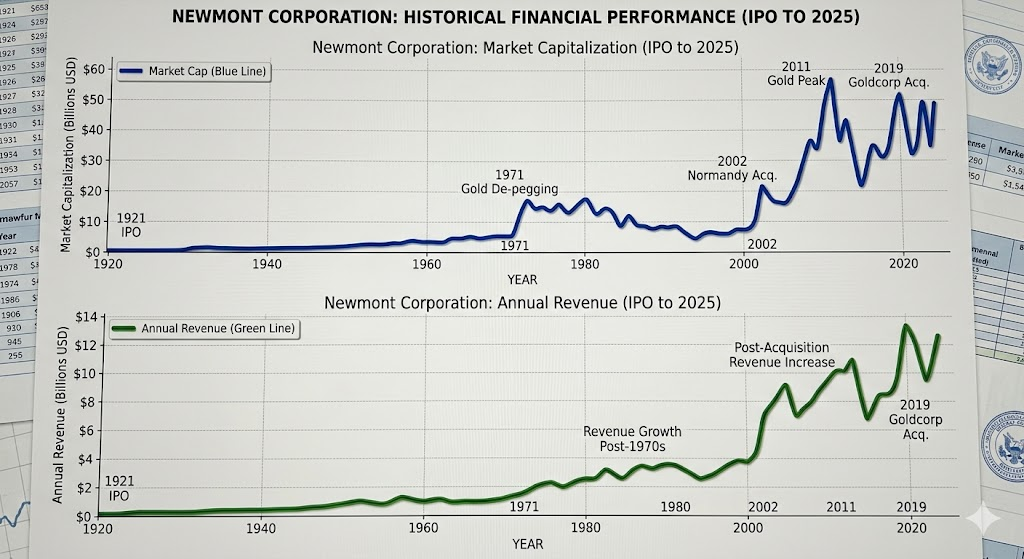
Newmont’s history can be categorized into several key phases, evolving from an investment holding firm into the world’s largest gold producer:
Early Expansion and Diversification (1921–1960s)
Founded in 1921 by William B. Thompson, Newmont began as a mining investment holding company. During this phase, it held a diverse portfolio including oil, gas, copper, and coal assets, establishing its foundation in resource development through strategic equity stakes in various mining ventures.
Strategic Transition to Gold (1970s–1990s)
Following the end of the gold standard and the rising demand for precious metals, Newmont executed a strategic pivot. The company divested from energy and base metal interests to focus exclusively on gold production. In 1987, Newmont consolidated its US gold assets to form the Newmont Gold Company, cementing its status as a gold-focused industry leader.
Global M&A and Economies of Scale (2000s–2010s)
Newmont aggressively expanded its global market share through strategic acquisitions. The 2002 acquisition of Normandy Mining and Franco-Nevada significantly widened its geographic footprint into Australia and the international market. Over the following decades, further integration of global mining projects enhanced economies of scale and operational efficiency, securing its position as the world’s top gold producer.
Asset Portfolio Optimization and ESG Transformation (2019–Present)
In 2019, Newmont acquired Goldcorp for 10B USD, significantly strengthening its asset portfolio across North and South America. Recently, the company has focused on optimizing its assets through selective divestments and the integration of new technologies. It has also placed ESG (Environmental, Social, and Governance) metrics at the core of its operations to address the challenges of climate change and resource sustainability.
As the world’s leading gold producer, Newmont Corporation operates in a highly professionalized and scale-driven environment. Below is a competitive analysis of Newmont within the 2026 market landscape.
Primary Competitor Segments
- Direct Peers (Scale and Production Capacity)
- Barrick Gold: Newmont’s primary rival. The two companies compete for the top spot in gold production and reserves. Notably, they operate the Nevada Gold Mines joint venture; this relationship—balancing partnership with fierce competition—drives continuous benchmarking in capital efficiency and cost control.
- Strong Mid-Tier and Regional Players
- Agnico Eagle Mines: Known for high-grade assets (e.g., Detour Lake) and superior management of jurisdictional risk. Their exceptional operational efficiency often leads to lower all-in sustaining costs (AISC) than Newmont’s global average, placing pressure on Newmont’s margins.
- Diversified Resource Groups (Indirect Competition)
- Mining Conglomerates (Rio Tinto, BHP, Freeport-McMoRan): While their core business differs, these companies compete with Newmont for capital and development projects, particularly as Newmont increases its copper production to diversify its portfolio.
- Alternative Investment Vehicles
- Gold ETFs and Digital Gold: Market participants seeking simple exposure to precious metals often opt for low-cost spot gold ETFs rather than individual equities, which poses a structural challenge to Newmont’s valuation multiples.
Competitive Strengths and Challenges (2026 Outlook)
| Strengths | Potential Challenges |
| Economies of Scale: Global asset base allows for significant post-merger cost synergies. | Rising AISC: As gold extraction complexity increases, maintaining low unit costs is an industry-wide struggle. |
| Geographic Diversification: Assets are located in politically stable jurisdictions, mitigating geopolitical risk. | Resource Replacement: Declining discovery rates for greenfield projects force reliance on expensive M&A for reserve replenishment. |
| Copper Strategy: Balancing gold with copper production hedges against gold price cycles. | Integration Risks: Successfully executing operational efficiencies and digital transformation post-major M&A remains critical. |
Core Competitive Strategy
- Profitability and Capital Discipline: Newmont prioritizes value over volume, utilizing dividends and share buybacks to maintain attractiveness for institutional investors.
- Technological Integration: Utilizing automated hauling systems (e.g., at the Boddington mine) to lower unit operating costs and combat rising labor and energy expenses.
- ESG Leadership: High ESG ratings serve as a competitive moat, lowering the cost of capital and securing the “social license to operate” in complex jurisdictions where smaller competitors may struggle.
In summary, Newmont’s competitive landscape in 2026 has shifted from a pure race for production volume toward a comprehensive assessment of resource efficiency, ESG quality, and free cash flow generation.
Source:
- https://www.newmont.com/
- https://www.barrick.com/
- https://www.agnicoeagle.com/
- https://www.nyse.com/quote/XNYS:NEM
Back to Newmont page