
The latest quarterly earnings report for Dell Technologies (DELL), specifically for the fourth quarter of fiscal year 2026, highlights strong growth driven by AI infrastructure demand. Here is the summary:
Financial Performance
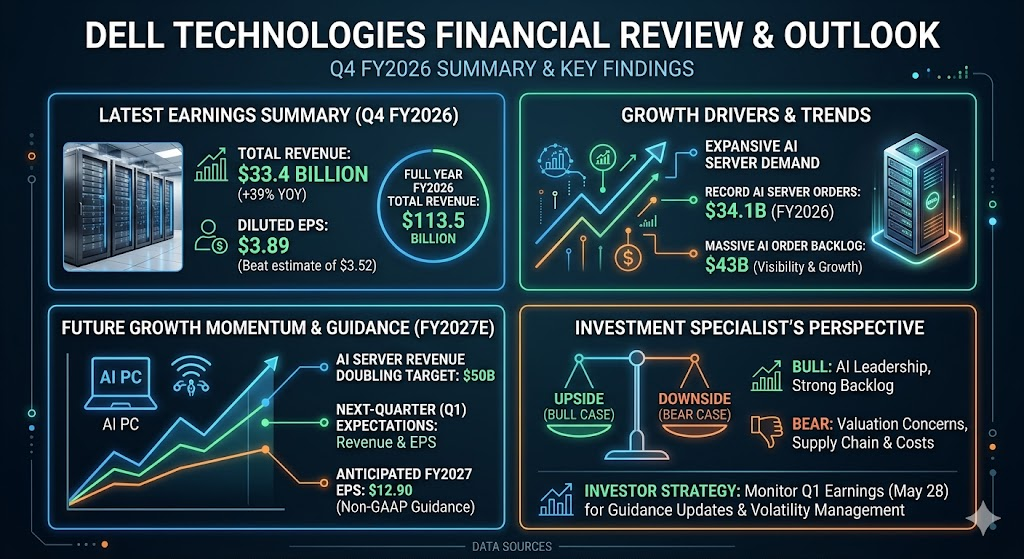
- Revenue: $33.4B, an increase of 39% year-over-year.
- Earnings Per Share (EPS): $3.89, surpassing market expectations of $3.52 by approximately 10.51%.
- Full Fiscal Year 2026: Total revenue reached $113.5B, up 19% YoY, with diluted EPS of $10.30, a 27% increase.
Business Highlights
- Infrastructure Solutions Group (ISG): Achieved record-breaking revenue fueled by robust demand for AI-optimized servers. Server and networking revenue reached $12.9B, a 69% increase YoY.
- AI Servers: Quarterly AI server shipments totaled $8.2B, with a remaining AI order backlog of $11.7B at the end of the quarter.
- Client Solutions Group (CSG): Revenue was $12.5B, up 1% YoY. Commercial client revenue grew by 2%, while consumer business saw a slight decline.
Cash Flow and Shareholder Returns
- Dell maintained a healthy financial position with strong operating and free cash flow, enabling the company to continue returning capital to shareholders through share repurchases and dividends.
The following highlights the significant changes and strategic shifts for Dell Technologies in the fourth quarter of fiscal year 2026, marking its transition into a dominant player in AI infrastructure:
1. AI Servers as the Primary Growth Engine
- Explosive Order Growth: New AI server orders reached $34.1B this quarter, bringing the total AI server bookings for the full fiscal year to $64.1B.
- Record Backlog: The AI server backlog reached $43B by the end of the quarter, providing high revenue visibility and confirming sustained, large-scale demand.
- Structural Shift: AI servers have evolved from opportunistic demand into a repeatable, scalable source of structural revenue for the company.
2. Structural Transformation of Infrastructure Business
- Dominant ISG Performance: The Infrastructure Solutions Group (ISG) saw revenue surge by 73%, with AI server revenue specifically growing 342% year-over-year.
- Modernization Cycle: Enterprise clients are actively upgrading legacy hardware (e.g., 14G) to the latest 17G architecture. Dell emphasized that this transition offers a 7-to-1 consolidation ratio in terms of space, power, and cooling, acting as a key catalyst for hardware refreshes.
- Storage Recovery: Dell’s IP storage portfolio (PowerMax, PowerStore, PowerScale) is showing renewed momentum, driven by the need for high-performance storage environments to support AI training workloads.
3. Operational and Financial Management Strategy
- Dynamic Pricing: In response to volatile component costs (particularly rising memory prices), Dell has implemented shorter quote validity periods, more flexible pricing, and reduced discounting to preserve margins.
- Capital Allocation: The company significantly bolstered shareholder returns, announcing a 20% increase in cash dividends and a new $10B share repurchase authorization. A total of 54 million shares were repurchased over the fiscal year.
- AI PC Market Share: Despite a challenging broader PC environment, Dell outperformed the market, achieving a 14% revenue increase in the Client Solutions Group (CSG), compared to the estimated 10% market average, driven by its AI-optimized PC lineup.
4. Outlook and Challenges
- Aggressive Growth Guidance: Dell provided a positive outlook for fiscal year 2027, projecting median revenue of $140B (a 23% YoY increase) and anticipating that AI server revenue will double to $50B.
- Supply Chain and Margin Pressure: Management is closely monitoring supply chain constraints—specifically GPU availability—and the impact of rising memory costs on margins. Dell continues to focus on balancing the lower gross margins inherent in AI servers with the need to maintain overall profitability.
Dell Technologies is set to report its fiscal 2027 first-quarter earnings on May 28, 2026. Market expectations are highly optimistic, with growth momentum driven primarily by the following factors:
1. Conversion of AI Server Backlog into Revenue
- Massive Order Backlog: Dell concluded the previous fiscal year with an AI server backlog of $43B. This backlog serves as the primary engine for Q1 and full-year revenue, providing high visibility into sustained demand for its AI infrastructure.
- Doubling Revenue Target: Management has provided clear guidance expecting AI server revenue to double to $50B in fiscal 2027. Q1 will be a critical benchmark to verify if this trajectory remains on track.
2. Accelerated Enterprise AI Spending Cycle
- Structural Demand: AI infrastructure spending has shifted from opportunistic, decentralized purchasing to a structural procurement cycle led by large enterprises and Neocloud providers. Dell’s robust enterprise sales channel and systems integration capabilities allow it to capture significant market share in this wave.
- Modernization Cycle: Businesses are actively upgrading from legacy (14G) to current (17G) server architectures. This cycle not only drives server unit sales but also stimulates demand for associated high-performance storage solutions, such as PowerMax and PowerScale.
3. PC Market Recovery
- Market Rebound: Beyond AI servers, Dell’s Client Solutions Group (CSG) is expected to benefit from a broader industry recovery. As AI-integrated PCs become more mainstream, Dell’s commercial PC business is poised to act as a steady secondary growth pillar.
4. Market Consensus and Financial Outlook
- Strong Projections: Analysts are projecting robust performance for Q1 FY2027, with revenue expected to reach $35.46B, representing a year-over-year growth of approximately 51.7%. Earnings per share (EPS) are projected at $3.00, a significant 93.6% increase compared to the same period last year.
- Investor Sentiment: Dell’s stock has recently reached record highs, reflecting Wall Street’s confidence in its transformation into an AI infrastructure leader. Markets are currently looking for Dell to not only beat expectations but potentially raise its full-year guidance.
In summary, the momentum for the upcoming quarter is rooted in the efficiency of delivering on the AI order backlog and sustained enterprise capital expenditure on data center modernization. Dell is increasingly viewed not merely as a hardware vendor, but as a critical infrastructure partner in the enterprise AI transformation.
The earnings per share (EPS) trajectory for Dell Technologies over the next year is a focal point for investors and analysts. Based on current financial forecasts and company guidance for fiscal year 2027, here is the outlook:
1. Fiscal Year 2027 EPS Projections
- Company Guidance: Dell management has provided a non-GAAP EPS guidance of $12.90 for the full fiscal year 2027.
- Market Consensus: The prevailing market expectation for Dell’s FY2027 EPS generally falls within the $12.90 to $13.16 range.
- Growth Expectation: Using the $12.90 midpoint as a baseline, this represents an approximate 25% year-over-year increase compared to the $10.30 EPS reported for fiscal year 2026.
2. Key Drivers Impacting EPS
- AI Server Revenue Contribution: This is the primary driver for earnings expansion. With AI server revenue projected to double to $50B in fiscal 2027, the scale of operations is expected to significantly boost bottom-line performance.
- Margin Management: While early-stage AI server deployments often carry lower gross margins compared to traditional enterprise hardware, Dell’s implementation of dynamic pricing and shorter quote validity periods is designed to preserve profitability during this high-growth phase.
- Capital Allocation: Dell’s strong free cash flow generation enables aggressive shareholder returns. The recent 20% dividend increase and expanded share repurchase authorization help support EPS growth by reducing the total number of outstanding shares.
- Broad-Based Recovery: Beyond AI, the cyclical recovery in the Client Solutions Group (CSG/PC business) and the ongoing enterprise refresh cycle for traditional data center infrastructure (ISG) are expected to provide a stable, compounding earnings base.
3. Summary Outlook Table
| Metric | Expected Value (FY2027) | Note |
| Full-Year EPS Guidance | $12.90 | Non-GAAP basis |
| Year-Over-Year Growth | ~25% | Reflects structural growth |
| Primary Catalysts | AI Servers, IT refresh, Shareholder returns | Sustained momentum |
Executive Summary:
Wall Street maintains a bullish outlook on Dell’s earnings potential. Numerous major financial institutions, including Evercore ISI and Bank of America, have recently adjusted their price targets higher, citing sustained AI infrastructure demand and successful corporate transformation. Investors will closely watch the Q1 earnings report scheduled for May 28, 2026. Whether the company decides to “raise” its full-year EPS guidance in light of stronger-than-anticipated AI momentum will be the primary indicator of the EPS trajectory for the remainder of the year.
Current Market Position
As of late May 2026, Dell shares have experienced an extraordinary surge, with a year-to-date gain exceeding 130%, trading near record highs (approx. $295). Wall Street’s sentiment is bifurcated: a strong consensus on the company’s AI-driven growth trajectory versus growing caution regarding its current valuation.
1. Upside Potential (The Bull Case)
The bullish outlook is driven by the anticipation that Dell will continue to exceed expectations.
- AI Infrastructure Dominance: Dell is widely seen as a primary beneficiary of the AI server boom. Its deep integration with hyperscalers and enterprises, combined with a record $43B AI backlog, provides high revenue visibility.
- Earnings Catalysts: With Q1 FY2027 earnings scheduled for May 28, 2026, there is widespread expectation for a “beat and raise” scenario. Analysts have consistently revised price targets upward (with many reaching $270–$290) in anticipation of stronger-than-expected earnings and potential guidance increases.
- Structural Refresh Cycle: The ongoing enterprise migration to next-generation (17G) hardware is creating a durable upgrade cycle that extends beyond just “AI hype.”
2. Downside and Valuation Risks (The Bear Case)
A more cautious perspective is emerging, particularly regarding the stock’s recent rapid appreciation.
- Priced-to-Perfection: Critics argue that much of the company’s future success is already reflected in the stock price. The stock’s P/E ratio has expanded significantly (now trading at ~32x), closing the historical discount gap Dell once held relative to the broader market.
- Supply Chain Headwinds: Rising memory costs and persistent GPU shortages are cited by some analysts (notably Morgan Stanley, which maintains an “Underweight” rating) as potential margin pressures that could impact the second half of the fiscal year.
- Valuation Overhang: Several valuation models suggest that the stock is currently trading near or slightly above its intrinsic value. Investors are concerned about a “sell the news” reaction if the upcoming earnings report fails to significantly exceed the already elevated expectations.
3. Summary of Expert Outlook
| Factor | Outlook | Key Considerations |
| Market Sentiment | Moderate Buy | Broad analyst support despite valuation concerns. |
| Growth Drivers | Strong | AI server demand and enterprise IT modernization. |
| Valuation | Extended | P/E ratio expansion has outpaced historical norms. |
| Near-term Catalyst | High Volatility | Q1 earnings on May 28, 2026, will be the decisive trigger. |
Investment Perspective
The risk-reward profile for Dell has shifted from “asymmetric upside” to “balanced” due to the massive run-up in the share price.
- For Long-term Holders: The thesis remains intact—Dell is successfully pivoting into a vital AI infrastructure partner. Volatility is expected, but the fundamental growth story is supported by a massive order backlog.
- For Potential New Investors: Exercising caution is advised. Given the stock is trading near 52-week highs, entering before the May 28 earnings release carries the risk of significant post-earnings volatility. Many analysts suggest waiting for a potential pullback or “re-rating” after the earnings event to establish a better entry point.
Disclaimer: This analysis is for informational purposes only and does not constitute financial advice. The stock market involves significant risk; please consult with a certified financial advisor before making any investment decisions.
Source:
- https://hk.investing.com/equities/dell-inc-earnings
- https://www.sinotrade.com.tw/richclub/hotstock/美股法說-DELL-Dell-戴爾科技-AI-伺服器成長帶動創紀錄營收-但盈利展望令投資人憂心-DELL-US-68b144870b776d5ef026d542
- https://investors.delltechnologies.com/news-releases/news-release-details/dell-technologies-delivers-fourth-quarter-and-full-year-fiscal-3
- https://www.investing.com/news/transcripts/earnings-call-transcript-dell-technologies-q4-2026-beats-expectations-with-record-earnings-93CH-4530107
- https://futurumgroup.com/insights/dell-q4-fy-2026-earnings-highlight-ai-optimized-server-ramp/
- https://intellectia.ai/news/crypto/dell-technologies-reports-q1-fy2027-financial-results-with-strong-projections
- https://www.fxleaders.com/news/2026/05/25/dell-dell-nears-300-ahead-of-earnings-after-ai-server-boom-ignites-140-rally/
- https://www.tradingview.com/news/zacks:28a9fc902094b:0-snowflake-vs-dell-which-ai-infrastructure-stock-has-the-edge/
- https://www.marketbeat.com/instant-alerts/dell-technologies-dell-to-release-quarterly-earnings-on-thursday-2026-05-21/
- https://www.investing.com/news/analyst-ratings/dell-technologies-on-ai-momentum-93CH-4706247
Back to Dell page