Progressive Corporation (PGR) demonstrated robust top-line growth in Q1 2026, driven by aggressive expansion and strong market positioning. Below are the key developments and shifts from the quarter:
1. Market Share Expansion
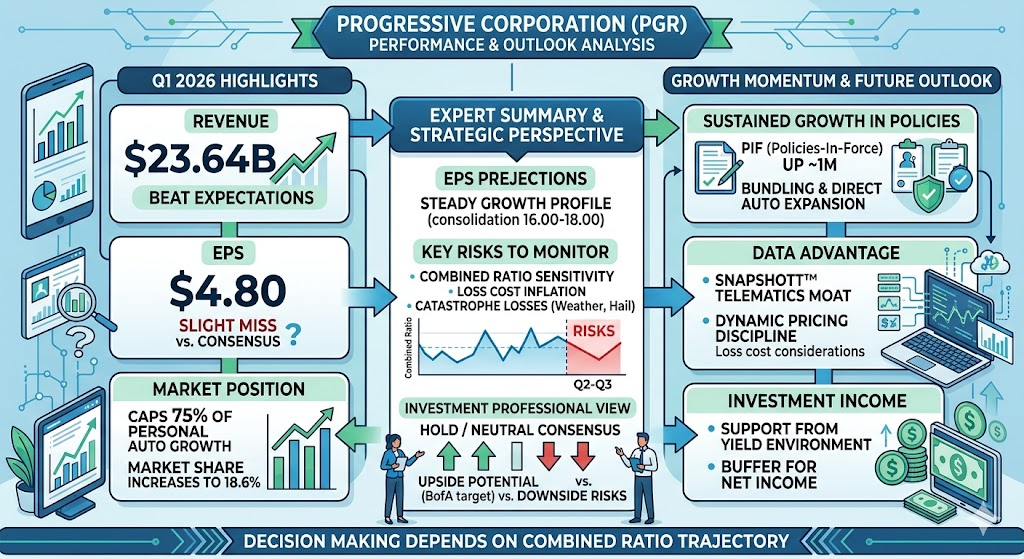
- Continued Growth: Progressive captured a significant portion of industry growth in 2025, reaching an 18.6% share of the personal auto market. This is the result of a two-year strategy that has significantly narrowed the gap with the industry leader, State Farm.
- Policy Gains: The company added approximately 1 million policies in force (PIF) during Q1, a 9% year-over-year increase, bringing the total to 39.6 million policies.
2. Financial Performance
- Revenue Beat: Q1 revenue reached 23.64B, surpassing the consensus forecast of 23.28B.
- Underwriting Profitability: The combined ratio for Q1 was 86.4. While slightly higher than the 86.0 reported in Q1 2025, it remains exceptionally strong and well below the company’s long-term target of 96, confirming its continued operational efficiency despite broader industry pressures.
- Net Income: Quarterly net income rose 10% to 2.8B, supported by higher premiums earned.
3. Strategic Shifts & Operational Investments
- Record Marketing Spend: To sustain growth, Progressive increased its media advertising budget by 20% compared to Q1 2025, marking its highest quarterly marketing expenditure ever.
- Digital & Pricing Edge: The company continues to leverage its “Snapshot” telematics data and sophisticated pricing models to attract profitable customers while maintaining discipline in risk selection.
- Segment Performance:
- Direct Auto: Experienced 10% growth in net premiums written.
- Agency Auto: Saw a 5% increase.
- Commercial Lines: Maintained steady growth of 3%, though the shift toward 6-month commercial policies has impacted the average premium per policy.
4. Market Sentiment & Risks
- EPS Surprise: While Progressive missed the EPS consensus (4.80 vs. 4.83) by a small margin, investors responded positively to the revenue outperformance and consistent market share gains.
- Emerging Pressures: Analysts are closely monitoring the impact of rising repair and medical costs (loss cost trends). Additionally, there is a focus on how the company manages its combined ratio as competition intensifies; for instance, the combined ratio in April 2026 rose to 90.2, partly due to catastrophe losses from hail and storms.
The growth momentum for Progressive (PGR) heading into the second quarter of 2026 and beyond is anchored in a balance between aggressive top-line expansion and operational risk management. Here is the outlook:
1. Sustained Policy Growth
- Market Penetration: The Direct Auto segment continues to be a primary engine, with policies-in-force (PIF) up 11% year-over-year as of April 2026. This indicates that Progressive’s high-frequency digital marketing and competitive pricing are successfully siphoning customers from incumbents.
- Bundling Strategy: Increasing cross-selling rates for Property and Special Lines remains a core focus. By bundling auto with homeowners or recreational vehicle insurance, Progressive significantly improves customer retention and increases the lifetime value (LTV) of each policyholder.
2. Data-Driven Competitive Advantage
- Telematics Moat: The company’s deep repository of driving data (via the “Snapshot” program) provides a substantial underwriting edge. As repair and medical costs (loss costs) remain volatile, this superior risk-selection capability allows Progressive to price policies more accurately than competitors, maintaining its industry-leading profitability.
- Dynamic Pricing: Progressive is expected to continue its flexible rate-adjustment strategy, ensuring that price increases are implemented promptly in response to inflationary trends while avoiding the loss of price-sensitive customers.
3. Marketing ROI
- Efficiency vs. Scale: Having hit record-high marketing spend in Q1, the key for Q2 is conversion efficiency. The growth momentum will depend on the ability of this record spend to continue attracting “preferred” (lower-risk) risk profiles, which are crucial for maintaining long-term profitability.
4. Key Risks to Momentum
- Combined Ratio Pressure: This is the primary metric to watch. April 2026 saw the combined ratio rise to 90.2 (compared to 84.9 in April 2025), largely due to elevated catastrophe losses from spring storms and hail. If severe weather patterns persist through the summer, the cost of claims will continue to pressure margins.
- Macro-Economic Sensitivity: Progressive is sensitive to inflationary pressure on auto parts, labor, and medical services. Furthermore, any cooling in the economy that affects vehicle miles driven or consumer retention could create a headwind for top-line growth.
5. Investment Portfolio Support
- Yield Environment: With interest rates remaining relatively high, the investment portfolio provides a steady income buffer. This serves as a secondary support for net income, insulating the company slightly against potential underwriting volatility caused by catastrophe losses.
Summary for Q2 2026:
The path forward for Progressive relies on its ability to sustain its growth in policies-in-force while effectively managing the impact of weather-related catastrophe losses on its combined ratio. While revenue growth is expected to remain strong, investors will be focused on whether the company can keep its combined ratio well below the long-term target of 96 despite ongoing inflationary and environmental pressures.
Based on recent consensus estimates and analyst coverage, the EPS outlook for The Progressive Corporation (PGR) over the next 12 months is characterized by steady growth, though it faces a tug-of-war between aggressive revenue expansion and cost-related headwinds.
1. EPS Projections
- Earnings Estimates: Market consensus forecasts generally project 2026 EPS to be in the range of 16.60, with expectations for a slight increase into 2027 to approximately 17.30.
- Primary Drivers:
- Revenue Growth: Strong momentum in policies-in-force (PIF) and higher net premiums earned remain the primary engines for EPS expansion.
- Investment Income: The current interest rate environment remains favorable for Progressive’s fixed-income-heavy investment portfolio, providing a consistent “cushion” for net income.
- Operational Discipline: Ongoing efforts to automate claims processing and optimize administrative expense ratios are expected to support operating margins.
2. Key Variables Affecting the Outlook
While the earnings trend is positive, analysts are closely monitoring factors that could cause volatility:
- Combined Ratio Sensitivity: As seen in the April 2026 results (where the ratio hit 90.2 due to catastrophe losses), external factors such as hail, storms, and extreme weather remain the most significant threat to hitting quarterly EPS targets.
- Loss Cost Inflation: The persistence of elevated vehicle repair costs and medical expenses continues to put pressure on underwriting margins. Progressive must maintain its pricing agility to ensure that premium increases adequately cover these rising loss costs.
- Competitive Pricing: As other major insurers recover their profitability, the industry may see a transition from aggressive rate hikes to more competitive pricing, which could temper future margin expansion.
3. Market Sentiment & Valuation
- Analyst Consensus: Wall Street ratings are generally split between “Hold” and “Buy.”
- Price Targets: The 12-month average price target for the stock currently sits at approximately 232.11, with a wide range reflecting different views on how the company will handle industry-wide loss cost trends versus its own unique growth trajectory.
Summary
For the next 12 months, investors should view Progressive as a “steady-state growth” story, with EPS likely consolidating in the 16.00 – 18.00 range. The most critical metric for assessing the health of this EPS trajectory is the combined ratio; specifically, whether the company can consistently keep this figure well below 90, even when faced with seasonal weather events and inflationary pressure.
Disclaimer: This information is based on financial market consensus and analyst reports as of late May 2026 and should not be considered as financial advice.
Investment Analysis: The “Steady-State” Growth Profile
Progressive is currently navigating a transition phase where its historic “hard market” tailwinds are moderating. The stock is viewed by the market as a high-quality insurer facing short-term volatility due to climate-related events and competitive pricing pressures.
1. Upside Potential
- Analyst Consensus: The median 12-month price target is approximately $221.00, representing an upside of roughly 10–11% from the recent trading price of ~$199.51. The most bullish outlook comes from BofA Securities, with a target of $320.00 (a ~60% upside), suggesting significant long-term potential if the company maintains its dominant underwriting margin.
- Valuation: Trading at a P/E ratio of approximately 10.1x, the stock is often cited as being undervalued relative to its growth prospects. Its ability to generate strong cash flow and its ongoing share repurchase program provide a “floor” for the stock price.
- Operational Edge: Progressive’s “Snapshot” telematics program and sophisticated data-driven pricing models remain its greatest competitive moat, allowing it to maintain profitability even when competitors struggle to price risks correctly.
2. Downside Risks
- Combined Ratio Volatility: This is the most critical metric for investors. In April 2026, the combined ratio worsened to 90.2 (up from 84.9 a year prior), largely due to severe weather-related losses (hail and storms). Persistent extreme weather patterns throughout the summer represent the primary near-term risk to earnings.
- Market Cycle Transition: The insurance sector is shifting away from the highly favorable pricing environment seen over the last two years. As competition intensifies, profit margins could narrow if Progressive is forced to balance growth with maintaining its combined ratio targets.
- Loss Cost Inflation: Ongoing inflationary pressure on vehicle repair parts, labor, and medical services requires the company to implement constant, surgical rate increases without losing too much market share to price-sensitive customers.
Strategic Perspective
For a long-term investor, Progressive remains a core holding in the insurance sector due to its operational discipline and market share gains. However, the current “Hold” consensus reflects a market that is waiting for clarity on whether the recent rise in the combined ratio is a temporary weather-related anomaly or a longer-term trend of rising loss costs.
Actionable Advice: If you are looking to enter or increase a position, monitoring the monthly results for the combined ratio is essential. A trend of the ratio consistently moving toward or above 95 would indicate deteriorating underwriting quality, while a return to the mid-80s would likely serve as a strong catalyst for a stock price re-rating.
Source:
- https://hk.investing.com/news/transcripts/article-93CH-1454903
- https://investors.progressive.com/financials/financial-news-releases/news-details/2026/Progressive-Reports-March-2026-Results/default.aspx
- https://www.insurancejournal.com/news/national/2026/04/15/866006.htm
- https://www.investing.com/news/transcripts/earnings-call-transcript-progressive-corp-q1-2026-shows-strong-revenue-growth-93CH-4659873
Back to Progressive page