
The history of Progressive can be categorized into the following four key stages:
1. Foundation and Early Years (1937–1950s)
Founded in 1937 by Jack Green and Joseph Lewis in Cleveland, Ohio, the company began as an auto insurer. From the outset, the founders recognized the rigid nature of the traditional insurance industry. They early on adopted a strategy of targeting drivers who were underserved or considered high-risk by established firms, setting the foundation for a specialized underwriting approach.
2. Transformation and Diversification (1960s–1980s)
The year 1965 marked a major turning point when Peter Lewis took over the leadership. He renamed the firm Progressive and pioneered market segmentation, matching insurance products to specific risk profiles. During this era, the company expanded its footprint across the United States and successfully went public in 1971.
3. Technological and Marketing Innovation (1990s–2000s)
This period saw Progressive achieve significant breakthroughs in marketing and technology. It was among the first insurance providers to offer online quotes, launching its web-based services in 1994. On the marketing front, the company introduced the iconic Flo character, which successfully elevated brand recognition and humanized the simplified, transparent quote process.
4. Digitalization and Data Leadership (2010s–Present)
In recent years, the company has doubled down on technological integration. Through the Snapshot program, it utilizes telematics to track driving behavior in real-time for personalized premium calculation. Progressive continues to optimize its digital channels and leverage a cross-selling strategy across auto, home, and other insurance products, sustaining profitable growth and solidifying its position as a market leader.
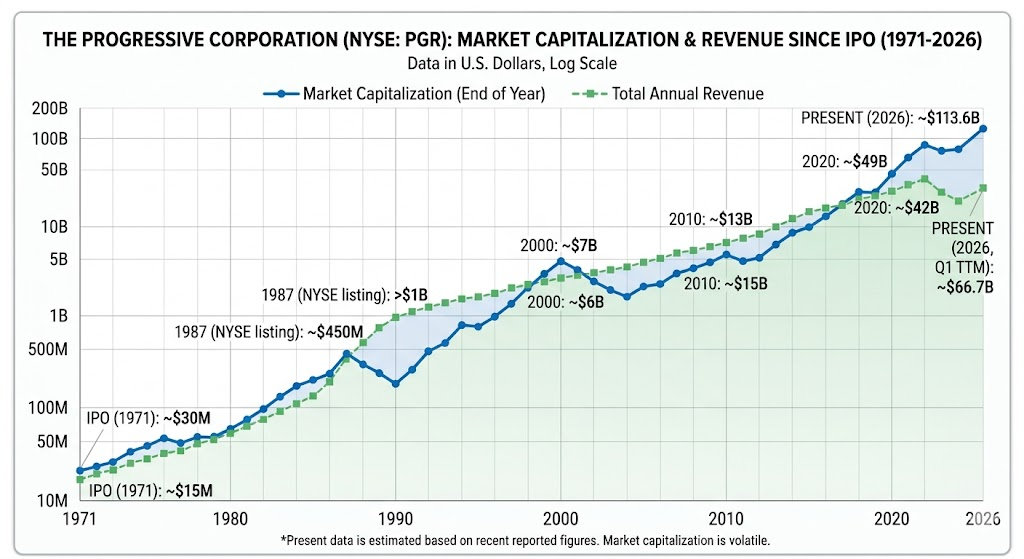
Progressive holds a leadership position in the U.S. auto insurance market, competing primarily with industry giants such as State Farm, GEICO, and Allstate. Below is a competitive analysis:
1. Market Share and Standing
As of mid-2026, Progressive commands approximately 16% to 17% of the U.S. auto insurance market, ranking second only to State Farm (at roughly 18% to 19%). These three companies, alongside GEICO, account for over one-third of the total national market, reflecting a highly concentrated industry.
2. Major Competitors
- State Farm (Scale and Agent Network): Structured as a mutual insurer, it boasts the largest network of dedicated agents. It prioritizes localized service and personalized relationships, providing a competitive edge in price and customer satisfaction.
- GEICO (Price and Digital Lead): Owned by Berkshire Hathaway, GEICO is known for its direct-to-consumer and low-cost strategy. It remains Progressive’s fiercest rival in digital channels and advertising, leveraging a streamlined digital experience to capture market share.
- Allstate (Bundling and Integrated Marketing): Focuses heavily on cross-selling auto and home insurance. Through advanced telematics and an extensive agency force, it remains highly competitive in risk pricing and customer retention.
3. Progressive’s Core Competitive Advantages (Moats)
- Data and Technology Leadership: Progressive pioneered telematics tools like Snapshot, which track driving behavior for personalized pricing. This level of granularity in risk classification serves as its most significant competitive moat.
- Dual-Channel Strategy: The company uniquely and effectively balances both direct-to-consumer and independent agency channels, allowing it to adapt flexibly to the needs of different consumer demographics.
- Underwriting Discipline: Unlike competitors that may prioritize market share through aggressive price cutting, Progressive emphasizes underwriting profitability. Its long-term goal is to maintain a combined ratio below 96%, ensuring operational stability and consistent margins.
4. Competitive Challenges and Risks
- Pricing Pressure: The auto insurance market is highly transparent and price-sensitive. When rivals like GEICO or State Farm initiate aggressive pricing, Progressive must carefully balance growth targets with profitability.
- Cost Inflation: Rising costs for vehicle repairs and medical claims continue to place significant pressure on insurance margins across the industry.
- Digital Transformation Competition: While Progressive held a first-mover advantage in online quoting, traditional competitors and emerging Insurtech startups are rapidly narrowing the technological gap through digital innovation.
Source:
- https://tracxn.com/d/companies/progressive/__Og2Jp7iBfgHbWYV2Tmrsk5iHLPt6M1Uq4mbeME0qCRk
- https://portersfiveforce.com/blogs/competitors/progressive
- https://www.valuepenguin.com/largest-auto-insurance-companies
- https://www.thezebra.com/insurance-companies/
Back to Progressive page