
The history of Bristol Myers Squibb (BMS) can be categorized into four distinct evolutionary stages:
1. Origins and Foundations (1858-1988)
This era stems from the development of two independent companies:
- E.R. Squibb & Sons (Founded 1858): Established by Dr. Edward Robinson Squibb, the company focused on pharmaceutical purity, quality control, and scientific research, becoming a primary supplier of penicillin during World War II.
- Bristol-Myers (Founded 1887): Founded by William McLaren Bristol and John Ripley Myers, the firm initially concentrated on consumer health products (such as Sal Hepatica and Ipana toothpaste) before expanding through acquisitions and marketing strategies.
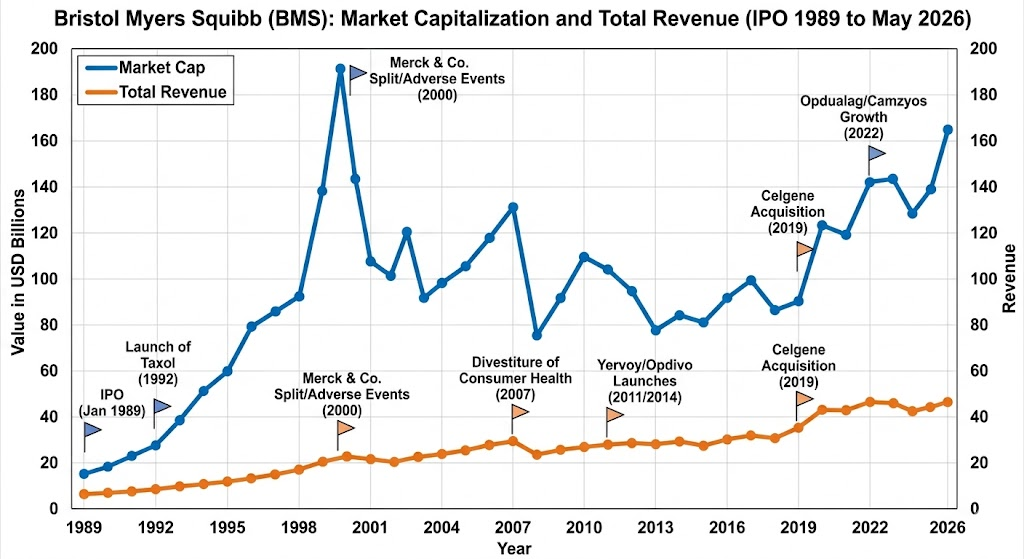
2. Merger and Pharmaceutical Transformation (1989-2008)
- 1989 Merger: Bristol-Myers and Squibb officially merged to form “Bristol-Myers Squibb,” creating one of the world’s largest pharmaceutical companies at the time.
- Business Reorganization: During this period, the company shifted toward chemical drugs and prescription medications, notably launching the chemotherapy drug Taxol in 1992, which established its early foundation in oncology.
3. Focus on Biopharmaceuticals and Immuno-Oncology Breakthroughs (2009-2018)
- Strategic Pivot: Starting in 2007, the company began divesting non-core assets (e.g., selling the Mead Johnson nutrition business in 2009) to evolve into a focused, innovation-driven biopharmaceutical enterprise.
- Immuno-Oncology (I-O) Leadership: Through the 2009 acquisition of Medarex, BMS secured key checkpoint inhibitor technology, successfully developing Yervoy (approved in 2011) and Opdivo (approved in 2014), cementing its status as a global leader in cancer immunotherapy.
4. Diversified Growth and Precision Medicine (2019-Present)
- Large-Scale Acquisitions: In 2019, BMS completed the $74B acquisition of Celgene, significantly expanding its footprint in hematology (e.g., Revlimid) and multiple myeloma treatments. This was followed in 2020 by the acquisition of MyoKardia, strengthening its cardiovascular pipeline (e.g., Camzyos).
- Advanced Technology and Precision Medicine: Recently, the company has continued to expand via strategic acquisitions (including Mirati, RayzeBio, and Karuna) into radiopharmaceuticals, precision oncology, and neuroscience to mitigate challenges from patent expirations and drive a more diversified portfolio.
Bristol Myers Squibb (BMS) operates in a highly competitive, innovation-driven biopharmaceutical landscape. As of mid-2026, the company is in a critical transition phase, balancing a “patent cliff” involving legacy products with an accelerating “growth portfolio.”
1. Competitive Landscape by Therapeutic Area
| Area | Primary Competitors | Competitive Dynamics |
| Oncology | Merck, Roche, AstraZeneca | BMS faces intense pressure from Merck’s Keytruda. BMS is pivoting toward next-gen modalities like ADCs (e.g., izalontamab brengitecan), CELMoD agents, and bispecifics to diversify beyond its I-O foundation. |
| Hematology | J&J, Amgen, Novartis | Following the Celgene acquisition, BMS remains a leader, though it faces fierce competition in CAR-T (Breyanzi) and multiple myeloma. Innovation in CELMoDs (e.g., mezigdomide) is key to defending market share. |
| Cardiovascular | Pfizer, Novartis | Eliquis continues to be a top revenue driver despite Medicare pricing pressures. The company is scaling its HCM franchise (Camzyos) to establish a new long-term pillar. |
| Immunology | AbbVie, Eli Lilly, J&J | BMS is attempting to expand its footprint with Sotyktu, though peer recognition in specialized areas like Psoriatic Arthritis remains a challenge compared to established leaders like AbbVie. |
2. Strategic “Growth vs. Legacy” Transition
As of Q1 2026, BMS has achieved a pivotal financial milestone: its growth portfolio now accounts for more than half of total revenue.
- Growth Portfolio: Products like Camzyos, Breyanzi, Reblozyl, Opdualag, and Cobenfy are scaling rapidly, with the growth portfolio delivering a 12% year-over-year revenue increase in Q1 2026.
- Legacy Portfolio: Older assets, particularly Revlimid and Pomalyst, are experiencing significant declines due to generic competition and Medicare Part D redesign. The company is managing this “patent cliff” by accelerating its pipeline and leveraging recent acquisitions (e.g., Mirati, Karuna, RayzeBio).
3. Competitive Advantages & Market Positioning
- Operational Efficiency: Through a strategic deal with Anthropic, BMS is integrating AI into its operating model, aiming to compress the time between clinical data locks and regulatory filings—a potential structural advantage over peers.
- Valuation & Financial Buffer: Trading at a forward P/E ratio of ~9.4–10x (as of late May 2026), BMS is one of the most attractively valued large-cap pharma stocks. Its 4%+ dividend yield and strong cash flow provide a cushion while investors wait for the new product pipeline to mature.
- R&D Breadth: With ~60 disclosures and 19 oral presentations at ASCO 2026, BMS continues to demonstrate one of the deepest late-stage pipelines in the industry, focusing on “differentiated” therapies rather than just incremental improvements.
4. Key Risks
- Revenue Pressure: Despite the growth portfolio’s success, analysts remain cautious about the overall top-line impact of declining legacy drugs, with some forecasting continued revenue contraction over the next 2-3 years.
- Market Sentiment: The stock currently trades as if the company is in permanent decline, ignoring the rapid scaling of newer assets. This creates a “valuation gap” that depends on management’s ability to stabilize margins and prove the durability of its new drug launches.
Source:
- https://www.bms.com/assets/bms/us/en-us/pdf/investor-info/doc_financials/quarterly_reports/2026/BMY-Q1-2026-Earnings-Press-Release.pdf
- https://www.fiercepharma.com/pharma/bms-well-prepared-camzyos-competition-revenue-new-growth-products-overtakes-legacy-portfolio
- https://www.hudson-labs.com/research/bristol-myers-squibb-competitors-bmy-2026-2026
Back to BMS page