
The development of Palo Alto Networks can be divided into four key stages:
1. Founding and Technological Breakthrough (2005–2011)
Founded in 2005 in Santa Clara, California, by former Check Point and NetScreen engineer Nir Zuk. The company aimed to solve the inability of traditional firewalls to identify modern applications. In 2007, they launched the industry’s first Next-Generation Firewall (NGFW), utilizing App-ID, User-ID, and Content-ID technologies to achieve precise control over applications, users, and content, quickly establishing a technological edge.
2. IPO and Global Expansion (2012–2017)
In July 2012, the company completed its Initial Public Offering (IPO) on the New York Stock Exchange (NYSE), raising 260M USD, marking it as one of the major tech IPOs that year. During this phase, the company rapidly expanded its global distribution channels and sales footprint, while strengthening its endpoint security (Traps) and threat intelligence (WildFire) through R&D and strategic acquisitions (e.g., Cyvera, LightCyber), solidifying its position as a global security leader.
3. Platform Transformation (2018–2021)
In 2018, former Google executive Nikesh Arora took over as Chairman and CEO, leading the company toward a platform-centric strategy. The company launched the Prisma (Cloud Security) and Cortex (AI-driven security operations) product portfolios. They aggressively expanded through major acquisitions (e.g., Demisto, Twistlock, CloudGenix) to fill gaps in cloud-native security and automation. In 2021, the company moved its listing from the NYSE to Nasdaq.
4. AI-Native and Comprehensive Security Integration (2022–Present)
This phase focuses on AI-native security and service integration. They launched Cortex XSIAM, which utilizes AI to automate Security Operations Center (SOC) functions. The company continues to deepen its presence in identity security, application security, and data protection through strategic acquisitions (e.g., IBM’s QRadar SaaS assets, CyberArk), aiming to provide an all-in-one Zero Trust platform covering network, cloud, and security operations.
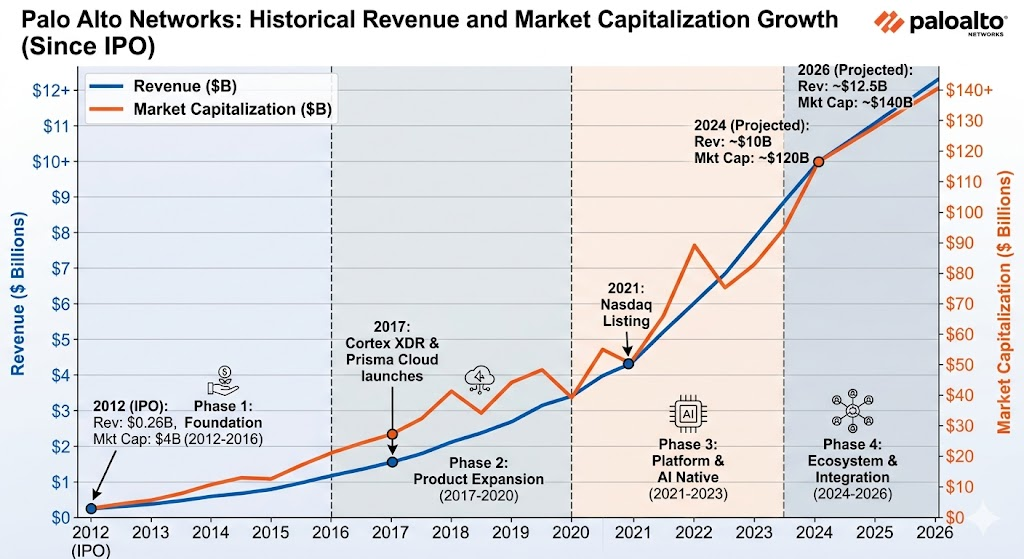
Palo Alto Networks (PANW) currently positions itself as an “Integrated Cybersecurity Platform” provider. In 2026, its core strategy centers on Platformization, aimed at consolidating fragmented security tools into a unified ecosystem to combat increasingly sophisticated AI-driven threats.
Competitive Landscape (2026)
The cybersecurity market is currently defined by a “Platform vs. Point Solution” battle. PANW faces competition from specialized cloud-native vendors and broad-spectrum tech giants.
| Competitor | Primary Focus | Competitive Advantage |
| CrowdStrike | EDR/XDR & Cloud Security | Cloud-native architecture with a high-growth “land-and-expand” model; known for rapid deployment and ease of use. |
| Fortinet | Network Security/SD-WAN | Superior price-performance ratio driven by proprietary ASIC hardware, dominating the mid-market and MSSP segments. |
| Zscaler | ZTNA & SSE | Leading cloud-native Zero Trust provider, excelling in secure web gateways and cloud-based traffic inspection. |
| Microsoft | Integrated Ecosystem | Massive distribution advantage through existing enterprise software (Windows/Azure/Office) and bundled security suites. |
Strategic Analysis: The Platformization Bet
Core Strengths
- Integrated Ecosystem: By bundling Network (Strata), Cloud (Prisma), and Security Operations (Cortex) under one umbrella, PANW effectively targets large enterprises (Global 2000) looking to reduce “vendor sprawl” and operational complexity.
- AI-Native Security: As of May 2026, the company is aggressively marketing “Secure AI by Design,” integrating AI-driven threat detection (Cortex XSIAM) to automate Security Operations Centers (SOC) at machine speed, which is a direct response to frontier AI-powered cyber threats.
- Financial Scale: With a strong balance sheet and healthy free cash flow (aiming for 40%+ margins by FY2028), PANW continues to use strategic acquisitions (e.g., CyberArk for identity security) to fill gaps in its portfolio.
Major Challenges
- Integration Hurdles: Critics and some analysts argue that the “platformization” strategy is effectively a packaging of various acquisitions. Ensuring seamless interoperability remains an execution risk compared to competitors who were “born in the cloud.”
- Sales Complexity: Unlike the lightweight, rapid-deployment models of CrowdStrike or Zscaler, PANW’s platform implementations often involve longer, more complex sales cycles.
- Market Sentiment: As of May 2026, some market observers categorize the stock as “modestly overvalued” given its P/E multiple relative to growth rates (roughly 15% YoY revenue growth), which lags behind the cloud-native “high-growth” cohort.
2026 Market Summary
The industry consensus is that 2026 is a critical year for PANW to prove that its “Platformization” thesis translates into sustained growth. While the company is considered an industry “wide-moat” leader, it is currently facing a “wait and see” approach from some investors who are prioritizing the higher-growth cloud-native peers (like Zscaler or Fortinet) during the current market cycle.
Source:
- https://www.paloaltonetworks.com
- https://investors.paloaltonetworks.com
- https://www.crowdstrike.com
- https://www.fortinet.com
- https://www.zscaler.com
- https://www.microsoft.com/security
Back to Palo Alto Networks page