
Prologis Q1 2026 Earnings Summary
Prologis (PLD) released its financial results for the first quarter (January to March) of 2026 on April 16, 2026. Key highlights are summarized below:
Financial Performance
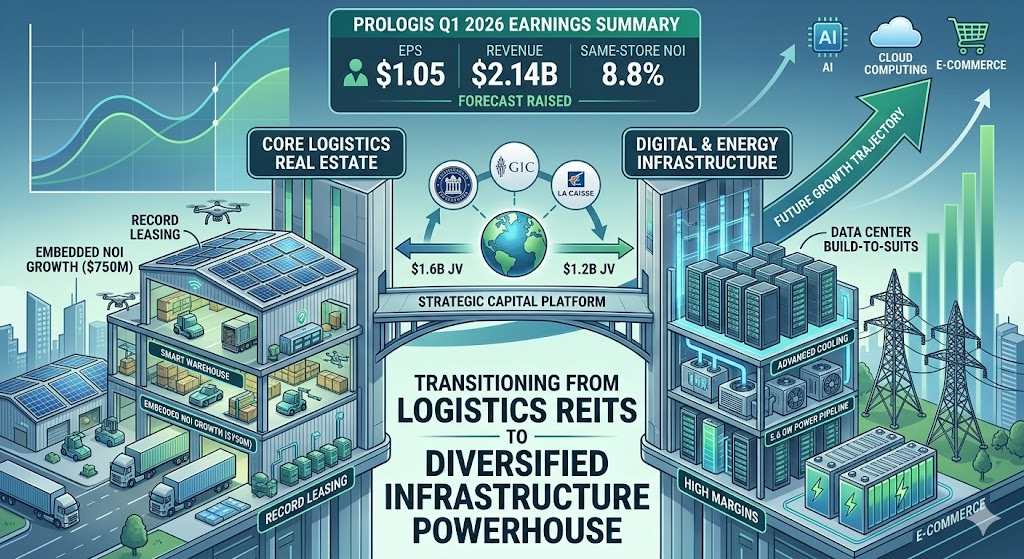
- Earnings Per Share (EPS): 1.05 USD, exceeding market expectations by 29.63%.
- Revenue: 2.14B USD, slightly higher than the market expectation of 2.12B USD.
- Same-store Net Operating Income (NOI) Growth: 8.8%.
Operational Highlights
- Leasing Activity: Successfully signed new and renewed lease agreements totaling approximately 6 million square meters of logistics space.
- Investment and Development:
- Development Starts: Approximately 2.15B USD.
- Acquisitions: Approximately 0.33B USD.
- Development Stabilizations: Approximately 1.25B USD.
- Dispositions: Approximately 1.21B USD (at a 5.1% capitalization rate).
2026 Full-Year Outlook Updates
The company revised its full-year guidance as follows:
- Earnings Guidance: Raised to a range of 3.80 USD to 4.05 USD per share.
- Development Starts Guidance: Adjusted to a range of 4.5B to 5.5B USD, with a strategic focus on data center infrastructure.
- Operational and Financial Metrics:
- Stabilizations: 2.5B to 3B USD.
- Strategic Capital Revenue: 0.61B to 0.63B USD.
- General and Administrative Expenses: 0.51B to 0.525B USD.
- Net Promote Income: 0.5B to 0.7B USD.
CEO Danielle S. Letter noted that through the expansion into digital infrastructure and energy sectors, the company is positioning itself for the next phase of growth.
The key changes for Prologis in Q1 2026 highlight an accelerated strategic transition from traditional logistics real estate toward “data center and energy infrastructure.” Below are the critical strategic shifts and operational changes this quarter:
1. Accelerated Data Center Deployment
This is the most significant strategic pivot this quarter. The company has identified data centers as a primary growth engine, with related business activities showing explosive momentum:
- Higher Development Weighting: Out of the 2.15B USD in total development starts this quarter, approximately 1.3B USD was dedicated to build-to-suit data center projects, accounting for over 60% of total start volume.
- Power Capacity Reserves: The company has secured or is in advanced negotiations for 5.6 GW of power capacity specifically for data centers (86% located in the U.S.).
- Margin Advantage: Management noted that data center development margins (25%-50%) are significantly higher than those of traditional warehouse facilities.
2. Expansion of Strategic Capital Platform
Through partnerships with large institutional investors, Prologis continues to strengthen its capital recycling and investment scale:
- New Partnerships: Announced a 1.6B USD joint venture with GIC this quarter, followed by a 1.2B USD joint venture agreement with La Caisse.
- Capital Recycling: The company completed approximately 1.2B USD in asset dispositions or transfers to joint ventures, maintaining the strength and flexibility of its balance sheet.
3. Resilience and Pricing Power in Logistics
Despite macroeconomic uncertainty, core logistics operations remain robust:
- Record Leasing Activity: Signed leases for approximately 64 million square feet (approx. 6 million square meters) of logistics space, setting a new quarterly record.
- Market Rent Rebound: After two and a half years of decline, market rents have begun to rise again.
- Pricing Power: While rent growth has moderated compared to previous peaks, cash rent spreads remain strong at 16.8%, indicating significant embedded NOI as expiring leases transition to current market rents.
4. Upward Revision of Financial Outlook
Based on the strong first-quarter performance, the company raised its full-year outlook:
- EPS Guidance Raised: Full-year guidance was increased from the previous 3.70-4.00 USD range to 3.80-4.05 USD.
- Development Target Adjustment: The full-year development start target was increased to 4.5B-5.5B USD, with approximately 40% of the budget explicitly allocated to data center projects.
Summary
This quarter demonstrates that Prologis is evolving from a single-focus “logistics warehouse provider” into an “integrated digital and energy infrastructure provider.” Despite geopolitical risks, the company has successfully leveraged strong demand in its leasing business and high-margin data center developments to offset potential vacancy pressures, leading to an increased full-year earnings outlook.
Looking ahead to Q2 2026 and beyond, Prologis’ growth momentum is anchored by two primary pillars: the maturation of its high-margin data center infrastructure platform and the structural recovery of its core logistics rental portfolio.
1. Data Center Platform: The New Earnings Engine
The data center initiative has evolved from a long-term vision into a tangible contributor to earnings.
- Margin Expansion: Data center developments offer margins of 25%-50%, significantly outperforming traditional logistics warehouses. As the 1.3B USD in builds started in Q1 move through construction, their impact on profitability will become increasingly visible in upcoming quarterly results.
- Scalable Pipeline: With 5.6 GW of power capacity secured or under advanced negotiation—86% of which is in the U.S.—Prologis is uniquely positioned to capture demand from hyperscalers. Investors should watch for further announcements regarding specific partnerships or project completions, which serve as catalysts for valuation multiple expansion.
2. Logistics Rental Recovery: Structural “Embedded” Growth
The core logistics business is benefiting from a “mark-to-market” phenomenon that provides high visibility into future revenue.
- Embedded NOI: Prologis holds approximately 750M USD in “embedded” Net Operating Income. This represents the gap between current in-place rents and higher market-rate rents. As existing leases expire and reset to current market levels, this revenue will be realized organically without the need for new leasing volume.
- Pricing Power: After 2.5 years of decline, market rents have begun to tick upward. Given the high occupancy levels (95.3% as of Q1) and tight supply, Prologis maintains significant leverage to push rents during lease renewals.
3. Operational Leverage via Strategic Capital
The company’s ability to recycle capital efficiently remains a competitive advantage.
- Fee-Based Revenue: Partnerships with major institutions like GIC and La Caisse provide a steady stream of management fees and potential “Net Promote Income” (performance-based bonuses), which bolster the bottom line while keeping the balance sheet lean.
- Capital Recycling: By selling stabilized assets to its co-investment ventures, Prologis generates liquidity to fund higher-yielding data center and energy infrastructure investments, maintaining its Debt-to-Adjusted EBITDA at a healthy 4.8x.
Key Metrics to Monitor
As you track the company toward the Q2 earnings release (expected mid-July 2026), keep an eye on these indicators:
- Core FFO Trends: Market expectations for Q2 Core FFO are generally rising, with analysts projecting mid-single-digit year-over-year normalized growth for 2026.
- Leasing Spreads: Continued strength in cash rent changes (which stood at 16.8% in Q1) will confirm the sustainability of the rental recovery.
- Data Center Conversion: Monitor the conversion rate of LOIs (Letters of Intent) into actual development starts to gauge the speed of the company’s shift toward digital infrastructure.
In summary, Prologis is effectively transitioning from a pure-play industrial REIT into a diversified “logistics and digital infrastructure” powerhouse. This dual-engine approach helps decouple the company from traditional real estate cyclicality and positions it for a higher growth trajectory in the coming years.
The significantly higher development profit margins for data centers (often 25%–50%) compared to traditional warehouses (typically 10%–20%) are driven by a combination of infrastructure scarcity, high technical barriers, and specialized demand.
1. The Scarcity of “Power and Land”
Unlike traditional industrial properties, a data center’s value is fundamentally tied to its energy access rather than just its square footage.
- The “Power Premium”: Electric grid capacity is currently the most significant bottleneck for AI infrastructure. Prologis leverages its massive, long-held land bank—much of which is already situated at strategic intersections with established utility connections. Being able to deliver a “power-ready” site is a unique asset that commands a massive premium.
- Geographic Advantage: Prologis’ ability to convert existing, strategically located industrial sites into power-rich data centers allows them to bypass years of greenfield permitting and grid-connection delays, creating immediate value that translates directly into higher margins.
2. High Technical Complexity and Barriers to Entry
Data centers are mission-critical “Build-to-Suit” (BTS) facilities rather than commodity storage spaces.
- Specialized Infrastructure: They require massive upfront investments in cooling systems, redundant power, and network connectivity. Because these facilities are so technically complex to build, they have a “moat” that prevents speculative developers from easily entering the market.
- Tenant Willingness-to-Pay: Major hyperscalers (like cloud service providers) prioritize uptime and location latency over pure cost. They are willing to pay significant premiums to developers who can guarantee power availability and reliable technical construction, allowing for higher profit margins on the initial development.
3. Shift from “Real Estate” to “Infrastructure”
The economic model of a data center is closer to infrastructure than typical commercial real estate.
- Longer-term Security: Data center leases are usually much longer than warehouse leases (10+ years vs. 3–5 years). The high cost for a tenant to move a massive server farm creates significant “stickiness,” providing developers with long-term, predictable revenue streams that support higher valuation multiples.
- Embedded Value Extraction: Prologis can monetize these assets through various paths, such as holding them for long-term yield, selling them to infrastructure funds at a premium, or contributing them to joint ventures. This flexibility allows them to capture value at multiple stages of the asset’s lifecycle.
4. Operational Leverage and Scale
- Cost Efficiency at Scale: As projects get larger (e.g., campus-style developments), developers can spread engineering and procurement costs across a larger footprint. Prologis’ immense scale allows them to negotiate better terms for hardware and construction, further widening the margin between the cost of construction and the exit value of the completed facility.
In short, Prologis has transitioned from selling “shelter for goods” to selling “enabling infrastructure for the digital economy.” This shift allows them to capture the scarcity value of electricity and the technical premium of high-performance digital environments, which are simply not present in the traditional, commoditized logistics warehouse market.
Regarding the outlook for Prologis (PLD) over the next year (mid-2026 to mid-2027), the company’s earnings trajectory is defined by a transition from a traditional industrial REIT to a diversified infrastructure player.
1. Updated 2026 Full-Year Guidance
Following a strong first quarter in 2026, Prologis management raised its full-year guidance, signaling confidence in its operational resilience:
- Core FFO (Funds From Operations): Guidance was increased to a range of $6.07 to $6.23 per share.
- Net Earnings: Guidance was updated to $3.80 to $4.05 per share.
- Operational Metrics: The company also raised its expectations for average occupancy (95.00%–95.75%) and cash same-store NOI growth (6.25%–7.00%).
2. Earnings Growth Drivers (Next 12 Months)
Market analysts generally project steady earnings growth for Prologis through 2027, supported by several structural advantages:
- Embedded NOI Growth: Prologis holds approximately $750M in “embedded” Net Operating Income. This represents the spread between in-place rents and current market rates. As existing leases expire and reset to higher market levels, this revenue is realized organically.
- Data Center Scale-up: A major focus for the next year is the deployment of $4.5B–$5.5B in total development starts, with approximately 40% specifically allocated to data center build-to-suits. As these high-margin (25%–50%) projects progress from construction to stabilization, they are expected to become a meaningful contributor to FFO growth.
- Strategic Capital & Fee Income: By expanding its joint venture platform with institutional partners (such as GIC and La Caisse), Prologis generates stable management fees and potential “Net Promote Income.” This high-margin revenue stream provides a cushion against macroeconomic volatility.
3. Analyst Sentiment and Outlook
- Earnings Growth Projections: While the industrial REIT sector faces some deceleration in rent growth compared to the 2021–2023 boom, Prologis is expected to grow its earnings at a steady pace. Consensus estimates for 2027 suggest continued modest growth, with EPS projections averaging around the $6.60+ level for Core FFO.
- Macro Considerations: Analysts remain mindful of “uneven” market conditions. While Prologis has demonstrated exceptional leasing velocity (record signings in Q1), the broader economic climate—influenced by interest rate paths and geopolitical tensions—remains a key monitoring point for 2027.
- Valuation: With the stock often trading at premium multiples (P/FFO of ~23x), investors are effectively pricing in the company’s “infrastructure” transition. Future returns will likely depend on the successful conversion of its 5.6 GW power pipeline into stabilized, income-generating data centers.
Summary for Investors
Over the next year, Prologis is positioned to deliver mid-single-digit core FFO growth. The primary “alpha” in the thesis is no longer just logistics volume, but the company’s ability to successfully execute its digital infrastructure pivot. If execution remains disciplined, the stock’s valuation is expected to remain supported by its transition into a critical utility-like provider for the AI and digital economy.
Disclaimer: This analysis is based on financial guidance and market data as of May 2026. REIT performance metrics like Core FFO are used as the primary measure of profitability, which may differ significantly from GAAP EPS due to non-cash depreciation.
Source:
- https://www.prologis.co.jp/news-research/press-releases/260428-2
- https://hk.investing.com/equities/prologis-earnings
Back to Prologics page