
The history of Prologis can be categorized into three key phases:
1. Founding and Foundation (1983–1990s)
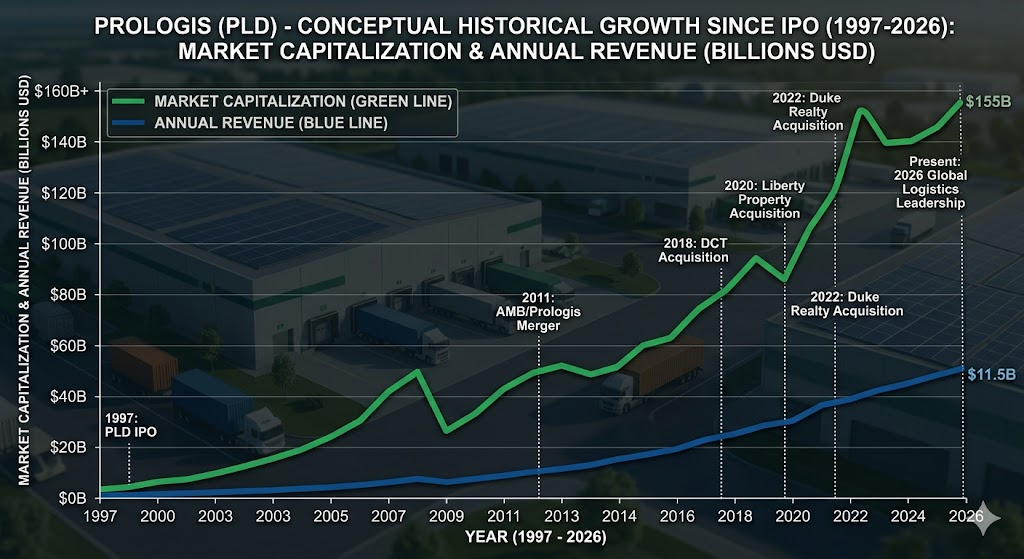
The company’s roots trace back to AMB Property Corporation, founded in 1983, and Security Capital Industrial Trust (SCI), established in 1991 by Hamid Moghadam and Douglas Abbey. The early strategy focused on acquiring industrial real estate across the United States to build a scalable logistics platform. In 1997, SCI went public on the NYSE and later rebranded as Prologis, marking the beginning of its era as a global logistics developer.
2. Integration and Transformation (2000–2011)
During this period, the company aggressively expanded its global footprint across Europe, Asia, and Latin America. However, the 2008 financial crisis exposed vulnerabilities in its high-leverage model. In 2011, Prologis completed a transformative merger with its long-time rival AMB Property Corporation in a deal valued at 8.7B. This merger cemented the company’s current strategic focus on high-barrier, high-growth hub markets and significantly optimized its organizational and asset structure.
3. Digitalization and Global Leadership (2012–Present)
Following the merger, Prologis entered a phase of rapid growth defined by capital efficiency and technological innovation. Beyond acquiring major logistics portfolios—such as DCT Industrial and Liberty Property Trust in 2019, and Duke Realty in 2022—the company launched Prologis Ventures to invest in supply chain technology and developed the digital platform Prologis Essentials. Today, Prologis has evolved from a traditional real estate landlord into an integrated supply chain infrastructure provider, offering warehouse space, energy solutions, and labor management services.
Prologis, as the global leader in logistics real estate, faces competition primarily from two sectors: industrial REITs and supply chain service providers.
1. Key Competitor Categories
- Industrial REITs (Direct Competitors)These companies compete directly in the development, acquisition, and management of industrial properties, vying for prime logistics hubs and major tenants (e-commerce and 3PL providers):
- Rexford Industrial Realty (REXR): Operates with a strong focus on high-barrier, core markets like Southern California, serving as a formidable regional competitor.
- First Industrial Realty Trust (FR): Specializes in industrial property development and operations, maintaining high operational efficiency with a strong foothold in the U.S. Midwest.
- EastGroup Properties (EGP): Focuses on multi-tenant distribution facilities, with a market footprint and demand profile that partially overlaps with Prologis.
- Terreno Realty (TRNO): Concentrates on high-value, infill industrial assets in major metropolitan areas, favoring a lean portfolio of high-quality properties.
- Industrial Logistics Properties Trust (ILPT): Owns and leases industrial and logistics properties across the United States.
- International and Service-Based Competitors
- GLP (Global Logistic Properties): Headquartered in Singapore, GLP holds immense influence in the Asian and global logistics markets and serves as the primary rival to Prologis’s international expansion.
- CBRE: While CBRE is a real estate services firm rather than a pure-play REIT, its core services in logistics real estate consulting, brokerage, and asset management often overlap with Prologis in market development and tenant acquisition.
2. Competitive Advantages and Market Position
Prologis maintains its lead through several key factors:
- Economies of Scale: Through a consistent M&A strategy—including past acquisitions of DCT Industrial and Liberty Property Trust, as well as the massive 2022 acquisition of Duke Realty—Prologis has established an insurmountable barrier to entry and unmatched capital scale.
- Technological Integration: By investing in supply chain technology through Prologis Ventures and developing digital platforms like Prologis Essentials, the company has pivoted from being a traditional landlord to an integrated supply chain infrastructure provider.
- Strategic Asset Placement: Its steadfast adherence to a “high-barrier, high-growth hub” strategy ensures its portfolio is situated in densely populated metropolitan areas, providing strong pricing power for rents.
3. Current Market Dynamics
As of 2026, the logistics real estate market is in a rebalancing phase. With new supply constrained, market rents are seeing renewed growth. The core competitive advantage for Prologis lies in its strategic focus on automated warehousing, energy solutions, and data center-adjacent logistics, which provides superior resilience against inflation and supply chain volatility compared to traditional industrial property owners.
Source:
- https://www.prologis.com/
- https://www.prologis.com/about/company-history
- https://www.youtube.com/watch?v=ffFPSjzzJbc
Back to Prologics page