
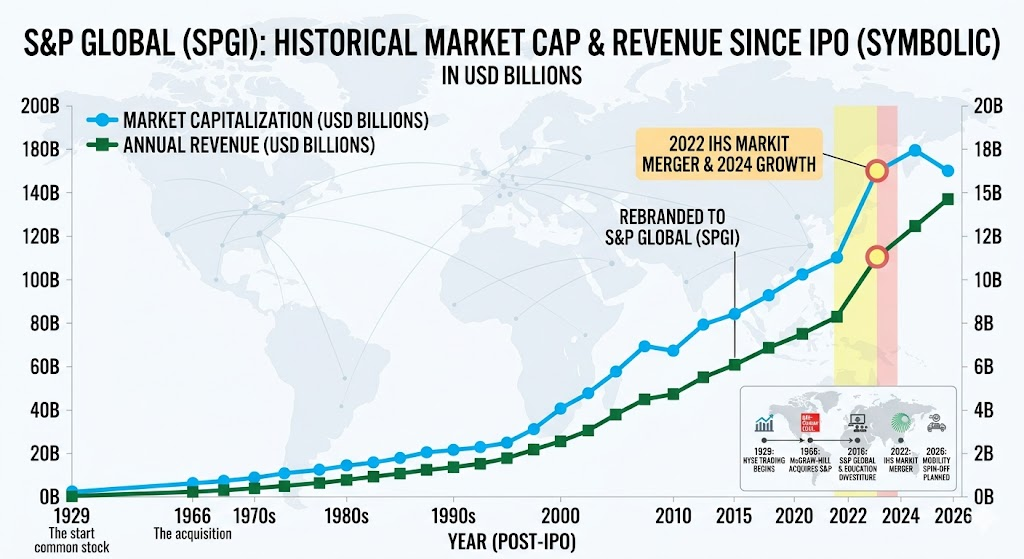
The history of S&P Global (SPGI) is a transformation from specialized publishing to a global financial infrastructure giant. Its evolution can be categorized into four distinct phases:
1. Foundation and Origins (1860s–1900s)
The company roots trace back to two pioneers of financial transparency:
- Poor’s Publishing: Founded in 1860 by Henry Varnum Poor, it published the History of Railroads and Canals of the United States, providing the first standardized financial reports for investors.
- Standard Statistics Bureau: Established in 1906, this entity focused on providing comprehensive securities data and pioneered credit ratings for corporate bonds.
2. Merger and the Ratings Era (1941–1960s)
- Creation of Standard & Poor’s: In 1941, the two firms merged to form Standard & Poor’s.
- Setting the Standard: Over the following decades, the company established itself as the authority in fixed-income markets. In 1957, it launched the S&P 500, which became the benchmark for the US equity market.
3. Diversification and Expansion (1966–2010s)
- McGraw-Hill Era: In 1966, McGraw-Hill acquired Standard & Poor’s, integrating its financial intelligence with educational and professional publishing.
- Strategic Growth: During this era, the company pivoted toward high-value data and analytics, including the acquisition of Platts, which solidified its dominance in the energy and commodity information space.
4. Rebranding and Fintech Dominance (2016–Present)
- Strategic Pivot: In 2016, the company divested its educational assets and rebranded as S&P Global, focusing exclusively on financial market infrastructure.
- The IHS Markit Merger: In 2022, S&P Global completed a landmark merger with IHS Markit, valued at approximately 44B USD. This deal significantly expanded the company’s capabilities in data analytics, ESG metrics, and complex derivatives, securing its position as a central pillar of the global financial ecosystem.
S&P Global (SPGI) operates in a highly competitive landscape that spans credit ratings, financial data, and market infrastructure. Its competitive dynamics vary significantly across its core business segments:
1. Credit Ratings
The credit ratings industry is an oligopoly characterized by high regulatory barriers to entry.
- Moody’s: The primary direct competitor. Both firms compete heavily on methodology, brand reputation, and global reach.
- Fitch Ratings: The third major pillar of the industry. It competes closely with S&P, particularly in structured finance and sovereign ratings.
2. Indices and Benchmarks
S&P Dow Jones Indices (S&P DJI) manages benchmarks tied to trillions of dollars in assets.
- MSCI: The most formidable competitor in global equity indices, factor investing, and ESG/climate analytics. It is the primary rival for asset manager licensing deals.
- LSEG (FTSE Russell): A significant competitor in global benchmarks, challenging S&P’s dominance in international equity markets.
3. Market Intelligence and Data
This segment faces intense competition from established incumbents and specialized providers.
- Bloomberg: The dominant force in real-time terminals, news, and financial workflows. It remains the most significant competitor to S&P’s overall market intelligence dominance.
- LSEG (Refinitiv): A major rival in data feeds, desktop analytics, and financial workflow solutions.
- FactSet: Focuses heavily on buy-side workflows, modeling, and deep data integration, directly competing with S&P Capital IQ Pro.
4. Commodity Insights
S&P Global Commodity Insights (Platts) is a leader in energy and commodity pricing, but faces niche competition.
- Argus Media, Wood Mackenzie, and ICIS: These firms maintain deep vertical expertise in oil, gas, metals, and supply chain logistics, often winning out with specialized local coverage and long-term contracts.
5. Emerging Threats and Disruptors
- AI-Native Fintechs: Companies like AlphaSense and Tegus utilize machine learning to extract insights from unstructured data, challenging the speed and efficiency of traditional research providers.
- Exchange Operators: Organizations like Intercontinental Exchange (ICE) are rapidly expanding into data and index businesses, effectively evolving into vertically integrated competitors that threaten S&P’s pricing power.
Competitive Moat
Despite this landscape, S&P Global maintains a significant lead due to:
- Regulatory Barriers: The “Big Three” ratings agencies benefit from deeply entrenched regulatory recognition (NRSRO), creating a massive barrier for new entrants.
- Network Effects: The S&P 500 is the industry standard for US equities, creating deep-rooted ecosystem dependency.
- Platform Integration: Following the acquisition of IHS Markit, S&P has created a “one-stop-shop” for debt, equity, commodity, and automotive data. This integration increases user switching costs and provides significant cross-selling opportunities across its entire suite of products.
Source:
- https://www.spglobal.com/en/
- https://www.moodys.com/
- https://www.fitchratings.com/
- https://www.msci.com/
- https://www.lseg.com/
- https://www.bloomberg.com/
- https://www.factset.com/
- https://www.argusmedia.com/
- https://www.woodmac.com/
- https://www.icis.com/
- https://www.theice.com/
Bakc to S&P page