
Stryker (SYK) released its Q1 2026 earnings report on April 30, 2026. Here is the summary:
Q1 2026 Earnings Summary
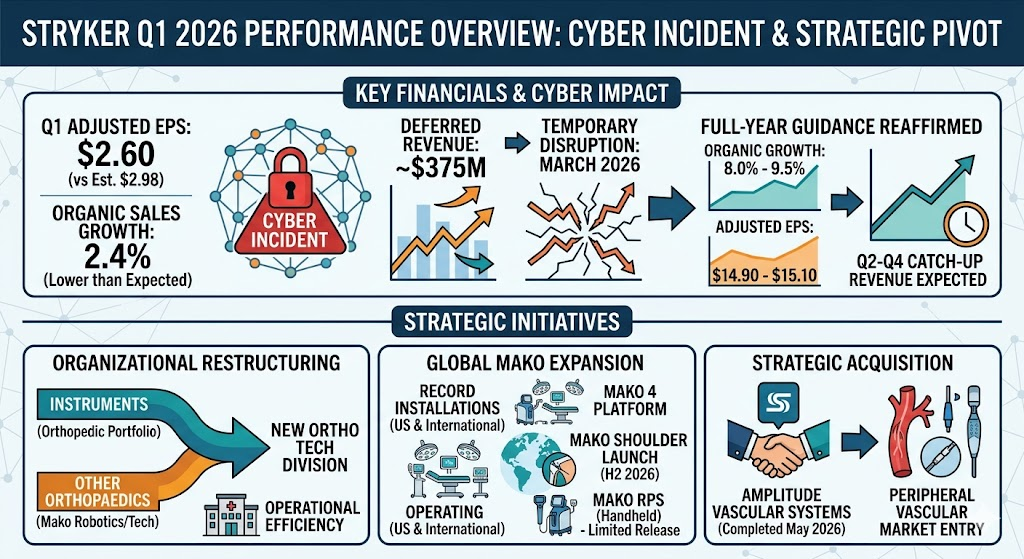
- Revenue and EPS: Both figures were impacted by a cybersecurity incident, leading to distorted financial results for the quarter. Reported EPS was $2.60, missing market expectations by 12.75%.
- Operational Impact: The cybersecurity incident caused disruption to business operations, resulting in the reported financial deviations.
- Full-Year Outlook: Despite the Q1 disruption, the company reaffirmed its full-year guidance. It expects organic sales growth to remain between 8% and 9.5%, and full-year EPS to be in the range of $14.90 to $15.10.
- Market Data (Reference): As of the latest data, Stryker’s TTM (Trailing Twelve Months) EPS is $8.73, with a P/E ratio of approximately 36.83x and an ROE of 15.1%.
The most significant development for Stryker in Q1 2026 was the global operational disruption caused by a major cybersecurity incident in March. Below is a summary of the key changes and their impacts:
1. Operational Disruption (Cybersecurity Incident)
- Operational Shutdown: The incident caused a roughly three-week halt in Stryker’s global manufacturing network, severely impacting order processing, product manufacturing, and logistics.
- Financial Impact: The incident resulted in approximately 375M USD of deferred or lost revenue, causing organic revenue growth for the quarter to reach only 2.4%, significantly below market expectations.
- Performance Distortion: Adjusted EPS was 2.60 USD, down 8.5% year-over-year and missing Wall Street estimates of 2.98 USD by approximately 12.75%.
- Recovery: The company confirmed that its global manufacturing network was fully operational as of the week of April 1.
2. Organizational Restructuring
- Formation of Ortho Tech: During this quarter, Stryker announced an organizational realignment. It merged the orthopedic instrument portfolio from the former “Instruments” segment with the Mako robotics and related technology platforms from “Other Orthopaedics” to create a new Ortho Tech division.
- Purpose: The move is intended to simplify the customer experience and accelerate the speed to market for innovative products. The financial reporting for previous periods has been restated to reflect this new structure.
3. Future Outlook and Guidance
- Reaffirmed Full-Year Guidance: Despite the setback in Q1, management expressed strong confidence, maintaining the full-year 2026 outlook:
- Organic Revenue Growth: Maintained at 8% to 9.5%.
- Adjusted EPS: Maintained at 14.90 USD to 15.10 USD.
- Growth Drivers: The company emphasized that despite the cyber-related disruption, underlying demand remains robust, particularly with the continued high adoption rate of the Mako robotic-assisted surgery platform.
4. Financial Metrics and Efficiency
- Margin Pressure: Due to lost manufacturing absorption caused by the production shutdown and other factors such as tariffs, the adjusted gross margin declined by 190 basis points (to 63.6%), and the adjusted operating margin declined by 180 basis points (to 21.1%).
Summary: The Q1 earnings report demonstrates Stryker’s resilience; despite a sudden global cyber incident, the company did not lower its annual forecast. The market is now focused on whether the company can successfully recover the lost sales and performance through the fulfillment of backlogged orders in the second quarter.
The cyberattack on Stryker in March 2026 is considered one of the most destructive security incidents in the medical device industry. Below are the core details and impacts of the event:
Event Overview
- Date: March 11, 2026.
- Attacker: The hacker group “Handala” (also known as the Handala Hack Team), linked to Iranian intelligence services.
- Methodology: This was a “wiper attack” rather than traditional ransomware. The attackers gained administrator access (via tools like Microsoft Intune) and sent remote commands to force thousands of global endpoints (servers, workstations, laptops, and mobile devices) to factory reset, effectively erasing all data.
- Scope: The impact spanned 79 countries, forcing Stryker’s global manufacturing network to shut down for approximately three weeks, not fully recovering until early April.
Key Technical Vulnerabilities
- Abuse of Management Tools: The hackers did not create custom malware; instead, they weaponized the company’s internal Unified Endpoint Management (UEM) system. This “destruction from within” approach bypassed traditional antivirus and Endpoint Detection and Response (EDR) systems, as the commands originated from trusted, authorized channels.
- Account Compromise: Attackers likely obtained valid employee credentials via infostealer malware, allowing them to infiltrate the company’s Microsoft environment and escalate their privileges to the administrator level.
Operational Impact
- Global Production Halt: Because order processing, manufacturing scheduling, and logistics systems relied heavily on the compromised Microsoft environment, business operations came to a near-standstill.
- Financial Loss: The incident resulted in approximately 375M USD of deferred or lost revenue, limiting organic revenue growth for Q1 to 2.4%.
- Equipment and Personnel: Reports indicate approximately 40,000 laptops were compromised, with internal access and work devices wiped for employees worldwide.
- Impact on Patients: While Stryker emphasized that the medical devices themselves (e.g., surgical robots, implants) were not directly affected, the supply chain and order system disruption led some hospitals to take precautionary measures, indirectly affecting surgical scheduling.
Recovery and Lessons Learned
- Recovery Status: Stryker restored its global manufacturing network by the first week of April and emphasized that underlying product demand remained intact despite the disruption.
- Security Review: The event highlights the double-edged sword of relying on centralized management platforms. Security experts note that companies must strengthen “Least Privilege” access, strictly enforce multi-factor authentication, and implement behavioral monitoring and anomaly detection specifically for these high-risk management tools.
Stryker’s growth momentum for the upcoming quarter (Q2 2026) and the remainder of the year relies heavily on operational recovery following the cybersecurity incident and the continued dominance of its surgical robotics and M&A strategy. Here are the key drivers:
1. Revenue Catch-up from Cyber Recovery
- Fulfillment of Backlogs: The production shutdown and logistics disruptions in Q1 caused approximately 375M USD of revenue to be deferred. Management has clearly indicated that Q2 will serve as a “catch-up” period, where these delayed orders and backlogged surgical procedures are fulfilled and recognized.
- Resilience of Demand: With global manufacturing and ordering systems fully restored as of early April, Stryker expects to recover most of the revenue lost in Q1 over the coming quarters. This recovery is the foundation for the company’s decision to maintain its full-year organic growth guidance of 8% to 9.5%.
2. Market Expansion of Mako Robotics
- Record Installs: Despite the Q1 cyber disruption, Mako surgical robot installations hit an all-time high in both US and international markets, demonstrating extremely robust underlying demand.
- Portfolio Expansion:
- Mako Shoulder: Set for a full release on the Mako 4 platform in the second half of the year, further expanding its influence in the shoulder arthroplasty market.
- Mako RPS (Handheld Robotics): This handheld robotic system has entered limited market release, designed to attract surgeons who prefer the tactile feel of handheld tools but still desire robotic precision, thereby broadening the addressable surgeon base.
3. Synergies from “Ortho Tech” Restructuring
- The new Ortho Tech division, created through this quarter’s realignment, consolidates orthopedic instruments with Mako robotics. This move is expected to simplify the procurement and training process for clinicians and accelerate the time-to-market for innovative product upgrades, enhancing cross-selling capabilities and product line stickiness.
4. Strategic M&A
- Amplitude Vascular Systems: Stryker completed the acquisition of Amplitude Vascular Systems in May 2026. This acquisition not only strengthens its peripheral vascular portfolio but also adds momentum to the company’s long-term expansion into cardiovascular markets.
- Financial Flexibility: With net leverage remaining at a healthy level (approximately 2.1x), Stryker maintains the financial flexibility to continue capital deployment for further acquisitions in high-growth segments.
Summary
Market focus on Stryker has shifted from the Q1 “cybersecurity disaster” to the “speed of recovery” in Q2. As long as manufacturing and supply chains remain stable, Stryker is well-positioned to demonstrate a significant rebound in Q2, fueled by its dominant position in orthopedic robotics (with over 75% market share) and the persistent demand for elective surgical procedures.
Stryker’s (SYK) EPS trajectory over the next year is anchored in its commitment to recover from the Q1 2026 operational disruptions while capitalizing on its core growth drivers.
1. 2026 Full-Year EPS Outlook
- Management Guidance: Stryker has reaffirmed its full-year 2026 adjusted EPS guidance of $14.90 to $15.10.
- Operational Recovery: While the Q1 adjusted EPS of $2.60 fell short of expectations (impacted by lost manufacturing absorption from the cyber incident and tariff headwinds), the company expects most of the lost Q1 sales to be recovered in the second, third, and fourth quarters.
- Market Consensus: Analysts largely view the Q1 miss as a temporary hurdle rather than a structural issue. The company’s underlying business momentum—particularly in Mako robotics and joint replacement—remains robust, supporting the firm’s confidence in meeting its annual targets.
2. 2027 EPS Growth Expectations
- Projected Growth: Financial forecasts for 2027 indicate a significant year-over-year rebound and growth, with analysts projecting EPS to reach approximately $16.57. This represents an expected annual growth rate of roughly 11% to 16% moving into 2027.
- Key Drivers for Upside:
- Robotics Momentum: Continued record installations of the Mako system provide a high-margin recurring revenue stream through implants and consumables.
- New Product Cycles: The upcoming full launch of Mako Shoulder on the Mako 4 platform and the limited release of Mako RPS (handheld robotics) are expected to expand Stryker’s total addressable market and surgical volume.
- Strategic M&A: The recent acquisition of Amplitude Vascular Systems is expected to contribute to earnings by expanding Stryker’s reach into peripheral and cardiovascular markets, diversifying its revenue base beyond orthopedics.
- Organizational Efficiency: The newly formed Ortho Tech division is designed to streamline R&D and sales, potentially improving operating margins as the company scales its innovative technology suite.
3. Summary of Key Financial Metrics
| Metric | 2026 Guidance/Forecast | 2027 Forecast |
| Adjusted EPS | $14.90 – $15.10 | ~$16.57 |
| Organic Sales Growth | 8.0% – 9.5% | Anticipated sustained growth |
Conclusion:
Despite the short-term earnings “miss” in Q1 2026, the long-term EPS trajectory remains positive. The market is closely watching the company’s ability to execute its “catch-up” plan in Q2. If Stryker successfully delivers on its backlogged orders and maintains its dominant market share in surgical robotics, the company is well-positioned to meet its 2026 guidance and drive double-digit earnings growth into 2027.
1. Market Sentiment and Price Target
The consensus on Wall Street remains bullish, despite the short-term noise from the Q1 2026 cyber incident.
- Current Price: ~$316.48 (as of May 22, 2026).
- Consensus Analyst Target: The average price target is approximately $390 – $397, suggesting a potential upside of roughly 23–25% from current levels.
- Analyst Ratings: The sentiment is overwhelmingly positive, with a consensus “Buy” rating. Approximately 75% of analysts maintain Buy or Strong Buy ratings, with zero “Sell” recommendations.
2. Bull Case (Upside Drivers)
- Revenue “Catch-up”: The cyberattack in March caused ~$375M in deferred revenue. Management has confirmed that manufacturing is fully restored and expects these delayed orders to be recognized in Q2–Q4 2026. This “catch-up” effect is the primary driver for meeting the maintained full-year guidance.
- Mako Robotics Dominance: Stryker’s Mako platform continues to post record installation numbers. Given its >75% market share in orthopedic robotics, this creates a “moat” and ensures a long-term, high-margin stream of revenue from surgical consumables.
- Operational Resilience: Stryker’s ability to maintain its full-year guidance ($14.90–$15.10 adjusted EPS) despite a global cyber disruption demonstrates significant operational discipline and demand elasticity in the medical device market.
- Strategic Growth: The creation of the Ortho Tech division and the acquisition of Amplitude Vascular Systems signal a clear strategy to streamline innovation and expand into broader, high-growth cardiovascular markets.
3. Bear Case (Downside Risks)
- Valuation Premium: Stryker trades at a higher P/E ratio (~34x) compared to the broader medical equipment industry average (~24x). Critics argue this premium requires flawless execution; any further quarterly misses or supply chain hiccups could trigger a valuation contraction.
- Execution Risk: If the “catch-up” revenue does not materialize as expected in Q2 or if the organizational restructuring of the Ortho Tech division faces integration hurdles, investors may grow impatient, leading to short-term volatility.
- Macro/Geopolitical Headwinds: Persistent inflationary pressures on input costs and ongoing global tariff headwinds remain a margin risk, as noted in recent earnings transcripts.
4. Expert Investment Perspective
Stryker is currently in a “prove-it” phase. The stock is trading below its 2025 all-time highs and some analyst targets, which creates a potentially attractive entry point for long-term investors who believe in the company’s structural growth.
- Strategy: Many institutional investors view the current price as a consolidation phase. If you are a long-term investor, the fundamentals—specifically the robust procedure demand and the Mako ecosystem—remain intact.
- Recommendation: Consider a differentiated entry. Given the potential for short-term volatility based on Q2 earnings results, scaling into a position rather than deploying all capital at once allows you to manage the risk of further quarterly fluctuations.
Disclaimer: This analysis is based on available market data and research as of May 24, 2026. It is for informational purposes only and does not constitute financial or investment advice. Always conduct your own due diligence or consult with a qualified financial advisor before making investment decisions.
Source:
- https://statementdog.com/analysis/SYK
- https://www.cmoney.tw/notes/note-detail.aspx?nid=1179586
- https://www.coalitioninc.com/blog/security-labs/how-infostealers-may-have-opened-door-stryker-wipe
- https://krebsonsecurity.com/2026/03/iran-backed-hackers-claim-wiper-attack-on-medtech-firm-stryker/
- https://s22.q4cdn.com/857738142/files/doc_financials/2026/q1/Q1-26-Earnings-Press-Release.pdf
Back to Stryker page