
The history of Welltower (formerly Health Care REIT) can be categorized into the following four key phases:
1. Foundation and Early Expansion (1970 – Late 1980s)
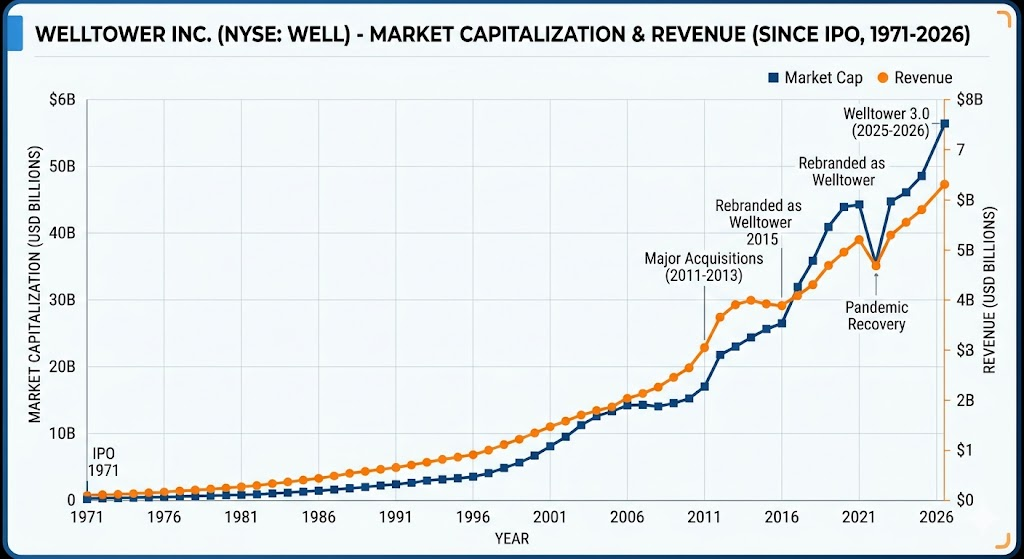
- Founded in 1970 by Fritz Wolfe in Lima, Ohio, as Health Care Fund, it was one of the first REITs dedicated to healthcare real estate.
- The company completed its IPO in 1971, establishing a capital base for growth.
- In 1985, it was renamed Health Care REIT and relocated its headquarters to Toledo the following year. This period focused on acquiring medical and rehabilitation facilities to build foundational influence in the sector.
2. Strategic Pivot and Diversification (1990s – 2014)
- Recognizing the growing demand for senior housing due to demographic shifts, the company began shifting its investment focus toward the senior housing sector starting in the 1990s.
- In the 2010s, the company adopted an aggressive acquisition strategy, including the 2.4B acquisition of Genesis HealthCare assets in 2011 and the 4.3B acquisition of the majority of Sunrise Senior Living’s real estate in 2013, securing its market position in large urban markets and high-end care facilities.
3. Rebranding and Evolution into an Investment Platform (2015 – 2024)
- In September 2015, the company officially rebranded as Welltower Inc., signaling a transition beyond traditional nursing homes toward broader healthcare infrastructure.
- During this phase, the company engaged in international M&A and joint ventures (notably with CPPIB), expanding its footprint into Canada and the United Kingdom.
- During the pandemic (2020), the company demonstrated strong capital resilience, employing both defensive and offensive maneuvers—such as non-core asset divestitures and balance sheet strengthening—to navigate market volatility.
4. Welltower 3.0: The Tech-Driven Operating Era (2025 – Present)
- Welltower 3.0 was launched, marking a shift toward an “operations and technology” core.
- The company heavily invested in the “Welltower Business System (WBS),” aiming to enhance resident experience and staff efficiency through digital innovation in senior housing.
- This period is defined by high-value transactions, such as the 2025 acquisition of Amica Senior Lifestyles and the acquisition of assets from Barchester Healthcare and HC-One in the UK, totaling approximately 6.4B GBP. These moves established Welltower as the largest investor in nursing homes in the UK and solidified its leadership as a pure-play senior housing platform.
Welltower holds a leading position in the healthcare REIT (Real Estate Investment Trust) industry. Its competitive landscape can be analyzed through its core competitors and market differentiation strategies.
Major Competitors
Welltower’s primary competitors are other large healthcare REITs, each with different focuses in asset allocation, operational priorities, and market positioning:
- Ventas (VTR): Welltower’s most direct competitor. It has a highly similar business model, possessing a vast portfolio of senior housing and medical office assets. Its strength lies in diversified asset allocation, including research facilities and post-acute care.
- Healthpeak Properties (DOC): Its strategy leans more toward life science laboratories and medical office buildings (MOB). Recent shifts have made it more focused on assets highly relevant to healthcare systems, with lower overlap with Welltower in the housing sector.
- Other Market Participants: This includes companies focused on specific care types, such as CareTrust REIT (CTRE), National Health Investors (NHI), and Omega Healthcare Investors (OHI). These companies are generally smaller but possess deep-rooted advantages in skilled nursing or specific regional markets.
Core Differentiation Strategies (Welltower’s Competitive Advantages)
Welltower’s ability to maintain high market valuation and growth over the long term stems primarily from the following strategies:
- Welltower 3.0 and Digital Transformation: Unlike companies acting merely as landlords, Welltower utilizes the Welltower Business System (WBS) to deeply engage with data and operational management. By digitizing property performance, staff efficiency, and resident experiences, it has created a significantly higher competitive moat.
- Focus on Premium Assets: Welltower tends to invest in high-growth, high-barrier-to-entry urban markets, targeting the needs of high-net-worth seniors. This ensures revenue stability superior to competitors focused on low-to-mid-tier care facilities.
- Strategic M&A and Capital Deployment: Welltower has demonstrated exceptional execution in mergers and acquisitions, particularly with large-scale acquisitions of nursing homes in the UK and North America over the past two years. This has placed it significantly ahead in economies of scale and allowed it to effectively leverage global capital markets for expansion.
- Integration of Operating Platforms: Welltower does not merely hold assets; it actively builds deep partnerships with top-tier operators. Through this “real estate + operations” synergy, the company can more flexibly respond to market shifts driven by aging demographics.
Competition Summary Table
| Competitor | Core Strength | Market Positioning Difference |
| Welltower (WELL) | Scale, data-driven management, premium housing | Global leader in operations and technology integration |
| Ventas (VTR) | Diversification, operational insight platform | Broad and balanced healthcare real estate investment |
| Healthpeak (DOC) | Life science labs, MOB specialization | Focused on medical discovery and delivery spaces |
| Specialized Nursing REITs | Niche market returns, high dividends | Specialized portfolios focused on long-term care assets |
In summary, Welltower is currently attempting to define itself as a “healthcare infrastructure technology platform,” which gives it a significant edge over traditional competitors who rely solely on rental income models.
Sources:
- https://welltower.com/
- https://welltower.com/investors/
- https://www.reit.com/
- https://www.sec.gov/edgar/searchedgar/companysearch.html
Back to Welltower page