
Lockheed Martin reported its first quarter 2026 financial results on April 23, 2026. The company experienced a slight quarterly miss on revenue and earnings due to near-term operational headwinds and unfavorable profit adjustments, causing a short-term stock correction. However, management reaffirmed its full-year guidance and highlighted robust demand across its portfolio.
Core Financial Metrics
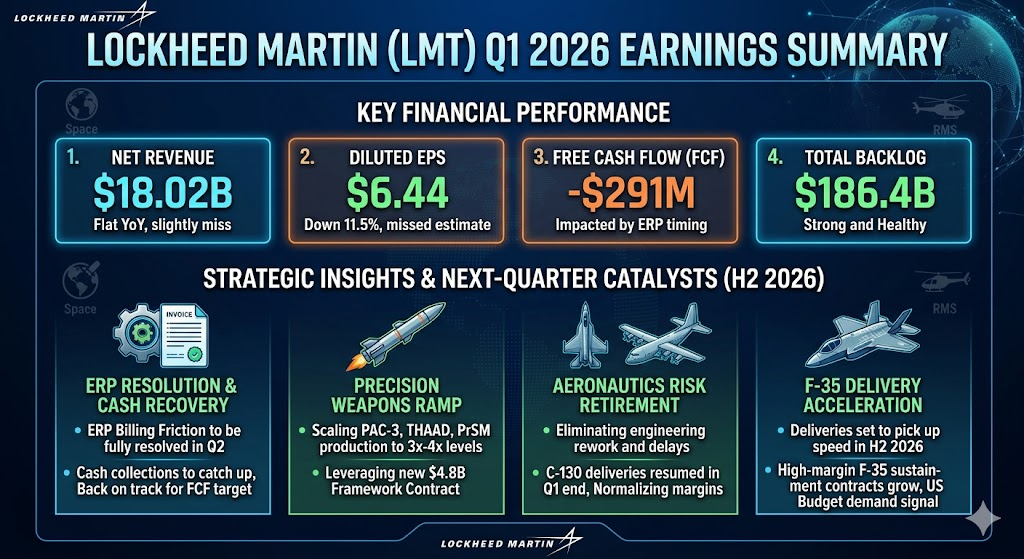
- Net Revenue: 18.02B, roughly flat year-over-year (up 0.30%), missing the consensus estimate of 18.25B.
- Diluted EPS: $6.44, down 11.5% compared to $7.28 in Q1 2025, falling below the market expectation of $6.74.
- Net Earnings: $1.5B, down from $1.7B in the prior-year period.
- Free Cash Flow (FCF): Turned negative at -$291M (compared to positive $955M in Q1 2025), primarily impacted by the timing of billing activities and working capital outflows related to a new ERP system implementation.
- Backlog: Total backlog remained healthy at 186.4B, providing long-term revenue visibility.
Business Segment Performance
- Missiles and Fire Control (MFC): The strongest performer of the quarter. Sales increased 8% to 3.65B, and operating profit rose 8% to $500M, driven by production ramps for the Patriot missile defense system (PAC-3) and tactical weapon programs (JASSM and PrSM). The segment also secured a major 4.8B fully-funded PAC-3 contract.
- Space: Sales grew 7% to 3.43B, supported by higher volumes on Fleet Ballistic Missile and Next Generation Interceptor programs. However, segment operating profit fell 26% to $281M due to the absence of one-time favorable commercial civil space milestones recorded in Q1 2025.
- Aeronautics: Revenue edged down 1% to 6.95B. Operating profit decreased 14% to $619M due to $125M and $55M in unfavorable profit adjustments stemming from production performance delays on the F-16 and delivery delays on the C-130. F-35 deliveries dropped to 32 aircraft from 47 a year ago.
- Rotary and Mission Systems (RMS): Sales dropped 8% to 3.99B, and operating profit fell 19% to $423M, affected by lower Sikorsky helicopter and radar volumes alongside unfavorable adjustments on the CH-53K and Seahawk programs.
Full-Year 2026 Guidance Reaffirmed
Management categorized the Q1 headwinds as temporary timing issues and confidently maintained its previous full-year outlook, expecting a significant step-up in performance during the second half of the year:
- Net Sales: 77.5B to 80.0B (reflecting ~5% year-over-year growth).
- Diluted EPS: $29.35 to $30.25.
- Free Cash Flow: 6.5B to 6.8B.
- Production Scaling: Production acceleration is underway via framework agreements to increase the output of Patriot missiles, THAAD interceptors, and Precision Strike Missiles by three to four times current rates.
Lockheed Martin highlighted several structural, operational, and strategic shifts during its Q1 2026 earnings conference call that will shape its performance moving forward:
1. Innovative Risk-Sharing “Framework Agreements”
To meet the urgent defense demands of the U.S. government and international allies without repeating past fixed-price losses, CEO Jim Taiclet announced new seven-year framework agreements with the DoD. These contain rare risk-mitigation clauses:
- Inflation Protection & Advance Payments: These ensure that the company remains cash-flow neutral during major manufacturing capacity build-outs.
- Clawback & Exit Protections: If government priorities shift or procurement slows down in the future, Lockheed is contractually protected against stranded capital investments. This marks a significant business model shift toward de-risking defense aerospace manufacturing.
2. Multi-Fold Scaling of Precision Munitions and Air Defense
The Missiles and Fire Control (MFC) segment has officially become the company’s core growth engine, driven by aggressive capacity expansion:
- The segment secured a massive 4.8B fully-funded contract to accelerate PAC-3 missile production.
- Management confirmed that production rates for Patriot (PAC-3), THAAD, and Precision Strike Missiles (PrSM) are being scaled to 3x or 4x current levels across more than 20 production facilities. For instance, the PAC-3 production target is climbing from roughly 650 missiles per year to 2,000.
3. Turbulence and Transitions in Core Aircraft Programs
Aeronautics operating margin compression reflected near-term transition pains across different airframes:
- F-35 Lightning II: Deliveries fell to 32 aircraft from 47 in Q1 2025. However, this volume decline was heavily offset by a 325M increase in high-margin F-35 sustainment contracts. Long-term demand also gained visibility as the U.S. FY2027 budget request raised F-35 procurement from 47 back to 85 aircraft.
- F-16 and C-130 Programs: Design, development, and engineering rework delayed F-16 deliveries, resulting in zero deliveries this quarter (compared to 4 in Q1 2025). This, combined with C-130 integration challenges, led to unfavorable profit adjustments of 125M and 55M respectively. On the commercial front, Lockheed successfully closed a 1.5B Direct Commercial Sale (DCS) for 12 new F-16 Block 70 aircraft for the Peruvian Air Force.
4. Deployment of the Centralized Lockheed Martin AI Center
The company made distinct progress in hardware-software integration by establishing a centralized, air-gapped AI Center:
- The facility operates with dedicated GPU compute infrastructure and sovereign datasets, allowing AI workloads to run directly inside highly classified environments.
- Management clarified that Lockheed’s focus is on “applying” rather than “developing” foundational large models. AI is currently being deployed in internal business systems (ERP, supply chain, defect detection) and operational defense applications (automated target recognition, tactical battle management).
5. Relief on Major Classified Program Risks
Over the past few quarters, investors were highly concerned that two large classified programs in the Aeronautics and Missiles segments could face massive fixed-price cost overruns. The CEO explicitly reassured the market that no losses or impairments were recorded on these classified programs this quarter. Government funding remains strong, and ongoing contract restructurings have significantly increased management’s execution confidence.
Lockheed Martin clearly signaled during its Q1 2026 earnings conference call that the quarter’s softer financial metrics were driven by temporary timing shifts and working capital fluctuations. Management expects results to rebound starting in Q2, with significant acceleration throughout the second half of 2026 (H2).
The following are the core growth engines and catalysts driving next quarter and the remainder of the year:
1. V-Shaped Free Cash Flow Recovery and ERP Resolution
- Growth Driver: Free Cash Flow (FCF) unexpectedly turned negative at -$291M in Q1. This was primarily due to a temporary billing and invoicing disruption caused by an ERP enterprise system implementation at a major business unit, coupled with standard working capital payment timing.
- Expected Timeline: CFO Evan Scott confirmed that the ERP billing friction is a known, transient issue that will be fully resolved during the second quarter (Q2). This will trigger a concentrated catch-up in cash collections alongside scheduled deliveries, putting the company back on track to achieve its full-year FCF guidance of 6.5B to 6.8B.
2. Milestone Achievements in Precision Weapons and Air Defense
- Growth Driver: The Missiles and Fire Control (MFC) segment is currently the company’s highest-demand and fastest-growing business, having already generated 8% revenue growth in Q1 backed by demand for PAC-3, JASSM, LRASM, and Precision Strike Missiles (PrSM).
- Expected Timeline: Management emphasized that major capacity expansions will begin transitioning into revenue over the coming quarters as several key manufacturing milestones are reached. Specifically, the upfront work and early deliveries for the newly signed 4.8B unpriced PAC-3 expansion contract (which includes 2.2B in contract actions for 2026) will scale up meaningfully in the upcoming quarters.
3. Acceleration of F-35 Deliveries and High-Margin Sustainment Inflow
- Growth Driver: F-35 deliveries dropped to 32 aircraft in Q1 compared to 47 in the prior-year period. However, high-margin F-35 sustainment and logistics contracts increased by 325M in Q1, providing a strong margin buffer.
- Expected Timeline: F-35 delivery velocity is projected to accelerate sharply in the back half of the year as supply chain bottlenecks ease and upgraded hardware-software integrations hit the line. Long-term demand signals also improved dramatically as the U.S. FY2027 budget request expanded F-35 procurement back up to 85 aircraft from the previously planned 47.
4. “Risk Retirement” and Profitability Restoration in Aeronautics
- Growth Driver: The Aeronautics segment’s operating margin was compressed in Q1 by 180M in unfavorable profit adjustments tied to F-16 engineering delays and C-130 supply chain constraints, resulting in zero F-16 deliveries during the quarter.
- Expected Timeline: Management confirmed that C-130 tactical transport deliveries officially resumed at the very end of Q1, which will directly lift Q2 segment results. Furthermore, as F-16 engineering rework and technical risks are progressively retired over the next few quarters, the margin headwinds experienced in Q1 will dissipate, enabling a return to normalized margin expansion.
5. Revenue Contribution from Major International Defense Wins
- Growth Driver: Supplementing its massive backlog, Lockheed successfully closed a landmark 1.5B Direct Commercial Sale (DCS) with the Peruvian Air Force for 12 new F-16 Block 70 aircraft just prior to the earnings release.
- Expected Timeline: This major new award, along with a potential follow-on option for a second squadron of 12 additional aircraft, will enter the supply chain procurement and early-stage revenue recognition phases over the next few quarters, injecting new medium-to-long term momentum into the Aeronautics portfolio.
In short, Lockheed Martin views 2026 as a heavily “back-half loaded” year. With the Q1 trough behind it, operational performance is set to enter an upward trajectory starting in Q2 as ERP billing normalizes and aircraft deliveries pick up speed.
During the Q1 2026 earnings conference call, Lockheed Martin (LMT) outlined a clear “back-half loaded” trajectory for its Earnings Per Share (EPS) over the next twelve months (spanning the remainder of 2026 through Q1 2027).
While the Q1 EPS of $6.44 was a near-term miss, both corporate guidance and Wall Street consensus indicate that EPS will steadily step higher quarter-over-quarter as operational headwinds clear and manufacturing capacity scales up.
1. Full-Year 2026 EPS Guidance
Despite the softer start to the year, management firmly reaffirmed its full-year EPS guidance range:
- Official EPS Guidance: $29.35 to $30.25.
- Wall Street Consensus: Currently clustering between $29.42 and $29.88.
- Implied Growth Rate: Compared to the lower baseline of $21.56 in full-year 2025, this represents a massive 36% to 40% rebound in profitability. This recovery is driven by the resolution of one-time charges and heavily concentrated production deliveries in the second half of the year.
2. Next Four Quarters EPS Path (Market Consensus)
Because the 180M in profit adjustments and the ERP billing delays in Q1 were categorized as transient timing issues, quarterly EPS is projected to follow an ascending step-like pattern over the coming year:
- Q2 2026 (Est. Late July): $7.21. EPS begins to bottom out and rebound as ERP billing normalizes and C-130 cargo aircraft deliveries resume.
- Q3 2026 (Est. October): $7.33. Profitability benefits from the initial manufacturing ramp of precision weapons (PAC-3, THAAD) and steady high-margin F-35 sustainment contract revenue.
- Q4 2026 (Est. January 2027): $8.02. The traditional peak defense delivery and billing quarter, coinciding with newly expanded production lines reaching optimized run-rates, making it the highest-earning quarter of the year.
- Q1 2027 (Long-term Projection): $6.40. Standard seasonal deceleration compared to Q4, though underlying supply chain conditions are modeled to be structurally smoother than in early 2026.
3. Long-Term 2027 EPS Outlook
Wall Street analysts project that once Lockheed Martin completes its aggressive capital deployment phase in 2026—which includes expanding capacity across more than 20 separate production facilities—the company’s earnings power will sustain its upward momentum into 2027:
- Full-Year 2027 EPS Consensus: Projected to climb an additional 7.76% to $32.20.
- Long-Term Compound Annual Growth Rate (CAGR): Driven by broad global defense budget expansions and multi-fold production increases in Patriot and THAAD interceptors, Lockheed’s long-term EPS CAGR is expected to hover at a healthy 12% to 13% over the next three years.
4. Key Factors Influencing the EPS Trajectory
To ensure EPS hits these targeted growth milestones over the next year, analysts are monitoring three operational execution variables:
- Risk Retirement on F-16 and C-130 Programs: Eliminating design rework costs on the F-16 and sustaining the newly resumed C-130 delivery schedule to recover segment operating margins.
- F-35 Delivery Cadence: Ensuring the updated hardware and software integration flows seamlessly through the assembly lines to hit volume delivery targets in H2.
- Supply Chain Volume Readiness: Verifying that sub-tier suppliers—particularly solid rocket motor manufacturers—can keep pace with Lockheed’s aggressive capacity ramp (such as scaling PAC-3 output toward 2,000 units annually).
From an institutional investment and risk-reward perspective, Lockheed Martin (LMT) is presenting a compelling asymmetrical setup following its post-earnings correction. Currently trading around the 516 to 522 range—down from its March peak near 676—the stock has significantly de-risked. Wall Street maintains a consensus Hold (Neutral) posture, yet the implied financial trajectory suggests a strong bottoming pattern.
Here is the structured institutional appraisal of LMT’s potential upside and downside over the next 12 months:
Potential Upside Target
- Consensus Target Price: Around 630 to 637, implying an immediate 18% to 23% upside from current levels.
- Bull Case Target Price (High Estimate): 700 to 756 (maintained by bullish firms like Susquehanna), representing a 34% to 45% potential upside.
- Intrinsic Value (DCF-Based): Multi-stage Discounted Cash Flow models project a conservative fair value near 675, showing that the current market price trades at a steep 22.9% discount to its fundamental cash-generating capability.
Core Catalysts for Upside (The Bull Case):
- The Structural Capacity Boom: Geopolitical defense procurement is no longer speculative; it is moving into the execution phase. LMT is overhauling 20+ production facilities to scale Patriot (PAC-3) and THAAD interceptors by 3x to 4x. This shift is backed by a fresh 4.8B fully-funded framework contract that guarantees robust top-line realization through late 2026.
- Margin De-risking via Invoicing Innovation: The newly instituted 7-year framework agreements with the DoD introduce rare margin-protection features, including inflation-pass-through adjustments and clawback protections against stranded capital expenditures. This shifts the defense manufacturing paradigm from a high-risk fixed-price structure to a highly predictable, protected baseline.
- F-35 Demand Re-acceleration: While Q1 delivery volumes dipped, high-margin sustainment and logistics contracts spiked by 325M. Long-term tailwinds are solidified by the U.S. FY2027 budget request, which expands F-35 procurement volume targets from 47 back up to 85 aircraft.
Potential Downside Risk
- Consensus Downside Support (Low Estimate): 511 to 515 (supported by conservative adjustments from RBC Capital and Bernstein SocGen).
- Extreme Downside Stress Test Range: 430 to 460 (observed only under assumptions of permanent systemic supply chain failure or sudden global defense budget contractions).
- Current Downside Protection: LMT’s trading price sits directly on top of the absolute lowest Wall Street targets (511). This indicates that the near-term downside risk is structurally capped at a mere -1% to -3%, exhibiting exceptional fundamental support.
Core Variables for Downside (The Bear Case):
- Upstream Supply Chain Friction: Shifting precision missile production to 300% or 400% capacity places extreme strain on sub-tier suppliers. Any localized disruption in solid rocket motors or raw energetic materials will delay deliveries and defer revenue recognition into late 2027.
- Extended Engineering Rework Costs: The 180M in unfavorable adjustments in Q1 from F-16 engineering delays and C-130 supply constraints compressed margins. Although C-130 shipments resumed at the end of the quarter, any persistent labor or design rework extending through Q2 will push out the expected margin recovery curve.
- Working Capital Volatility: The temporary FCF drop (-291M) stemming from an ERP billing system implementation must clear out in Q2. If this administrative friction lingers into Q3, institutional investors will question management’s ability to hit the full-year FCF target of 6.5B to 6.8B.
Institutional Investment Summary
Lockheed Martin presents a classic asymmetric Negative News Priced In, Back-Half Loaded Growth) thesis. The operational and invoicing mishaps of Q1 have been thoroughly digested and cleared out via the recent 22% stock pullback.
Given that corporate leadership firmly re-anchored full-year EPS guidance at 29.35 to 30.25—implying a steep step-up in sequential earnings power over the next three quarters—the downside is tightly bounded near current pricing. For mid-to-long term portfolios, entering at this cyclical trough to capture a highly visible 20%+ upside offers an incredibly strong risk-reward ratio.
Source:
- https://www.prnewswire.com/news-releases/lockheed-martin-reports-first-quarter-2026-financial-results-302750718.html
- https://ca.investing.com/news/company-news/lockheed-martin-corp-lmt-q1-2026-earnings-call-highlights-navigating-challenges-with–4584900
- https://qz.com/lockheed-martin-q1-2026-earnings-f16-c130-delays-042326
- https://simplywall.st/stocks/us/capital-goods/nyse-lmt/lockheed-martin/news/lockheed-martin-lmt-margin-compression-in-q1-2026-tests-bull
Back to Lockheed Martin page