
Foundational Era (1956–1970s)
The roots of TJX trace back to 1956 when cousins Stanley and Sumner Feldberg founded the Zayre discount department store chain. In 1976, Zayre hired Bernard Cammarata (who became the first CEO of TJX) to launch a new off-price chain called T.J. Maxx in Massachusetts. This innovative concept proved highly successful and rapidly expanded across the eastern United States.
Corporate Transformation and Aggressive Acquisition (1980s–1990s)
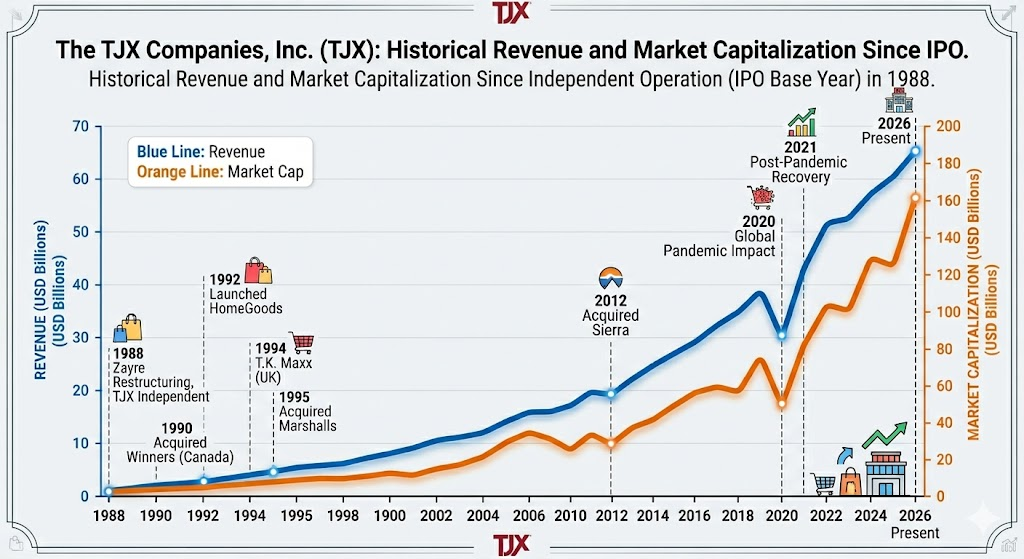
In 1988, Zayre underwent a major corporate restructuring, selling its core Zayre nameplates and renaming the remaining entity The TJX Companies, Inc. The 1990s marked a period of explosive growth and consolidation:
- 1990: Acquired Canadian chain Winners, marking its first international expansion.
- 1992: Launched HomeGoods, expanding its off-price expertise into home furnishings.
- 1994: Entered Europe by opening T.K. Maxx in the UK, slightly modifying the name to avoid confusion with an existing British retailer.
- 1995: Acquired its chief rival, Marshalls, which solidified TJX as the undisputed leader in the US off-price apparel market.
Brand Diversification and Global Footprint (2000s–2010s)
During this era, TJX continuously diversified its portfolio and expanded its geographic reach:
- 2001: Launched the Homesense brand in Canada, later bringing it to Europe in 2007 and the US in 2017.
- 2012: Acquired off-price outdoor gear and apparel retailer Sierra Trading Post (now branded as Sierra).
- 2015: Acquired Australian retailer Trade Secret and converted the stores into T.K. Maxx, establishing a foothold in the Asia-Pacific region.
Modern Retail Leadership and Resilience (2020s–Present)
Despite the rise of e-commerce and the unprecedented disruptions of the global pandemic, TJX demonstrated incredible resilience. Its “treasure hunt” physical shopping experience, paired with an agile supply chain, shielded the company from broader brick-and-mortar declines. Today, TJX operates over 4900 stores globally and generates more than 50B in annual revenue, maintaining its position as the premier global leader in the off-price sector.
Core Competitors and Market Positioning
The TJX Companies, Inc. operates as the global titan of the off-price retail sector. Its competitive landscape comprises direct off-price peers, traditional department stores, and e-commerce giants.
- Ross Stores (ROST): As the second-largest off-price retailer in the US (operating Ross Dress for Less and dd’s DISCOUNTS), Ross targets a more budget-conscious, lower-income demographic compared to TJX. Ross features a more standardized and no-frills store layout. TJX differentiates itself by offering a more upscale, designer-forward brand assortment, alongside an expansive international presence in Europe and Australia.
- Burlington Stores (BURL): Formerly Burlington Coat Factory, this company has successfully pivoted into a pure-play off-price model. Although smaller in scale than TJX and Ross, Burlington has driven strong comparable store sales by shrinking store footprints, upgrading supply chain vendor relations, and accelerating inventory turnover.
- Traditional Department Stores (e.g., Macy’s, Kohl’s, Nordstrom Rack): Traditional department stores act as both a primary source of inventory (via closeouts) and direct competitors. Due to rigid pricing and slow supply chains, full-line department stores have consistently lost market share to TJX. In response, premium retailers leverage sub-brands like Nordstrom Rack to compete directly in the off-price arena.
- Amazon and E-Commerce: While e-commerce dominates many retail sectors, apparel and home decor remain highly experiential. TJX’s unique “treasure hunt” model—where inventory changes constantly and items are available in limited quantities—creates an urgency to buy that is difficult to replicate online, effectively insulating the company from digital disruption.
TJX’s Core Competitive Advantages
- Unmatched Global Vendor Network: TJX maintains relationships with a vast network of over 21000 vendors worldwide. When manufacturers overproduce, department stores cancel orders, or seasons change, TJX stands as the preferred clearinghouse. Its massive liquidity, willingness to buy in bulk, and policy of not demanding marketing allowances or return privileges make it a highly attractive partner for top-tier brands.
- Agile Supply Chain and Flexible Buying: Unlike conventional retailers that plan inventory months or seasons in advance, TJX buyers shop the market year-round. This opportunistic buying allows them to react instantly to shifting fashion trends and acquire premium merchandise at deep discounts, keeping store inventory fresh and fast-moving.
- Flexible Store Layouts: TJX locations do not utilize rigid, permanent department walls or fixed vendor boutiques. Almost all fixtures and racks are on wheels, allowing store managers to expand or contract sections (such as expanding home goods or shrinking footwear) depending on weekly delivery patterns and local demand, maximizing sales per square foot.
- Recession-Resilient Business Model: TJX exhibits strong performance across all economic cycles. During economic expansions, consumers visit TJX to find high-end designer brands at a discount. During economic downturns or periods of high inflation, middle-class shoppers pull back on discretionary spending at department stores and trade down to off-price retailers, sustaining TJX’s robust customer traffic.
Source:
- https://www.tjx.com/
- https://investor.tjx.com/
- https://www.tjx.com/investors/financial-information/annual-report
- https://www.tjx.com/docs/default-source/investor-docs/quarterly-results/tjx-fiscal-year-2026-form-10-K.pdf
Back to TJX page