
Below is the PepsiCo Q1 2026 earnings summary:
Q1 2026 Earnings Summary: PepsiCo (PEP)
PepsiCo delivered a robust performance in its latest earnings report released in mid-April 2026. Both revenue and profits exceeded analyst expectations, highlighted by a critical volume recovery in its North American snack business (Frito-Lay).
Core Financial Metrics
- Net Revenue: 19.44B (YoY +8.5%), surpassing the market expectation of 18.94B.
- Core EPS: 1.61 (YoY +9%), outperforming the anticipated 1.55.
- Organic Revenue Growth: 2.6%.
- Operating Profit: 3.3B (YoY +16.4%); Operating Margin increased from 15.8% to 17.0% compared to the same period last year.
Segment Performance
- Frito-Lay North America (FLNA):
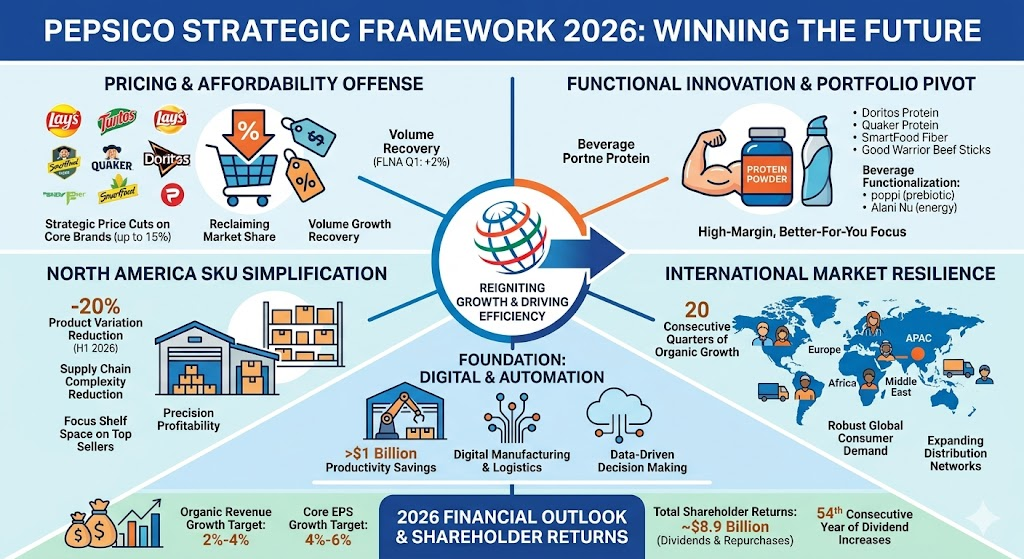
- Volume growth of 2%, marking the first positive turn in over two years.
- This was driven by strategic price adjustments on core brands like Lay’s and Doritos (with price cuts up to 15%), successfully securing more shelf space in retail channels.
- PepsiCo Beverages North America (PBNA):
- Net revenue grew by 9%, with 7% attributed to acquisitions and partner brands (such as poppi prebiotic soda and Alani Nu energy drinks).
- Excluding the impact of the water business transition, volume remained largely flat.
- International Markets:
- Food volume grew by 9% across Asia Pacific, Europe, Middle East, and Africa.
- CEO Ramon Laguarta noted that global consumer demand remains steady despite ongoing geopolitical tensions in the Middle East.
Outlook and Shareholder Returns
- 2026 Guidance: Maintained full-year organic revenue growth targets of 2%-4% and Core EPS growth expectations of 4%-6%.
- Shareholder Returns: Planned return of approximately 8.9B to shareholders in 2026 (comprising 7.9B in cash dividends and 1B in share repurchases).
- Dividend Hike: Announced an increase in the annual dividend from 5.69 to 5.92, marking the 54th consecutive year of dividend increases.
Key Strategic Trends
- Pricing Pivot: Shifting from “price-driven growth” to “price adjustments and promotions” to combat consumer fatigue and reclaim market share.
- Product Innovation: Increased investment in functional foods and beverages (e.g., Quaker Protein Crisps, energy drinks) and SKU simplification in North America (planned 20% reduction in H1) to optimize supply chain efficiency.
Based on PepsiCo’s Q1 2026 earnings report and conference call, this quarter demonstrated a significant shift in operational strategy, centered on the following four core changes:
1. Pricing Strategy Pivot: From “Cost Pass-Through” to “Growth Reignition”
This represents the most critical strategic adjustment this quarter. For the past two years, PepsiCo relied on aggressive price hikes to counter inflation, which led to volume erosion. This quarter, the company initiated a Pricing Reset:
- Strategic Price Cuts: Implemented price reductions or increased promotional activities for core North American brands (such as Lay’s and Doritos), with some items seeing price drops of up to 15%.
- Results: Frito-Lay North America (FLNA) successfully reversed its volume decline to achieve 2% growth, indicating high consumer price sensitivity and PepsiCo’s decision to prioritize regaining market share over pure margin expansion.
2. Massive Simplification of North American Supply Chain and Product Lines
PepsiCo is undertaking its largest SKU (Stock Keeping Unit) optimization in recent years:
- SKU Simplification: The CEO noted an expected 20% reduction in product varieties within the North American market during the first half of 2026.
- Objective: By removing low-volume, low-margin products, the company aims to reduce supply chain complexity and warehousing costs while allowing retailers to focus shelf space on top-selling items. This marks a shift from “diversified expansion” toward “precision profitability.”
3. “Functionalization” and “Externalization” of the Beverage Portfolio
The growth structure of PepsiCo Beverages North America (PBNA) has undergone a fundamental change:
- De-emphasizing Traditional Bottled Water: To optimize profitability, PepsiCo actively reduced the promotion of low-margin bottled water and traditional mass-market carbonated drinks.
- Embracing Partner Brands: The primary driver of revenue growth came from acquisitions or the distribution of functional beverages, such as poppi (prebiotic soda) and Alani Nu (energy drinks). This shows PepsiCo transitioning into a more agile distribution platform, leveraging its robust logistics network to scale third-party brands that align with health trends, rather than relying solely on the Pepsi trademark.
4. Investment in Digitalization and Automation
The company emphasized automation investments within Frito-Lay’s manufacturing during this quarter. By utilizing digital management systems, PepsiCo automated logistics operations that had become complex due to increased promotional activity. This efficiency was a key factor in boosting the Operating Margin to 17.0% this quarter.
According to PepsiCo’s latest earnings report released in April 2026 and its 2026 strategic roadmap, the growth momentum for the upcoming quarter (Q2 2026, results expected in July) and beyond will be primarily driven by a dual-engine strategy of Affordability and Functional Innovation.
Here is the analysis of key growth drivers:
1. Volume Recovery Driven by “Pricing Reset”
PepsiCo has positioned 2026 as the year of “The Affordability Offense.”
- Core Brand Reshaping: Continuing the Q1 price reduction strategy for core brands like Lay’s and Doritos. Larger-scale marketing campaigns are expected in Q2 to ensure that volume growth trends persist in the North American market, moving away from a reliance on price hikes.
- Capturing Shelf Share: By enhancing price competitiveness, the goal is to reclaim market share from smaller competitors and private labels (store brands).
2. Explosion of Functional Nutrition and Protein Products
PepsiCo is aggressively shifting its product mix from “mass snacks” to “functional nutrition,” which will serve as a high-margin revenue source in the coming quarter:
- Good Warrior Brand: The grass-fed beef sticks (Good Warrior Beef Sticks) launched in March 2026 will achieve full distribution in Q2, targeting the high-growth meat snack market.
- Protein-Enhanced Series: A suite of “fortified” new products, including Doritos Protein, Quaker Protein (cereal bars and oats), and SmartFood Fiber, will enter their peak sales season.
- Functional Beverages: Leveraging poppi (prebiotic soda) and new functional waters under the Gatorade umbrella (such as Propel Clear Protein) to accelerate penetration during the summer peak season.
3. Resilience in International Markets
International markets have delivered mid-single-digit organic growth or higher for 20 consecutive quarters, and they remain a core driver for the next quarter:
- APAC and Middle East Markets: Despite geopolitical volatility, PepsiCo’s performance in the Asia-Pacific food sector remains strong. Management expects further room for growth in per capita consumption in developing countries and will continue to expand distribution networks.
4. Margin Expansion through Digitalization and Cost Optimization
- SKU Simplification Results: The company expects to cut 20% of low-efficiency product items (SKUs) in the first half of 2026. The margin contribution from this simplification is expected to be more pronounced in Q2, helping to offset gross margin pressure from price cuts.
- Digital Manufacturing: Through automated logistics and production systems, the company expects to achieve over 1B in productivity savings for the full year of 2026.
5. Shareholder Returns and Valuation Support
- Dividend Hike: The dividend payment in June 2026 will officially apply the new increased rate (annualized at 5.92), providing stable support for the stock price at the end of Q2.
- Share Repurchases: The planned 1B share buyback program for 2026 will continue, helping to sustain Earnings Per Share (EPS) growth.
Summary of Financial Guidance
PepsiCo maintains its full-year 2026 targets:
- Organic Revenue Growth: 2%-4%
- Core Constant Currency EPS Growth: 4%-6%
- Expected Q2 EPS (Zacks Estimate): 2.20 (higher than the previous estimate of 2.17), reflecting market optimism regarding the transformation results.
Based on the latest market data and analyst forecasts as of May 2026, PepsiCo (PEP) is expected to maintain a steady growth trajectory in its Earnings Per Share (EPS) over the coming year. Following a period of stabilized earnings in 2025, the company anticipates that volume recovery driven by “pricing adjustments” will propel profit growth back onto its historical track in 2026.
Below is the specific EPS trend forecast for the upcoming year:
1. 2026 Full-Year Earnings Targets and Market Expectations
- Company Guidance: PepsiCo has maintained its target for 2026 full-year core constant currency EPS growth of 4%-6%. This translates to an expected core EPS range between 8.47 and 8.63.
- Analyst Consensus: Wall Street analysts (per Zacks and Seeking Alpha data) are currently more optimistic, projecting a full-year 2026 EPS of 8.63 to 8.66, representing a year-over-year growth rate of approximately 6%.
2. Quarterly Estimates for the Next Four Quarters
Analysts expect EPS to strengthen sequentially, aligned with the seasonal peak for beverages in Q2 and Q3:
- Q2 2026 (Expected July): 2.20 to 2.22 (compared to 2.12 in the same period last year).
- Q3 2026 (Expected October): Approximately 2.43.
- Q4 2026 (Expected February 2027): Above 2.30.
- Full-Year 2027 Outlook: Preliminary consensus suggests EPS will further grow to 9.17 in 2027, maintaining a year-over-year growth rate of about 6.2%.
3. Key Drivers Influencing EPS Trends
- Volume Inflection Point: Frito-Lay North America volume turned positive in Q1 2026. If volume continues to recover in the second half of the year following price cuts, it will be the primary factor for an EPS beat.
- Support from Share Repurchases: The Board has authorized a long-term 10B share buyback program, with 1B expected to be executed in 2026. This directly reduces the outstanding share count, thereby boosting EPS.
- Productivity Savings: Through supply chain automation and SKU simplification, the company expects to save over 1B in costs for the full year. This is crucial to offsetting margin pressure from the “pricing reset.”
4. Investment Risks and Headwinds
- Currency Headwinds: The company expects foreign exchange fluctuations to have a negative impact of approximately 0.5% on net revenue and EPS in 2026.
- Inflationary Resilience: Although PepsiCo has hedging mechanisms in place (6-12 months for raw materials), persistent increases in labor and certain commodity costs could constrain profit growth.
Source:
- https://www.fool.com/earnings/call-transcripts/2026/04/16/pepsico-pep-q1-2026-earnings-call-transcript/
- https://www.tikr.com/blog/pepsico-q1-2026-earnings-what-19-4b-in-revenue-means-for-the-investment-case/
- https://seekingalpha.com/news/4575257-pepsico-q1-earnings-in-focus-amid-pricing-reset
- https://www.pepsico.com/investors
- https://www.marketbeat.com/instant-alerts/zacks-research-estimates-pepsicos-q2-earnings-nasdaqpep-2026-05-01/
- https://simplywall.st/community/narratives/us/food-beverage-tobacco/nasdaq-pep/pepsico/bn0bpc0a-pepsico-inc-pep-the-strategy-reset-and-the-fy2026-innovation-pivot
- https://www.zacks.com/stock/quote/PEP/detailed-earning-estimates
- https://simplywall.st/stocks/us/food-beverage-tobacco/nasdaq-pep/pepsico/future
- https://seekingalpha.com/symbol/PEP/earnings/estimates
- https://www.marketbeat.com/instant-alerts/filing-maxi-investments-cy-ltd-invests-235-million-in-pepsico-inc-pep-2026-05-08/
Back to Pepsico page