
Morgan Stanley (MS) released its first quarter 2026 financial results on April 15, 2026. The performance for this quarter was exceptional, with both revenue and earnings reaching record highs and significantly exceeding market expectations.
The following is a summary of the core financial highlights:
Core Financial Data
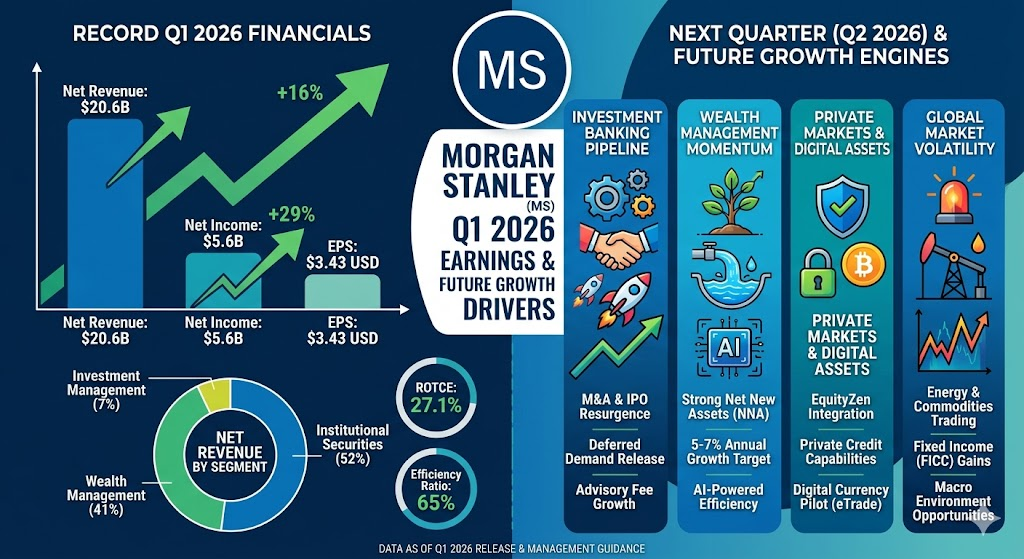
- Net Revenue: 20.6B, a 16% increase compared to 17.7B in the same period last year.
- Net Income: 5.6B, compared to 4.3B in the same period last year, representing a 29% year-over-year growth.
- Diluted Earnings Per Share (EPS): 3.43 USD, surpassing last year’s 2.60 USD and exceeding market expectations of 3.02 to 3.09 USD.
- Return on Average Tangible Common Equity (ROTCE): 27.1%, demonstrating very strong performance.
- Efficiency Ratio: 65%, indicating effective operating leverage management.
Business Segment Performance
- Institutional Securities: Revenue reached 10.7B, a record for this department. Investment banking revenue grew by 36%, while both equity and fixed income trading revenues grew by over 20%.
- Wealth Management: Revenue reached a record high of 8.5B. Net New Assets (NNA) for the quarter reached a massive 118B, with fee-based asset flows at 54B. The pre-tax profit margin for the segment was 30.4%.
- Investment Management: Revenue was 1.5B, primarily driven by management fee income from increased Assets Under Management (AUM). As of quarter-end, total AUM was approximately 1.87 trillion USD.
Shareholder Returns and Capital Position
- Dividend Distribution: The Board of Directors announced a quarterly dividend of 1.00 USD per share.
- Share Repurchases: The company repurchased approximately 1.75B of common stock during the quarter.
- Capital Adequacy: The Standardized CET1 capital ratio stood at 15.1%.
Future Outlook and Developments
CEO Ted Pick stated that the record-breaking performance was fueled by strong global client engagement and increased market activity. The company also announced the launch of a digital asset pilot program (in partnership with Zero Hash) during the quarter, allowing select eTrade clients to trade digital currencies, and completed the acquisition of Equity Zen to strengthen its private credit capabilities.
Morgan Stanley demonstrated strong growth momentum in the first quarter of 2026. Beyond the record-breaking financial figures, here are the key strategic changes and details worth noting this quarter:
1. Business Structure and Profitability Highlights
- Significant Recovery in Investment Banking: Investment banking revenue increased by 36% year-over-year. The Advisory business performed exceptionally well, with revenue reaching 978 million USD, a 74% increase, signaling a clear resurgence in M&A activity.
- Strong Asset Inflow in Wealth Management: Net New Assets (NNA) reached 118B this quarter. This is a remarkably high growth figure for a single quarter, solidifying the firm’s position as an asset management giant.
- Energy Markets Driving Trading Revenue: Fixed income trading revenue hit a post-financial crisis record, primarily driven by increased activity in energy markets and commodities trading.
2. Operational Efficiency and Personnel Adjustments
- Streamlining for Efficiency: Despite record revenues, the company executed a global workforce reduction of approximately 2%, incurring 178 million USD in severance costs. This move aims to optimize operating leverage and improved the efficiency ratio to 65%.
- Significant ROTCE Improvement: Return on Average Tangible Common Equity (ROTCE) jumped from 23% in the same period last year to 27.1%, reflecting highly efficient capital utilization.
3. Strategic Acquisitions and Technical Layout
- Acquisition of EquityZen: The completion of the acquisition of EquityZen, a secondary market platform for private equity, will further strengthen Morgan Stanley’s capabilities in private credit and alternative investments.
- Digital Asset Pilot: In partnership with Zero Hash, the firm launched a digital currency trading pilot on the eTrade platform, marking a more concrete step into cryptocurrency services.
4. Capital Management and Risk Factors
- Active Capital Returns: In addition to the 1.00 USD quarterly dividend, the company repurchased approximately 10 million shares of common stock, demonstrating confidence in its earning power.
- Potential Challenges: During the earnings call, management noted ongoing pressure on management fees from passive investing and potential increases in compliance costs due to the global regulatory environment, such as the finalization of Basel III.
Based on the first quarter 2026 earnings call and management guidance, Morgan Stanley’s growth momentum for the upcoming quarter (Q2 2026) and the remainder of the year will be driven by the following four primary engines:
1. Release of Deferred Demand in Investment Banking (Pipeline)
- M&A and IPO Resurgence: CEO Ted Pick noted that long-standing pent-up demand for mergers and acquisitions (M&A) is beginning to unlock. With expectations of continued interest rate cuts by the Fed in 2026, the corporate financing environment is improving, resulting in a very robust deal pipeline.
- Advisory Fee Income: The strong momentum in the advisory business, which saw 74% year-over-year growth in Q1, is expected to carry into Q2, particularly regarding consolidation activity in the technology, energy, and biotechnology sectors.
2. Scalable Growth in Wealth Management
- Sustainability of Net New Assets (NNA): Following the impressive 118B in net new assets recorded in Q1, the firm expects to maintain its annual NNA growth target of 5% to 7% throughout 2026.
- Automation and AI Transformation: Morgan Stanley is accelerating the integration of generative AI into its wealth management systems (such as its assistant developed with OpenAI). This is expected to boost profit margins on fee-based assets in the coming quarters by increasing financial advisor efficiency.
3. Private Markets and Digital Asset Positioning
- Private Credit: Following the acquisition of EquityZen, integration synergies are expected to materialize starting in Q2. In an environment where bank lending standards remain relatively tight, the private credit business has become a vital growth point within Institutional Securities and Investment Management.
- Digital Asset Monetization: If the newly launched digital asset pilot program on the eTrade platform expands in Q2, it will introduce new transaction fee revenue for the retail brokerage business.
4. Volatility-Driven Gains from the Macro Environment
- Energy and Commodities: Geopolitical risks and energy transition demands are keeping market volatility elevated. This favors Morgan Stanley’s traditional strength in Fixed Income, Currencies, and Commodities (FICC) trading, with further room for trading gains in energy markets during the second quarter.
General Outlook and Risks
- Earnings Guidance: Analyst estimates for Q2 EPS currently range between 2.63 and 3.14 USD.
- Key Risks: Management cautioned that potential compliance costs from the global regulatory environment (such as the Basel III Endgame) and ongoing fee pressure from passive investment vehicles remain downside factors to monitor in the coming quarters.
Source:
- https://www.morganstanley.com/about-us-ir/shareholder/1q2026.pdf
- https://uk.investing.com/news/transcripts/earnings-call-transcript-morgan-stanley-q1-2026-beats-forecasts-stock-rises-93CH-4610149
- https://ca.investing.com/news/company-news/morgan-stanley-ms-q1-2026-earnings-call-highlights-record-revenues-and-strategic-growth-amid–4567899
- https://admiralmarkets.com/analytics/traders-blog/trading-idea-morgan-stanley-q1-2026-earnings
- https://www.spglobal.com/ratings/en/regulatory/article/credit-trends-global-issuance-forecast-and-financing-conditions-q2-2026-expansion-still-expected-this-year-s101680346
Back to Morgan Stanley page