
Citigroup delivered a strong performance for the first quarter of 2026, marking its best quarterly revenue in a decade. The results highlight the initial success of its organizational restructuring and strategic pivot.
Financial Performance Overview
The bank reported total revenue of 24.6B, representing a 14% increase year over year. Net income rose significantly by 42% to 5.8B, driven by growth across its core franchises. Earnings per share (EPS) reached 3.06, comfortably beating market expectations of 2.63 to 2.67. The Return on Tangible Common Equity (RoTCE) improved to 13.1%, up 400 basis points from the previous year.
Segment Highlights
Growth was broad-based across Citigroup’s specialized business segments:
- Services: This segment was the standout performer with 17% revenue growth, fueled by a 40% increase in custody service mandates.
- Markets: Revenue exceeded 7B for the first time in ten years. Equities revenue surged nearly 40%, supported by strong activity in derivatives and prime brokerage.
- Banking: Investment banking fees increased by 12%, with advisory services hitting record levels and Equity Capital Markets (ECM) revenue growing by over 60%.
- Net Interest Income (NII): Reached 15.7B, a 12% annual increase, reflecting favorable rate contributions across the portfolio.
Efficiency and Capital Management
Citigroup demonstrated positive operating leverage as its efficiency ratio improved to 58.1%, down 410 basis points. While the provision for credit losses rose 26% to 2.8B, non-performing loans (NPLs) actually decreased compared to the previous quarter, suggesting stable credit quality. The bank maintained a healthy CET1 capital ratio of 12.7% and returned 7.4B to shareholders through dividends and share buybacks during the quarter.
Strategic Outlook
CEO Jane Fraser noted that the bank is hitting a “critical mass” in its transformation efforts. The company is maintaining its full-year 2026 RoTCE target of 10-11%. Key priorities moving forward include continuing the divestiture of non-core international markets—such as Russia and Mexico (Banamex)—and accelerating the integration of AI to further streamline operations and reduce structural costs.
Based on Citigroup’s 1Q26 financial results, several critical structural and operational shifts indicate that the bank’s multi-year transformation is reaching a turning point:
1. Positive Operating Leverage and Efficiency Gains
The most significant change this quarter is the achievement of positive operating leverage. Revenue grew by 14% while expense growth remained disciplined, driving the efficiency ratio down to 58.1% (a 410 bps improvement YoY). This suggests that the organizational simplification and headcount reductions initiated over the past year are finally translating into higher profit margins.
2. Shift in Profitability Drivers
While Net Interest Income (NII) remained a steady contributor with 12% growth, the real catalyst this quarter was the surge in non-interest income. The Services and Markets segments, historically seen as stable anchors, delivered their best quarterly revenues in a decade. Specifically, a 40% jump in custody mandates and a surge in equity derivatives trading pushed the Return on Tangible Common Equity (RoTCE) to a robust 13.1%.
3. Strong Recovery in Investment Banking
Following a prolonged period of market dormancy, Citigroup’s Banking division saw a sharp rebound. Equity Capital Markets (ECM) revenue skyrocketed by over 60% year over year, and advisory fees reached record levels. This indicates that Citi is successfully regaining market share in corporate financing and high-value transaction counseling.
4. Resilience in Credit Quality and Capital Return
The bank demonstrated a high capacity for capital return, distributing 7.4B to shareholders via dividends and buybacks. Although credit loss provisions were increased to 2.8B as a cautionary measure, the actual volume of non-performing loans (NPLs) declined. This suggests that the underlying asset quality is holding up better than anticipated despite the volatile interest rate environment.
5. Accelerated International Divestiture
Management reiterated its commitment to exiting non-core retail markets. The separation and potential IPO of Banamex in Mexico, alongside the exit from Poland, are moving at an accelerated pace. This reflects a strategic pivot toward high-margin institutional clients and wealth management, moving away from capital-intensive retail operations in secondary markets.
These developments collectively signal that Citigroup is transitioning from a “restructuring phase” into a “growth phase,” effectively leveraging market volatility to raise its overall earnings ceiling.
Looking ahead to the second quarter of 2026 (2Q26) and beyond, Citigroup’s growth momentum is shifting from “organizational restructuring” toward “core business expansion” and “operational harvest.” Here are the four primary engines expected to drive growth in the coming quarter:
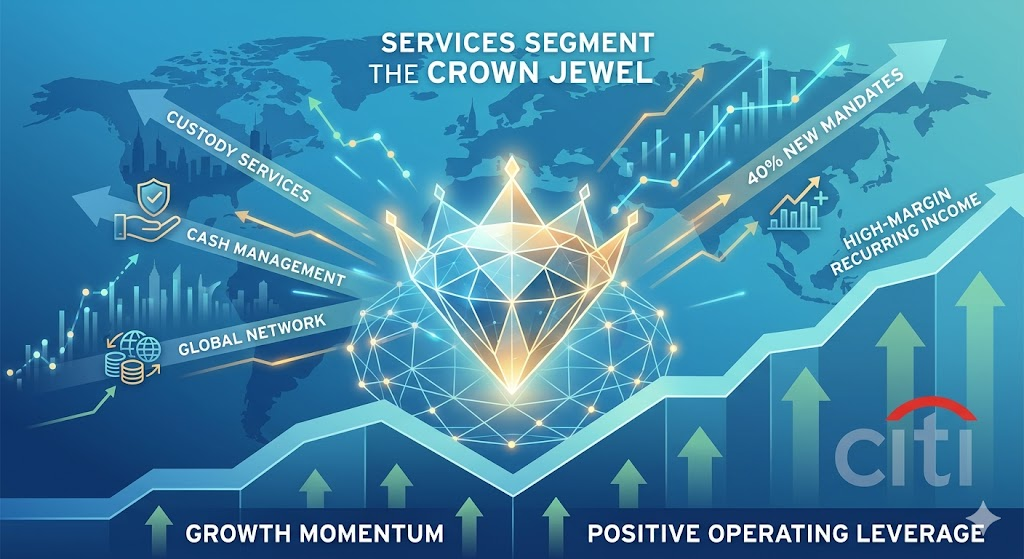
1. The “Crown Jewel” Effect of Services
The Services segment has emerged as Citi’s most consistent profit engine. Growth in the next quarter is expected to be fueled by:
- Onboarding of New Mandates: The 40% surge in new custody service mandates recorded in 1Q26 will begin to materialize into realized revenue throughout the next few quarters.
- Cross-border Network Advantage: As global supply chains continue to realign, demand for Citi’s multinational corporate services remains high, providing high-margin recurring income.
2. Investment Banking Pipeline Recovery
Following a strong rebound in 1Q26, the Banking division carries significant momentum into the next quarter:
- Deal Closures: Benefit from a record backlog in M&A advisory and the momentum from a 60% increase in Equity Capital Markets (ECM) revenue. As market sentiment stabilizes, the execution of these deals will drive higher fee income.
- Improved Agility: Management has noted that the simplified organizational structure allows banking teams to respond faster to client needs, which is expected to result in further market share gains.
3. Wealth Management Transformation
The Wealth division is undergoing a recovery in profitability following its recent restructuring:
- Portfolio Shifts: Wealth revenue grew by 11% in the first quarter. For 2Q26, the bank anticipates increased client demand for US large-cap equities, high-quality fixed income, and gold, which should drive Assets Under Management (AUM) and advisory fees.
- AI Integration: Citi is moving into a critical phase of AI deployment, aiming to enhance advisor productivity and lower structural costs, with the impact expected to become more visible in the upcoming quarter.
4. Expense Reduction and Operating Leverage
- Declining Severance Costs: 1Q26 results included approximately 500M in restructuring and severance charges. As the heavy lifting of the reorganization concludes, these one-time expenses are expected to drop significantly in the next quarter.
- Structural Savings: The firm is trending toward its full-year RoTCE target of 10-11%. Maintaining positive operating leverage—where revenue growth outpaces expense growth—will be the key catalyst for elevating the earnings ceiling.
Potential Risks to Monitor
While the momentum is strong, several factors could impact performance:
- Credit Card Delinquencies: The 26% YoY increase in credit loss provisions, primarily from the US consumer card business, warrants close attention to see how inflation or labor market shifts affect credit quality.
- Geopolitical Headwinds: The pace of divesting non-core markets like Russia and Poland may still be influenced by geopolitical volatility, potentially affecting the timing of capital releases.
Based on analyst projections and recent financial trends, Citigroup’s earnings per share (EPS) are expected to enter a phase of “stable growth and structural optimization” over the next year.
The following analysis outlines the anticipated trajectory of Citi’s EPS:
EPS Forecast Figures
- 2026 Full-Year Outlook: The current market consensus expects Citigroup to deliver a full-year EPS of approximately 10.86.
- Growth Rate: Analysts project a compound annual growth rate (CAGR) for EPS of roughly 14.9% over the next three years, which outpaces many of its large-cap peers.
- Quarterly Trends: Following the stronger-than-expected 3.06 in the first quarter, the second quarter estimate sits around 2.64, accounting for seasonal adjustments and ongoing transformation costs.
Three Primary Drivers for EPS Upside
- Aggressive Capital Returns: Citigroup returned 7.4B to shareholders in the first quarter through dividends and buybacks. Continuous share repurchases reduce the total share count, which mechanically increases EPS even if net income remains flat.
- Operating Leverage Gains: As the heavy lifting of the restructuring concludes, one-time severance and reorganization expenses are expected to decline sharply. Analysts anticipate Citi’s profit growth to outpace its peers as the efficiency ratio continues to improve toward the bank’s medium-term targets.
- High-Quality Revenue Mix: The increasing contribution from high-margin segments like Services and the recovery in Banking fees provide a higher quality of earnings compared to volatile interest-rate dependent income.
Potential Downside Risks
- Credit Quality Deterioration: Credit loss provisions increased YoY in the first quarter. If persistent inflation or a softening labor market leads to higher-than-expected credit card defaults, Citi may need to divert more earnings to reserves, thereby compressing EPS.
- Macroeconomic Policy: Any sudden shifts in interest rate policy could impact Net Interest Income (NII) growth, which remains a key variable for all major financial institutions in the latter half of 2026.
Overall Market Sentiment
Wall Street remains generally optimistic about Citi’s EPS trajectory. Firms such as Wells Fargo have recently raised their price targets for the stock, citing that the “end-state” profitability of a simplified Citigroup will represent a significant step up from its 2025 performance levels.
Source:
- https://www.citigroup.com/rcs/citigpa/storage/public/Earnings/Q12026/2026psqtr1rslt.pdf
- https://www.investing.com/news/transcripts/earnings-call-transcript-citigroup-q1-2026-sees-strong-earnings-beat-93CH-4613428
- https://www.citigroup.com/rcs/citigpa/storage/public/Earnings/Q12026/2026prqtr1rslt.pdf
- https://www.zacks.com/stock/news/2904644/citigroup-q1-revenues-hit-decade-high-mark-whats-fuelling-growth
- https://www.investing.com/news/analyst-ratings/wells-fargo-raises-citi-stock-price-target-on-restructuring-outlook-93CH-4644219
- https://simplywall.st/stocks/us/banks/nyse-c/citigroup/future
- https://www.zacks.com/stock/news/2897211/insights-into-citigroup-c-q1-wall-street-projections-for-key-metrics
Back to Citigroup page