
ASML Q1 2026 Earnings Summary
ASML reported its first quarter 2026 results on April 15, 2026, delivering a performance that exceeded market expectations and prompted an upward revision of its full-year guidance.
Financial Performance Highlights
- Net Sales: 8.8B EUR, landing within the guided range.
- Net Income: 2.8B EUR.
- Gross Margin: 53.0%, reaching the upper end of the guidance, primarily driven by a more profitable mix in the Installed Base Management business.
- Earnings Per Share (EPS): 7.15 EUR.
Operational and Product Mix
- System Sales: A total of 79 lithography systems were sold during the quarter.
- EUV Dominance: EUV systems accounted for 66% of net system sales, a significant increase from 48% in Q4 2025.
- Installed Base Management: Revenue reached 2.5B EUR, performing better than anticipated.
- Regional Shifts:
- South Korea: Surged to 45% of revenue, becoming the leading market.
- China: Decreased to 19% of revenue, compared to 36% in the previous quarter.
Future Outlook and Guidance
- Full Year 2026: ASML raised its net sales guidance to between 36B EUR and 40B EUR. The annual gross margin is expected to stay between 51% and 53%.
- Q2 2026 Guidance: Net sales are projected to be between 8.4B EUR and 9.0B EUR. The gross margin is expected to normalize slightly to 51%–52% due to a different product mix.
- Capacity Targets: The company aims to deliver at least 60 EUV (Low NA) systems in 2026 and expand capacity to 80 units by 2027.
Market Analysis
While the Q1 earnings beat expectations, investors reacted cautiously to the slightly lower gross margin guidance for Q2. However, management remains highly optimistic about sustained demand driven by AI infrastructure, which is fueling growth across both the Logic and Memory segments.
ASML Q1 2026 Earnings: Key Strategic Shifts
The Q1 2026 results reveal a significant structural transition in ASML business model, characterized by a geographical pivot and a more aggressive focus on High-NA technology.
1. Geographical Pivot: South Korea Surpasses China
The most striking change this quarter is the redistribution of revenue by region, largely driven by the AI memory boom and export restrictions.
- South Korea Surge: Revenue share nearly doubled from 22% in Q4 2025 to 45% this quarter. This shift is fueled by heavy investments from Samsung and SK Hynix in HBM (High Bandwidth Memory) and advanced logic nodes.
- China Contraction: China’s contribution dropped sharply from 36% to 19%. This reflects both the exhaustion of the massive “pre-control” buying spree seen in 2025 and the escalating impact of Dutch and US export licensing requirements.
- Taiwan Stability: Taiwan remains a steady pillar, contributing 23% of revenue.
2. High-Value Product Mix: EUV Dominance
While the total number of units sold (79 systems) was lower than in previous peak quarters, the average selling price and profitability improved.
- EUV Revenue Share: EUV systems now account for 66% of net system sales, up from 48% just one quarter ago. This represents over 4.1B EUR in EUV revenue.
- High-NA Progress: The quarter included the formal revenue recognition of two High-NA EUV systems. These next-generation machines are critical for maintaining gross margins as the industry moves toward sub-2nm processes.
- Installed Base Growth: Service and upgrade revenue reached 2.5B EUR, providing a high-margin buffer that helped push the overall gross margin to 53.0%.
3. Upgraded Full-Year 2026 Outlook
ASML shifted from a “transitional” mindset to a “growth acceleration” stance for the remainder of the year.
- Revenue Guidance Hike: The company raised its full-year net sales forecast to 36B EUR–40B EUR (previously 34B EUR–39B EUR).
- AI as the Primary Catalyst: Management explicitly stated that the recovery in the logic segment and the frantic demand for AI-specific memory are outpacing earlier conservative estimates.
- Capacity Expansion: Plans are now in place to deliver 60 EUV units in 2026 and reach a capacity of 80 units by 2027 to meet the projected 2027-2030 semiconductor cycle.
Market Sentiment and Risks
Despite the strong performance, the market focused on the Q2 2026 gross margin guidance of 51%–52%. This slight sequential dip is attributed to higher operational costs associated with scaling High-NA production and a temporary shift back toward DUV (Deep Ultraviolet) shipments in the coming months.
Based on ASML latest outlook released in mid-April 2026, the growth momentum for the upcoming quarter (Q2 2026) and the remainder of the year will be driven by these three core engines:
1. The “AI Transformation” of the Memory Market
Memory revenue accounted for 51% of total sales this quarter, and this strength is expected to persist into Q2.
- HBM Capacity Expansion: Samsung and SK Hynix are accelerating the expansion of High Bandwidth Memory (HBM) capacity, which requires a high volume of advanced lithography equipment.
- Sold-out Signal: Management noted that major customers have largely sold out their 2026 capacity, prompting them to secure equipment orders early. Order intake is expected to remain at high levels through Q2.
2. Accelerated EUV Deliveries and Product Upgrades
ASML is entering a period of intensive delivery for high-value products.
- Low-NA EUV Ramp-up: The delivery target for 2026 has been raised to over 60 units, up from approximately 48 units in 2025. More EUV systems are expected to complete final acceptance and convert to revenue in Q2.
- High-NA EUV Contributions: The first batch of High-NA EUV systems (priced at over 350M EUR each) has begun processing wafers. While Q2 revenue will still be dominated by standard EUV, the performance data from High-NA systems will dictate the mass production procurement pace for major clients like Intel and TSMC in the second half of 2026.
3. Immersion Equipment Filling the Gap Outside China
While the Chinese market is cooling due to export controls, robust demand from other regions is offsetting the shortfall.
- Advanced Logic and Foundry: Demand for immersion DUV equipment in non-China regions (such as the US, Taiwan, and Europe) is performing better than expected.
- Stable Installed Base Management: ASML expects service revenue to remain steady at around 2.5B EUR in Q2. As global fab utilization rates rise, software upgrades and maintenance services will provide strong cash flow support.
Key Observation: The Revenue vs. Margin “See-saw”
Despite strong growth momentum, investors should note the following financial characteristics for Q2:
- Revenue Forecast: Q2 guidance is set between 8.4B EUR and 9.0B EUR.
- Gross Margin Pressure: Gross margin is expected to dip to 51%–52% (down from 53% in Q1). This is not due to a decline in demand but rather a product mix in Q2 that includes more DUV systems and higher operational expenses as the company prepares for a production surge in the second half of the year.
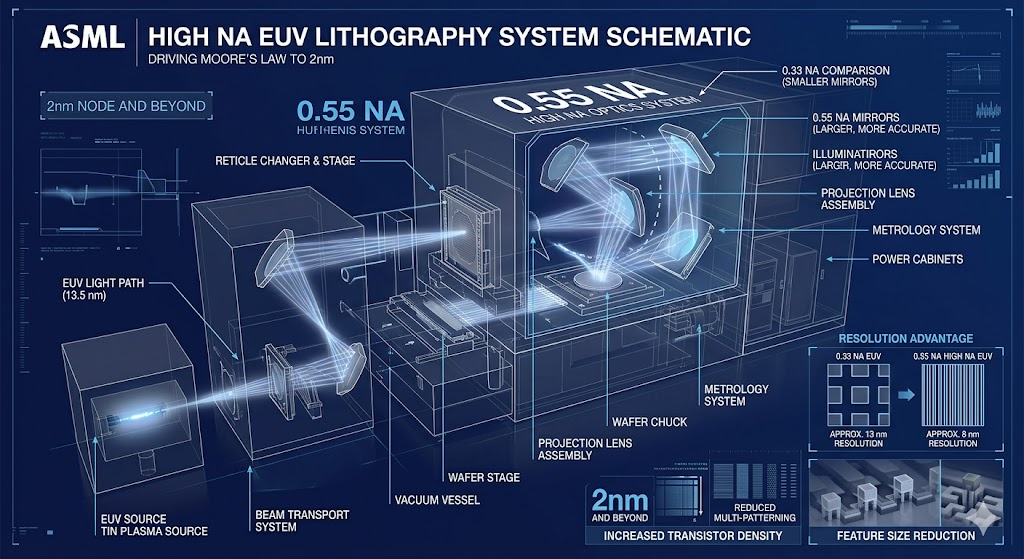
High-NA EUV (High Numerical Aperture) is the next-generation lithography technology that is critical for producing chips at the 2nm node and beyond. While standard (Low-NA) EUV has a numerical aperture of 0.33, High-NA increases this to 0.55, enabling higher resolution and smaller transistor patterns.
Based on the Q1 2026 earnings report and current industry status, here are the key updates regarding High-NA EUV:
1. Revenue and Delivery Progress
- First Revenue Recognized: In Q1 2026, ASML officially recognized revenue for its first High-NA EUV systems. These machines, specifically the Twinscan EXE:5000, carry a price tag of approximately 350M EUR to 380M EUR per unit.
- 2026-2027 Roadmap: ASML plans to deliver around 10 High-NA units in 2026. This is part of a broader target to ship over 60 total EUV units this year, with capacity expected to rise to 80 total EUV units (including High-NA) by 2027.
- Product Evolution: The company is transitioning from the first-gen EXE:5000 to the high-volume manufacturing (HVM) version, the EXE:5200B, which features improved overlay precision and higher throughput (wafers per hour).
2. Adoption Strategies: Intel vs. TSMC
A clear divergence in strategy has emerged among the “Big Three” chipmakers:
- Intel (The Pioneer): Intel is the most aggressive adopter, being the first to receive and install these systems. It plans to use High-NA for its Intel 14A node to gain a competitive edge in “single-patterning” complexity reduction.
- TSMC (The Conservative): TSMC recently confirmed it will rely on standard (Low-NA) EUV with “double-patterning” for its initial 2nm production to manage costs. It views the current price of High-NA as too high and only plans to integrate it when it becomes economically essential, likely around 2027 or for 1.4nm (A14) nodes.
- Samsung and SK Hynix: Both are active in the High-NA roadmap, particularly for next-gen DRAM. SK Hynix is expected to utilize at least two High-NA units for its advanced memory operations by 2027.
3. Key Technical Advantages
- Resolution: Achieves 8nm resolution, allowing features to be printed 1.7 times smaller than current EUV.
- Transistor Density: Enables a 2.9x increase in transistor density compared to the NXE (standard EUV) platform.
- Simplicity: Reduces the need for multiple patterning, which shortens production cycle times and potentially improves yield for extremely complex chip designs.
Financial Impact
Although High-NA represents the future, it is currently a “margin drag” in the short term. The high R&D and initial manufacturing costs are part of why ASML projected a slightly lower gross margin for Q2 2026 (51%–52%). However, as these units move into high-volume delivery in 2027, they are expected to be a massive revenue driver.
Source:
以下是本對話資訊來源的網址連結:
- https://www.asml.com/en/news/press-releases/2026/q1-2026-financial-results
- https://ourbrand.asml.com/asset/d7b914e6-fdd1-4262-b805-d80f3efcb39a/2026_04_15_Presentation-Investor-Relations-Q1-2026.pdf
- https://www.investing.com/news/company-news/asml-q1-2026-slides-strong-results-overshadowed-by-margin-outlook-93CH-4635292
- https://finance.biggo.com/news/WdYllJ0BrdTHlKtCY3-7
- https://www.stocktitan.net/sec-filings/ASML/6-k-asml-holding-nv-current-report-foreign-issuer-728274d6f07a.html
- https://newsroom.intel.com/press-kit/intel-high-na-euv
- https://www.zeiss.com/semiconductor-manufacturing-technology/inspiring-technology/high-na-euv-lithography.html
Back to ASML page