
The history of Allianz Group can be divided into several key strategic phases:
Phase 1: Founding and Early Expansion (1890-1918)
- 1890: Founded by Carl von Thieme and Wilhelm von Finck in Berlin. Initially focused on transport and accident insurance.
- 1893: Opened its first international branch in London.
- 1900: Became a pioneer by introducing engineering insurance.
- 1906: Faced a critical test by providing massive payouts for the San Francisco earthquake, which earned the company global credibility.
Phase 2: Consolidation and Challenges Between Wars (1919-1945)
- 1922: Established Allianz Lebensversicherung (Life Insurance), expanding into the life sector.
- Late 1920s: Through a series of mergers (such as acquiring Frankfurter Versicherungs-AG), it became Germany’s largest insurer.
- WWII Era: As a German enterprise, it was deeply integrated into the wartime economy. In recent decades, Allianz has adopted a transparent approach to researching and apologizing for its history during the Nazi era, including insuring concentration camps and denying claims to Jewish policyholders.
Phase 3: Post-War Reconstruction and Internationalization (1946-1990)
- 1954: Due to the division of Berlin, the headquarters were moved to Munich.
- 1950s-1970s: Followed the German “Economic Miracle,” rapidly recovering and expanding across France, Italy, and the UK.
- 1985: Restructured into a holding company, officially named Allianz AG, to better manage its global diversified business.
Phase 4: Evolution into a Global Financial Giant (1990-Present)
- 1990s: Acquired Fireman’s Fund (USA), AGF (France), and RAS (Italy), solidifying its dominance in Europe.
- 2000: Acquired PIMCO, the world-renowned asset management firm. This marked Allianz’s shift toward a dual-core strategy of “Insurance and Asset Management.”
- 2001: Acquired Dresdner Bank to attempt bancassurance (later sold to Commerzbank in 2008).
- 2006: Converted into a European Company (Societas Europaea, SE), becoming one of the first blue-chip companies to adopt this legal form.
- 2010s-Present: Focused on digital transformation, ESG (Sustainable Investment), and significant growth in the Asia-Pacific region.
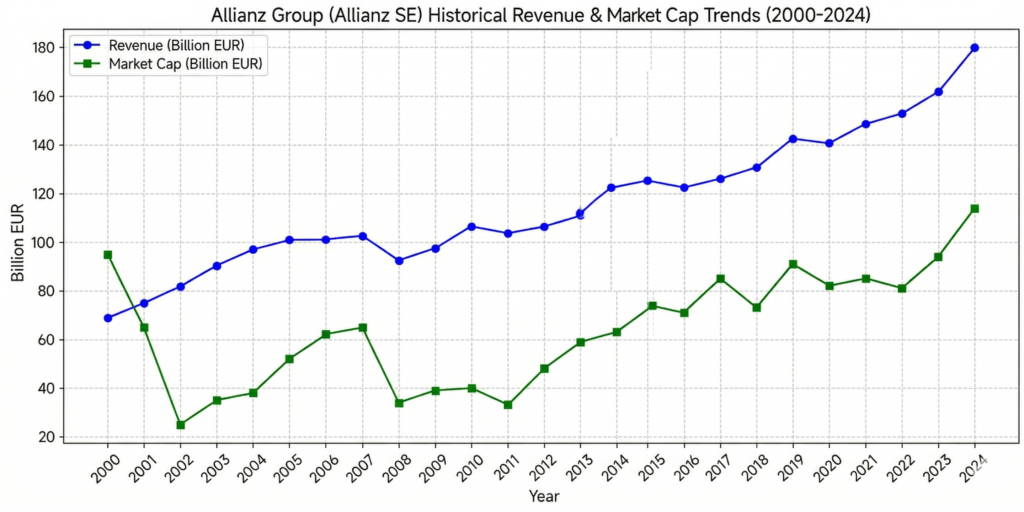
The following is a competitive analysis of Allianz Group summarized in bullet points:
1. Global Peers and Market Positioning
- AXA (France): Allianz’s primary rival in Europe. Both compete head-to-head for the top spot in global Property & Casualty (P&C) and Health insurance.
- Zurich Insurance (Switzerland): Focuses on high-margin commercial sectors and high-net-worth individuals, with a strong emphasis on digital claims efficiency.
- Ping An Insurance (China): A leader in integrating finance with technology (AI/Big Data) and health ecosystems, though concentrated heavily in the Asian market.
- Chubb (USA): Dominates the premium commercial and specialty insurance markets globally, serving as a key competitor to Allianz in North America.
2. Core Business Competitive Dynamics
- Property & Casualty (P&C)
- Growth: Achieved strong double-digit growth in motor insurance (approx. 14%) in 2024 due to proactive inflation-linked pricing.
- Risk: Increasing frequency of natural catastrophes (e.g., European floods) poses a challenge to maintaining a low combined ratio.
- Asset Management
- Dual Pillars: Managed through PIMCO (active fixed income) and AllianzGI. Total third-party assets under management (AUM) are nearing 2 trillion EUR.
- Pivot: Shifting focus from low-margin passive funds to high-margin “alternatives” such as infrastructure and private debt to compete with BlackRock and Vanguard.
- Life & Health
- Interest Rates: Benefiting from the higher-for-longer interest rate environment, which supports capital-efficient retirement and annuity products.
- Regional Competition: Facing intense pressure from AIA in the Asia-Pacific region and specialized health giants in the US.
3. Strategic SWOT Analysis
- Strengths
- Brand Power: Ranked as the world’s #1 insurance brand by Interbrand, valued at over 28 billion USD.
- Capital Solidity: Solvency II ratio consistently remains above 200%, providing a massive buffer against market volatility.
- Weaknesses
- Digital Legacy: As a legacy giant, digital transformation is slower compared to agile “Insurtech” startups.
- European Concentration: A significant portion of operating profit is still tied to the Eurozone, leaving it exposed to regional economic stagnation.
- Opportunities
- AI Integration: Implementing AI in underwriting and claims automation to significantly reduce operational costs.
- ESG Leadership: Allianz is a first-mover in green energy insurance, positioning itself to capture the massive renewable energy transition market.
- Threats
- Climate Change: Systemic risk from catastrophic weather events may outpace the insurance industry’s ability to price risk accurately.
- Regulatory Burden: Increasing compliance costs related to EU data privacy and evolving ESG reporting standards.
Sources:Allianz Official History,MBA Lib
Back to Allianz page