
Evolution of Mitsubishi UFJ Financial Group (MUFG)
The history of MUFG is a saga of grand mergers, tracing back to the 17th-century money changers of the Edo period. However, the modern entity was forged through the consolidation of four major Japanese banking pillars in the early 2000s.
1. The Four Pillars (17th Century – 1990s)
The group’s foundation rests on four distinct banking lineages:
- Mitsubishi Bank: Founded in 1880, it was the financial heart of the Mitsubishi zaibatsu (conglomerate). It was known for its conservative management and strong corporate ties.
- Bank of Tokyo: Established in 1880 as the Yokohama Specie Bank, it served as Japan’s primary foreign exchange bank for over a century, providing the group with a massive global network.
- Sanwa Bank: Formed in 1933 in Osaka, it was a “people’s bank” with a massive retail customer base and strong ties to the textile and manufacturing industries.
- Tokai Bank: Founded in 1941 in Nagoya, it served as the regional powerhouse for the Chubu industrial heartland (the home of Toyota).
2. The First Wave: Birth of Mega-Banks (1996 – 2001)
The collapse of the Japanese asset price bubble in the early 1990s forced a radical restructuring of the financial sector:
- 1996: Mitsubishi Bank and the Bank of Tokyo merged to form The Bank of Tokyo-Mitsubishi (BTM). This created a powerhouse combining domestic corporate strength with international expertise.
- 2001: Mitsubishi Tokyo Financial Group (MTFG) was established as a holding company to integrate BTM with Mitsubishi Trust and Banking.
3. The UFJ Integration (2002 – 2004)
Simultaneously, the other two pillars were merging to survive:
- 2002: Sanwa Bank and Tokai Bank merged to form UFJ Bank (United Financial of Japan).
- However, UFJ struggled with a massive mountain of non-performing loans (NPLs) and regulatory pressure, leading to a desperate search for a stronger partner.
4. The “Century Merger”: MUFG is Born (2005 – 2006)
In a move that shook the global financial world, MTFG and UFJ decided to join forces:
- October 2005: Mitsubishi UFJ Financial Group (MUFG) was officially established through the merger of the two holding companies.
- January 2006: The two commercial banks merged to become The Bank of Tokyo-Mitsubishi UFJ (BTMU), creating the largest bank in Japan and one of the largest in the world.
5. Global Expansion & The Morgan Stanley Strategic Alliance (2008 – Present)
During and after the Global Financial Crisis, MUFG pivoted toward aggressive international growth:
- 2008: In a legendary deal during the height of the crisis, MUFG invested $9 billion for a 21% stake in Morgan Stanley, saving the Wall Street firm and creating a lasting strategic alliance that persists today.
- 2010s: The group focused on Southeast Asia, acquiring majority stakes in Bank of Ayudhya (Krungsri) in Thailand and Bank Danamon in Indonesia.
- 2018: The core bank was renamed MUFG Bank to simplify the brand globally.
- Present Day: MUFG is now focused on digital transformation and ESG (Environmental, Social, and Governance) initiatives, positioning itself as a global financial partner rather than just a Japanese domestic lender.
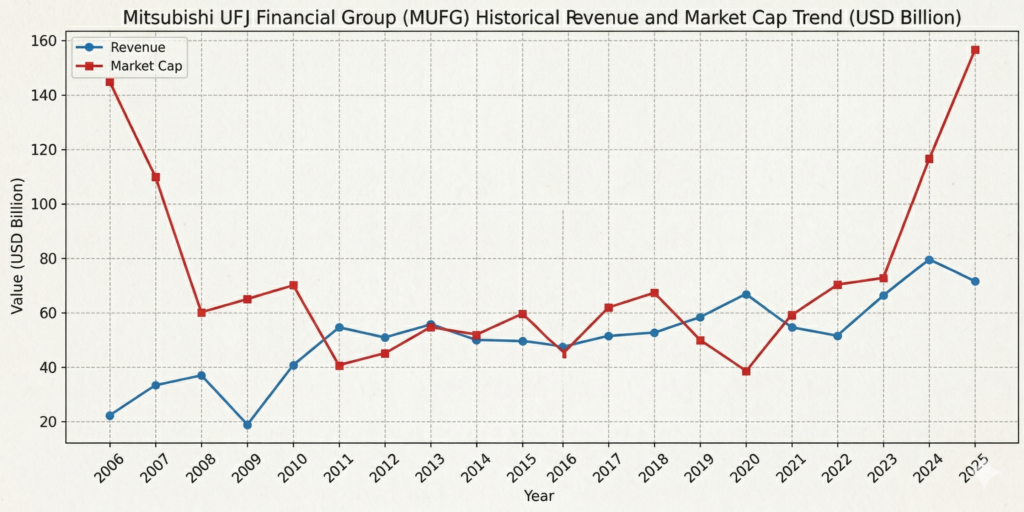
Competitive Landscape Analysis of MUFG (2026)
Mitsubishi UFJ Financial Group (MUFG) remains the undisputed leader in Japanese finance and a formidable global “Mega-bank.” As of early 2026, its competitive position is defined by its massive balance sheet, strategic Wall Street alliances, and its pivot toward high-growth Asian markets.
1. Global Peer Comparison (Total Assets)
MUFG consistently ranks among the top 10 largest banks globally by total assets. While Chinese state-owned banks dominate the top spots in terms of sheer size, MUFG competes directly with US and European giants for global corporate and investment banking mandates.
| Rank | Institution | Origin | Key Competitive Edge |
| 1-4 | Chinese “Big Four” (ICBC, etc.) | China | Domestic infrastructure and state backing |
| 5 | JPMorgan Chase | USA | Highest profitability and technology spend |
| 7 | HSBC | UK/HK | Global trade finance and wealth management |
| 10 | MUFG | Japan | Largest non-Chinese bank in Asia by assets |
2. Domestic Rivalry: The “Japanese Three”
Within Japan, MUFG’s primary competition comes from Sumitomo Mitsui Financial Group (SMFG) and Mizuho Financial Group.
- MUFG (Market Leader): Boasts the largest international network and a unique “hybrid” model through its stake in Morgan Stanley. It leads in corporate banking and cross-border M&A.
- SMFG (The Efficiency Challenger): Traditionally more profitable in terms of ROE (Return on Equity). SMFG is aggressive in digital retail banking and has made significant inroads in India.
- Mizuho (The Corporate Specialist): Deeply embedded in Japan’s “Keiretsu” (conglomerate) ecosystem and government projects, though it has historically struggled with IT legacy issues compared to MUFG.
3. Strategic Advantages & Differentiators
The Morgan Stanley Catalyst
MUFG’s ~20% ownership of Morgan Stanley is its most potent weapon. This alliance allows MUFG to offer world-class investment banking services to Japanese clients while sharing in the lucrative profits of a top-tier US investment bank. This partnership is a hurdle that its domestic rivals have struggled to replicate.
The “Second Home Market” Strategy
Unlike its peers, MUFG has successfully established deep “local” roots in Southeast Asia.
- Thailand: Owns Bank of Ayudhya (Krungsri).
- Indonesia: Owns Bank Danamon.
- Philippines: Strong stake in Security Bank.This geographic diversification provides a hedge against Japan’s aging population and low-growth environment.
4. SWOT Analysis (2026 Outlook)
Strengths
- Interest Rate Tailwind: As the Bank of Japan (BoJ) normalizes interest rates, MUFG’s massive yen deposit base finally generates significant interest income.
- Global Footprint: Over 50% of its net income now originates outside of Japan.
Weaknesses
- Legacy Infrastructure: Like many legacy giants, MUFG faces high maintenance costs for its traditional branch networks and aging mainframe systems.
- Efficiency Ratio: Its overhead-to-income ratio remains higher than US peers like JPMorgan or Bank of America.
Opportunities
- Wealth Management: Capitalizing on the Japanese government’s “Asset Doubling Plan” by shifting consumer savings into investment products (via WealthNavi acquisition).
- AI Integration: Deploying generative AI to automate middle-office functions and personalized retail lending.
Threats
- Fintech Disruption: Tech giants and startups (like PayPay or Rakuten) are aggressively capturing the payments and small-ticket lending market in Japan.
- Geopolitical Risks: Exposure to US-China trade tensions, which affects its multinational corporate clients.
Sources:
- MUFG Official History
- Investopedia: Mitsubishi UFJ Financial Group Overview
- The New York Times: Mitsubishi-UFJ Deal Archives (2005)
- S&P Global Market Intelligence – World’s Largest Banks 2025/2026
- Financial Times – MUFG Strategy and Earnings Analysis
- Nikkei Asia – Japanese Megabanks Competitive Outlook
Back to MUFG page