
Phase 1: Founding and Boutique Advisory (1985–1987)
In 1985, Peter Peterson and Stephen Schwarzman founded Blackstone with 400,000 in seed capital after leaving Lehman Brothers.
- Initial Positioning: Originally a boutique firm focused on Mergers and Acquisitions (M&A) advisory.
- Key Pivot: In 1987, Blackstone successfully raised its first private equity fund (Blackstone Capital Partners I) with 850 million, a staggering amount for a first-time fund at that time. This marked its transition from an advisory firm to a capital-deploying entity.
Phase 2: Diversification and Rapid Expansion (1988–2006)
During this stage, Blackstone demonstrated sharp business acumen by expanding beyond private equity, laying the foundation for its status as a diversified alternative investment giant.
- Business Expansion:
- 1988: Partnered with Laurence Fink to form Blackstone Financial Management, which later spun off to become BlackRock.
- 1990: Launched the Hedge Fund Solutions business (BAAM).
- 1991: Established the Real Estate investment department, which eventually became Blackstone’s most profitable segment.
- 1999: Entered the Mezzanine financing sector.
- Flagship Acquisitions: Completed iconic deals such as the acquisition of Hilton Hotels and Equity Office Properties.
Phase 3: IPO and the Financial Crisis Test (2007–2018)
- 2007 IPO: Blackstone went public on the NYSE (Ticker: BX) in June 2007, raising 4.13 billion. This IPO was perfectly timed, securing “permanent capital” just before the global financial crisis hit.
- Crisis Response: While Assets Under Management (AUM) were affected during the crisis, Blackstone used its liquidity to buy aggressively during the downturn, particularly in the real estate market. This bottom-fishing strategy fueled a massive rebound post-crisis.
- Strategic Upgrades: Post-2010, the firm further strengthened its Credit and Infrastructure businesses.
Phase 4: Corporate Restructuring and Scale Leap (2019–2023)
- C-Corp Conversion: In 2019, Blackstone converted from a Publicly Traded Partnership (PTP) to a C-Corporation. This move aimed to remove tax and investment restrictions for institutional investors, allowing BX stock to be included in major indices like the S&P 500.
- The Trillion-Dollar Milestone: In 2023, Blackstone’s total AUM officially surpassed 1 trillion, making it the first alternative asset manager in the world to achieve this feat.
Phase 5: The Era of AI and Infrastructure (2024–Present)
Blackstone is currently shifting its focus toward “megatrends” driving the future economy:
- Data Centers and AI: Acquired QTS and invested heavily in data center power supply and cooling infrastructure.
- Life Sciences: Expanding the Blackstone Life Sciences (BXLS) department, focusing on drug development and medical infrastructure.
- Wealth Management: Aggressively targeting high-net-worth individual investors, moving beyond a pure focus on institutional clients.
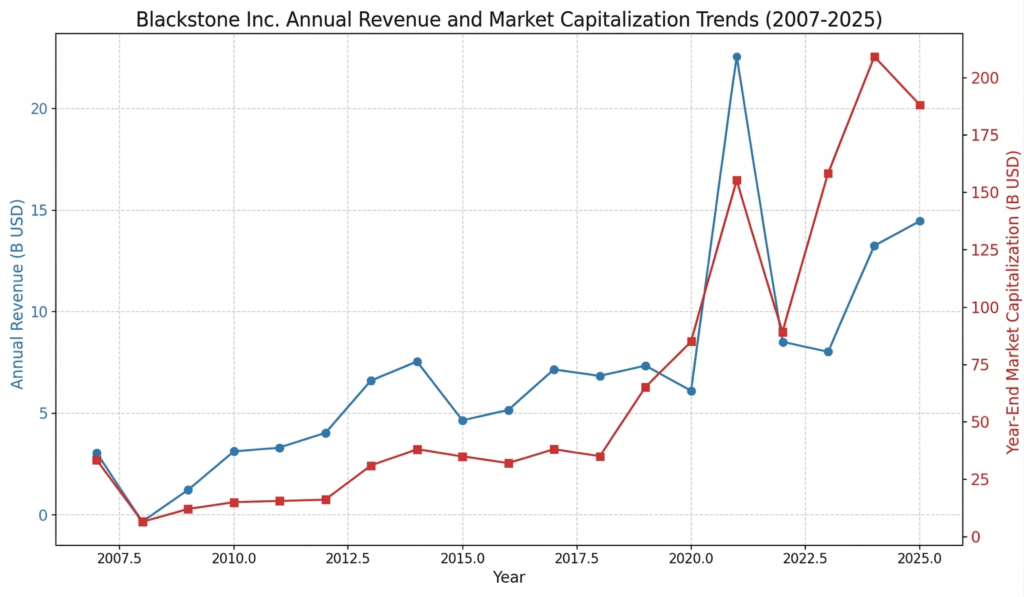
Competitive Analysis: Blackstone vs. Peers
In the alternative asset management industry, Blackstone (BX) is the undisputed leader in terms of scale, but it faces specialized competition from other “Big Four” firms: Apollo Global Management (APO), KKR & Co. (KKR), and The Carlyle Group (CG).
1. Competitive Matrix
| Feature | Blackstone (BX) | Apollo (APO) | KKR (KKR) | Carlyle (CG) |
| Primary Strength | Real Estate & Tactical Opps | Yield & Private Credit | Infrastructure & Buyouts | Global PE & Credit |
| Key Differentiator | Massive Retail/Wealth Channel | Insurance Integration (Athene) | Strong Balance Sheet Investing | Deep Industry Specialization |
| AUM (2025/26 Est.) | ~1.2T+ | ~750B+ | ~650B+ | ~420B+ |
| Strategic Focus | AI Data Centers & Logistics | Senior Debt & Fixed Income | Scaled Infrastructure & Energy | Mid-to-Large Cap Buyouts |
2. Core Strategic Advantages (The Moats)
- The “First Mover” in Retail: Blackstone pioneered the democratization of private markets. Through products like BREIT (Real Estate) and BCRED (Credit), they captured the “High-Net-Worth” individual market years before peers. This provides a diversified, sticky capital base that is less dependent on volatile institutional cycles.
- Infrastructure & AI Connectivity: While others are catching up, Blackstone’s 2021 acquisition of QTS positioned it as the largest private builder of data centers globally. By 2025, their pipeline in power and cooling infrastructure for AI has become a primary driver of valuation premiums.
- Scale and Brand Halo: As the first to hit 1T in AUM, Blackstone benefits from a “virtuous cycle”—their massive size allows them to write checks for deals that are too large for almost any other competitor, reducing the bidding pool for mega-assets.
3. Competitive Risks & Threats
- The Rise of Private Credit: While Blackstone is strong in credit, Apollo is often considered the “gold standard” here due to its ownership of Athene (insurance). Apollo can use low-cost insurance float to fund credit deals, giving them a structural margin advantage over Blackstone’s third-party funded credit.
- Asset Concentration: Blackstone’s heavy weighting in commercial real estate (Logistics and Rental Housing) makes it sensitive to regional regulations and interest rate shifts. KKR, by contrast, has a more balanced exposure to core infrastructure and insurance (Global Atlantic).
- Valuation Compression: As a C-Corp, Blackstone’s stock (BX) trades at a high P/E multiple compared to Carlyle or KKR. Any slowdown in fundraising or “Carried Interest” realization could lead to a sharper market correction than its more “value-priced” peers.
4. Future Outlook: The AI Race
The current battleground is Energy & AI. Blackstone is pivoting heavily toward “The Great Re-industrialization,” investing in power grids and green energy to support AI workloads. Their primary competition here is no longer just other PE firms, but also specialized infrastructure funds like BlackRock and Macquarie.
Source:
- https://www.blackstone.com/shareholders/financial-information/annual-reports/
- https://www.macrotrends.net/stocks/charts/BX/blackstone/market-cap
- https://finance.yahoo.com/quote/BX/history/
- https://www.wallstreetzen.com/stocks/us/nyse/bx/revenue
- https://www.blackstone.com/news/press-releases/blackstone-reports-fourth-quarter-and-full-year-2025-results/
- https://www.sec.gov/edgar/browse/?CIK=1393818
- https://www.bloomberg.com/quote/BX:US
- https://www.reuters.com/business/finance/blackstone-beats-quarterly-profit-estimates-asset-sales-2025-01-23/
Bakc to Blackstone page