
The History of China Life Insurance (Chronological Stages)
The history of China Life Insurance reflects the evolution of China’s financial and insurance sectors, progressing from a state-run department to a global financial giant.
1. Foundation and State-Owned Era (1949 – 1995)
During this period, life insurance was not an independent entity but a department within the People’s Insurance Company of China (PICC).
- 1949: PICC was established following the founding of the People’s Republic of China, handling all insurance business, including life insurance.
- 1958: Domestic life insurance business was suspended due to historical reasons, leaving only certain foreign-related services operational.
- 1982: The Chinese government officially resumed domestic insurance operations, with PICC re-establishing its life insurance department.
2. Separation and Institutionalization (1996 – 2002)
To comply with new regulatory requirements and market reforms, life insurance began its journey as a separate business.
- 1996: In accordance with the Insurance Law requiring the separation of property and life insurance, Zhongbao Life Insurance Co., Ltd. was formally established.
- 1999: The company was renamed China Life Insurance Company, becoming a state-owned enterprise directly under the State Council. It began managing “legacy policies” that carried high guaranteed interest rates from previous years.
3. Restructuring and Triple Listing (2003 – 2006)
This era marked China Life’s transformation into a modern corporation and its entry into global capital markets.
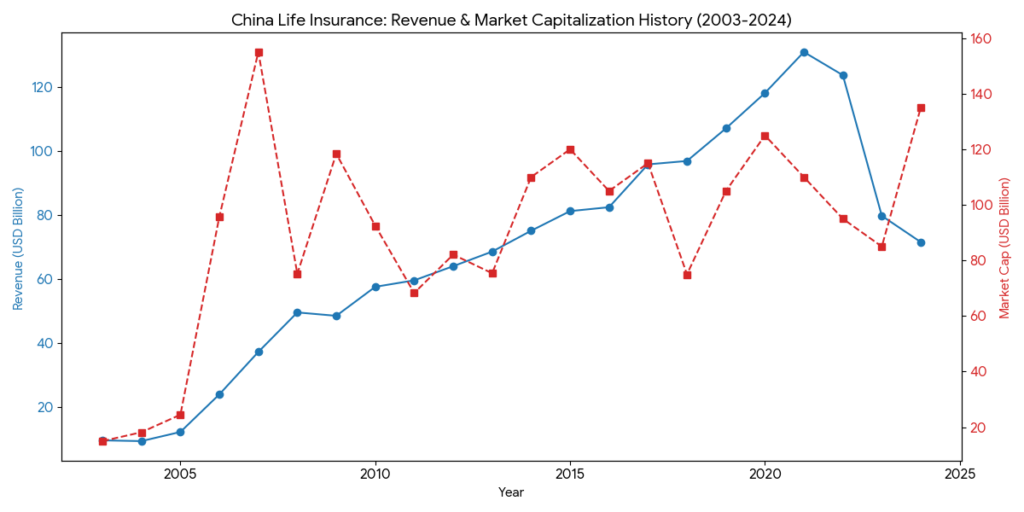
- 2003: China Life underwent a major restructuring to form China Life Insurance (Group) Company. Simultaneously, China Life Insurance Company Limited (the subsidiary) was listed on both the New York and Hong Kong stock exchanges, marking the world’s largest IPO at the time.
- 2006: China Life returned to the A-share market, listing on the Shanghai Stock Exchange. It became the first insurance company to be listed in New York, Hong Kong, and Shanghai.
4. Conglomeration and Comprehensive Finance (2007 – 2018)
The group shifted from a pure-play life insurer to a diversified financial services provider.
- Strategic Expansion: The group increased investments in infrastructure, real estate, and private equity. It also launched the “Big Health, Big Elderly Care” strategy.
- 2016: China Life became the largest shareholder of China Guangfa Bank (CGB), solidifying its “Insurance + Investment + Banking” tripartite business model.
5. High-Quality Development and Digitalization (2019 – Present)
Facing a maturing market, the company launched the “Dingxin Project” to focus on efficiency and technology.
- Reform Focus: Transitioning away from a massive agent force toward high-productivity teams and AI-driven underwriting and claims.
- Global Status: It consistently ranks among the Fortune Global 500 and remains China’s largest commercial insurance group and a pivotal institutional investor.
Competitive Analysis: China Life vs. Industry Peers (2025-2026)
- Market Leadership & Scale
- Dominant Market Share: China Life remains the largest life insurer in China by premium income, maintaining a leading position in the “Big Five” (China Life, Ping An, CPIC, NCI, PICC).
- Unrivaled Distribution Network: Possesses the most extensive branch network and agent force, particularly in Tier 3 to Tier 5 cities where competitors find it difficult to penetrate.
- Government-Backed Trust: Operates as a central state-owned enterprise (SOE), providing a perceived safety net that attracts risk-averse retail and institutional customers.
- Financial Performance & New Business Value (NBV)
- Strong NBV Growth: Projected 2026 NBV growth is estimated between 38% and 44%, outperforming major peers like Ping An due to aggressive cost controls and “reporting-execution unity” policies.
- IFRS 17 Adaptation: Successfully transitioned to new accounting standards, focusing more on insurance service results rather than gross premiums.
- Investment Advantage: As a “national team” player, it has preferential access to large-scale national infrastructure projects and strategic equity investments (e.g., China Guangfa Bank).
- Key Competitors & Market Threats
- China Ping An (The Technology Rival): Leads in AI, FinTech, and “Integrated Finance” (Healthcare + Elderly Care ecosystem), creating higher customer stickiness than China Life’s traditional model.
- PICC Life (The Growth Challenger): Demonstrating explosive NBV growth (projected 70% in 2026) by leveraging its massive P&C (Property & Casualty) network for cross-selling.
- AIA China (The Premium Competitor): Captures high-net-worth individuals in Tier 1 cities with superior agent quality and sophisticated estate planning products.
- Strategic Shifts in 2026
- Product Pivot: Shifting focus from fixed-rate products to participating insurance and universal life insurance as guaranteed interest rates trend below 2%.
- Silver Economy: Rapidly expanding the “Big Health & Big Elderly Care” strategy to compete with Ping An’s healthcare ecosystem.
- Digital Transformation: Executing the “Dingxin Project” to reduce reliance on low-productivity agents and transition toward data-driven underwriting.
- Risks & Vulnerabilities
- Agent Attrition: Facing industry-wide pressure on agent recruitment and retention as the traditional “human wave” sales model loses efficiency.
- Interest Rate Risk: Prolonged low-interest-rate environments in China put pressure on investment yields required to cover legacy high-cost policy liabilities.
Sources:
China Life Official Website: https://www.chinalife.com.cn/
Sina Finance – China Life Listing History: https://finance.sina.com.cn/
Back to China Life Insurance page