Phase 1: Foundations and the CDMA Gamble (1985-1995)
In 1985, Irwin Jacobs and six co-founders established Qualcomm in San Diego. The name stands for “Quality Communications.”
- The CDMA Breakthrough: While the industry favored TDMA, Qualcomm bet everything on Code Division Multiple Access (CDMA). Many experts at the time dismissed it as theoretically impossible for commercial use.
- Early Success: To fund R&D, they launched OmniTRACS in 1988, a satellite-based data system for the trucking industry that became a massive success.
- Standardization: By 1995, CDMA was adopted as a cellular standard (IS-95), paving the way for the digital mobile revolution.
Phase 2: The 3G/4G Era and the Rise of Snapdragon (1996-2010)
As mobile data became the focus, Qualcomm transitioned from a hardware manufacturer to a licensing and chipset powerhouse.
- Business Model: Qualcomm established its dual-track model: selling chips (QCT) and licensing its massive patent portfolio (QTL), often referred to as the “Qualcomm Tax.”
- Snapdragon Debut: In 2007, the first Snapdragon processor was launched. It was a “System-on-Chip” (SoC) that integrated the CPU, GPU, and modem, which became the blueprint for modern smartphones.
- Focusing In: They sold their handset business to Kyocera and infrastructure business to Ericsson to focus entirely on chip design and IP.
Phase 3: 5G Dominance and Global Legal Battles (2011-2020)
Qualcomm solidified its position as the undisputed leader in mobile modems but faced intense regulatory scrutiny.
- 5G Leadership: Qualcomm led the 3GPP standards for 5G, launching the first commercial 5G modems (X50) in 2019, years ahead of most competitors.
- Antitrust Challenges: The company faced multi-billion dollar fines and lawsuits from the FTC, EU, and Apple over its licensing practices. Most were eventually settled or overturned, including a landmark settlement with Apple in 2019.
- Leadership Shift: Cristiano Amon began steering the company toward a broader vision beyond just smartphones.
Phase 4: Diversification, AI PC, and Automotive (2021-Present)
Under CEO Cristiano Amon, Qualcomm is transforming into a “connected processor company” for the intelligent edge.
- Automotive Growth: The Snapdragon Digital Chassis has become the industry standard for “software-defined vehicles,” powering everything from infotainment to autonomous driving.
- The PC Revolution: Following the acquisition of Nuvia, Qualcomm launched the Snapdragon X Elite in 2024. This marked a historic shift in the PC market, bringing ARM-based efficiency and high-performance AI to Windows laptops.
- On-Device AI: Qualcomm is now focused on “Edge AI,” enabling generative AI models to run directly on phones and PCs rather than relying on the cloud.
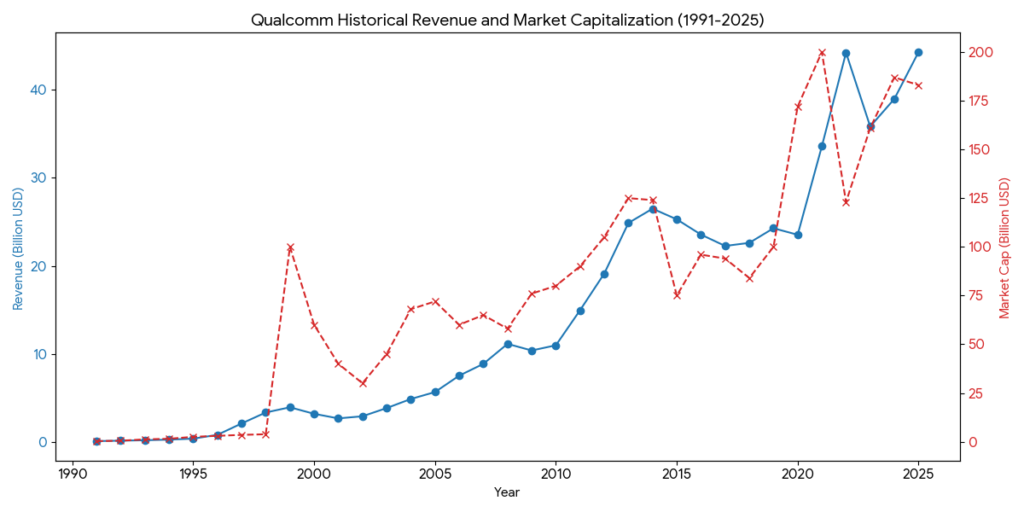
In 2026, Qualcomm is no longer just a “modem company.” It has transformed into a diversified Edge AI Powerhouse. The competitive landscape has shifted from simple hardware specs to a battle over software ecosystems and AI integration.
Here is the competitive analysis of Qualcomm across its four core battlefronts:
1. Smartphones: The “Premium” Trench War
While Qualcomm remains the gold standard for Android flagship performance, it is being squeezed from both the top and bottom.
- MediaTek (The Volume Challenger): By 2026, MediaTek’s Dimensity 9500 series has largely closed the gap in ISP (camera) and AI performance. MediaTek is winning on price-to-performance, forcing Qualcomm to rely heavily on its custom Oryon CPU cores to maintain a performance lead in the $800+ segment.
- Apple (The Vertical Integration Model): Apple continues to set the bar for efficiency. While Qualcomm’s Snapdragon 8 Gen 5/6 rivals Apple’s A-series in raw benchmarks, Apple’s control over the OS allows for superior battery optimization.
- The In-House Threat: Samsung (Exynos) and Google (Tensor) are increasingly using their own silicon to differentiate their AI features (like Circle to Search), reducing their total orders from Qualcomm.
2. PC & Computing: The Arm vs. x86 Revolution
This is Qualcomm’s biggest growth bet. The Snapdragon X Elite and its successors are challenging the decades-long dominance of Intel and AMD in the Windows ecosystem.
- Intel & AMD (The x86 Giants): Intel’s Panther Lake and AMD’s Strix Point architectures have responded with massive NPU (Neural Processing Unit) upgrades to meet Microsoft’s “Copilot+” PC requirements.
- Key Advantage: Qualcomm’s edge remains Battery Life per Watt. For the first time, Windows laptops can match MacBook Air endurance levels, a feat Intel is still struggling to achieve consistently across all price points.
3. Automotive: The Digital Chassis Battle
Qualcomm is successfully pivoting to become the “Brain of the Car,” but the competition here is fierce and follows much longer product cycles.
- NVIDIA (The Autonomous King): While Qualcomm dominates Digital Cockpits (screens, infotainment), NVIDIA’s DRIVE Thor platform remains the preferred choice for high-level (L3/L4) autonomous driving due to its massive raw TFLOPS and software maturity.
- Mobileye & NXP: These incumbents hold the “safety-critical” legacy. Qualcomm’s strategy is the Snapdragon Digital Chassis, a modular platform that allows carmakers to pick and choose features (connectivity, cockpit, or ADAS).
4. Edge AI: The New Frontier
As AI shifts from the Cloud (ChatGPT) to the Device, Qualcomm is positioning itself as the “NVIDIA of the Edge.”
- The Moat: Qualcomm’s AI Engine is optimized for Inferencing—running AI models locally. By 2026, the Qualcomm AI Hub supports over 100+ open-source models (Llama, Mistral) optimized specifically for Snapdragon hardware.
- The Rivalry: NVIDIA remains the king of training AI, but Qualcomm is fighting to ensure that once an AI is trained, it runs on a Snapdragon chip.
Competitive Matrix (2026 Outlook)
| Competitor | Primary Threat Area | Strength | Qualcomm’s Defense |
| MediaTek | Mid-to-High Smartphones | Pricing & High-volume supply | Proprietary Oryon CPU & Brand prestige |
| Intel | AI PCs & Laptops | Software compatibility (x86) | Superior Power Efficiency & Integrated 5G |
| NVIDIA | Automotive & Data Center | AI Ecosystem (CUDA) & High-end ADAS | Digital Chassis modularity & Edge AI focus |
| Apple | High-end Consumer Devices | Ecosystem lock-in & Silicon efficiency | Open ecosystem for Windows & Android |
Summary: Qualcomm’s biggest risk is no longer just a “better chip” from a rival, but the trend of OEMs designing their own silicon. To win, Qualcomm must prove that its “One Technology Roadmap” (sharing tech across phones, cars, and PCs) provides better R&D scaling than any single company can do on its own.
Sources:
[1] Qualcomm Investor Day 2024: Diversification Strategy
[2] Counterpoint Research: Global Smartphone AP Market Share 2025-2026
[3] Canalys: The Rise of AI PCs and Arm’s Growing Market Share
Back to Qualcomm page