Financial Performance Summary
Applied Materials reported first-quarter 2026 revenue of $7.01 billion, representing a slight 2% decrease year-over-year. Despite the revenue dip, GAAP net income surged 71% to $2.03 billion, primarily driven by investment gains and tax adjustments. On a non-GAAP basis, which management views as more reflective of core operations, net income was $1.90 billion, down 2% compared to the same period last year. Gross margins remained healthy and stable at approximately 49%.
Segment Analysis
- Semiconductor Systems: This core segment generated $5.14 billion in revenue, down 8% year-over-year. While Foundry and Logic investments saw a relative slowdown (accounting for 62% of segment sales), DRAM revenue reached a record high, now representing 34% of the mix, fueled by memory demand for AI applications.
- Applied Global Services (AGS): This segment delivered a standout performance with record revenue of $1.56 billion, a 15% increase year-over-year. The growth highlights the resilience of the company’s recurring revenue streams from services and spare parts as the installed base continues to expand.
- Other (Display): Revenue in this category grew 44% to $312 million, though it remains a smaller portion of the overall business.
Cash Flow and Capital Allocation
The company demonstrated strong cash generation with $1.69 billion in cash from operations. Non-GAAP free cash flow reached $1.04 billion, a significant 91% increase compared to the previous year. Applied Materials continues to prioritize shareholder returns, distributing $702 million during the quarter through $337 million in share repurchases and $365 million in cash dividends.
Strategic Outlook and AI Impact
Management is highly optimistic about the “acceleration of industry investments in AI computing.” The shift toward high-performance, energy-efficient chips is driving demand for Gate-All-Around (GAA) transistors, high-bandwidth memory (HBM), and advanced packaging—all areas where Applied holds a leadership position. To prepare for this growth, the company has nearly doubled its system manufacturing capacity over the past few years. For the second quarter of fiscal 2026, the company expects revenue to increase to approximately $7.65 billion, signaling a positive momentum heading into the rest of the year.
Future Outlook and Business Guidance
Applied Materials management is positioning the company as a central player in the AI infrastructure era. Based on the 2026 Q1 report, here are the key forward-looking insights:
Near-Term Guidance (Q2 Fiscal 2026)
For the upcoming second quarter of fiscal 2026, the company expects:
- Net Revenue: Approximately $7.65 billion (plus or minus $500 million), indicating a sequential increase from Q1.
- Non-GAAP Diluted EPS: Approximately $2.64 (plus or minus $0.20).
AI-Driven Industry Inflection
CEO Gary Dickerson highlighted an “acceleration of industry investments in AI computing.” The company anticipates its semiconductor equipment business will grow over 20% this calendar year, driven by three primary technological shifts:
- Leading-Edge Logic: The transition to Gate-All-Around (GAA) transistors at 2nm and beyond.
- High-Bandwidth Memory (HBM): Critical for AI data centers, boosting record DRAM revenues.
- Advanced Packaging: Increasing complexity in chip integration that requires specialized materials engineering.
Strategic Infrastructure and R&D
- Capacity Expansion: CFO Brice Hill noted that the company has nearly doubled its system manufacturing capability over the past few years to prepare for this market growth.
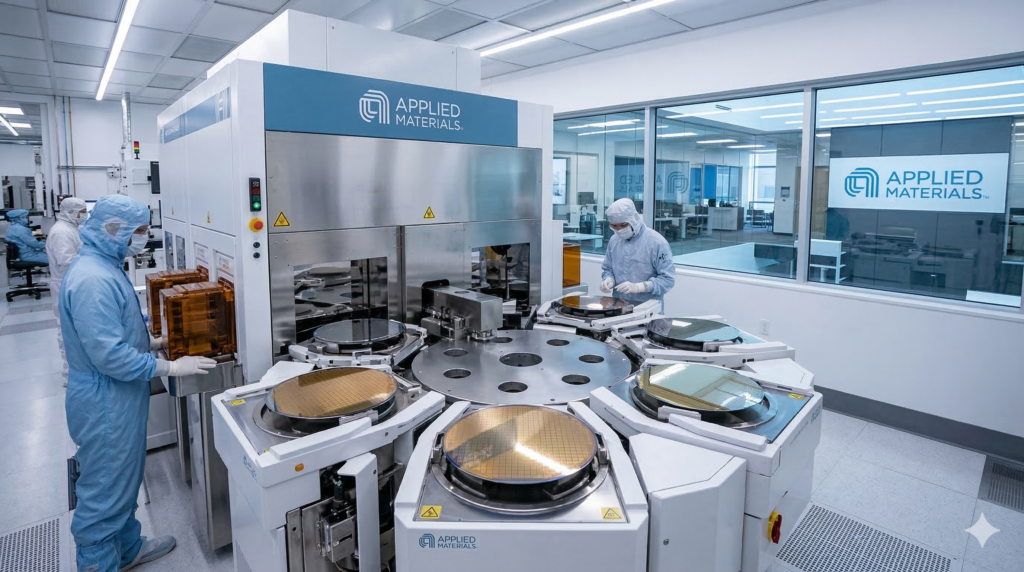
- EPIC Center Collaboration: Samsung Electronics recently joined Applied’s new EPIC Center in Silicon Valley. This hub is designed to reduce the time-to-market for new technologies, moving them faster from research to high-volume manufacturing.
- Material Innovation: The introduction of systems like Spectral (replacing tungsten with molybdenum) and Viva (atomic-level precision for GAA) targets the physical limits of semiconductor scaling, ensuring long-term technological leadership.
Summary Analysis
The outlook suggests that while general-purpose computing may be stabilizing, the AI-specific hardware cycle is providing a massive tailwind. Applied Materials is leveraging its strength in materials science to capture the high-value segments of the 2nm transition and the surge in high-performance memory demand.
Financial Health and Solvency
Applied Materials maintains an exceptionally strong balance sheet. The current ratio, which measures the ability to cover short-term liabilities, stood at 2.54 in 2021 and remained robust at 2.61 by 2025. This indicates a very high level of liquidity. Furthermore, the debt-to-equity (D/E) ratio has generally trended downward, decreasing from 0.45 in 2021 to 0.32 in 2025, reflecting a conservative approach to financial leverage. The interest coverage ratio has consistently stayed above 27x, peaking at 32.5x in 2023, which demonstrates that the company’s earnings can comfortably cover its interest expenses many times over.
Operational Efficiency
The company’s efficiency metrics reflect its strategic adjustments to global supply chain conditions. Days Sales Outstanding (DSO) has remained stable, fluctuating between 66 and 70 days, showing consistent collection performance from major customers like TSMC and Intel. However, Days Inventory Outstanding (DIO) saw a notable increase from 125 days in 2021 to 162 days in 2025. This rise was largely due to intentional inventory building to mitigate supply chain risks and prepare for the AI-driven demand surge. Consequently, the asset turnover ratio dipped from 0.94 to 0.77 over the period, as the company significantly expanded its asset base and manufacturing capacity to support future growth.
Profitability and Shareholder Value
Profitability has been a highlight of the past five years. Gross margins improved from 47.3% in 2021 to 48.7% in 2025, driven by a shift toward higher-value equipment for advanced nodes like 2nm and GAA transistors. While the Return on Equity (ROE) moderated from a peak of 51.5% in 2022 to 33.6% in 2025 due to a larger equity base, it remains significantly above industry averages. The company continues to return the majority of its free cash flow to shareholders through dividends and aggressive share repurchases.
Based on current market data and financial reports, here is a P/E (Price-to-Earnings) ratio analysis comparing Applied Materials (AMAT) with its primary peers in the semiconductor equipment industry as of early 2026.
Comparative P/E Analysis
- Applied Materials (AMAT):AMAT currently trades at a P/E ratio in the range of 25x to 30x. This represents a significant premium over its five-year historical average of approximately 15x to 20x. Investors are currently pricing in the “AI re-rating,” acknowledging AMAT’s essential role in materials engineering for 2nm and GAA (Gate-All-Around) architectures.
- ASML (ASML):ASML typically commands the highest valuation in the sector, with a P/E often exceeding 40x to 50x. This high multiple is attributed to its total monopoly on EUV (Extreme Ultraviolet) lithography machines. Market sentiment remains that ASML is a unique bottleneck for the entire semiconductor roadmap, justifying its premium.
- Lam Research (LRCX):Lam Research is currently trading at a P/E ratio of approximately 25x to 28x, slightly lower than or on par with AMAT. While Lam is a leader in etch and deposition, its valuation is more sensitive to the cyclicality of the memory market (NAND and DRAM), which can lead to more volatile valuation fluctuations compared to AMAT’s more diversified logic/foundry exposure.
- KLA Corporation (KLAC):KLA maintains a P/E ratio between 28x and 32x. KLA specializes in inspection and metrology. As chip manufacturing becomes more complex at the 2nm level, the yield management provided by KLA becomes increasingly valuable, allowing it to maintain margins and valuation multiples slightly above AMAT.
Key Valuation Drivers
- Technology Transition Premium:Valuations for AMAT and ASML are being driven by the transition to 2nm nodes. As traditional transistor scaling reaches physical limits, the industry is shifting toward “Materials Engineering” (where AMAT excels) to solve leakage and power efficiency issues.
- Recurring Revenue Stability:AMAT’s Applied Global Services (AGS) segment, which recently delivered record revenue, provides a stable, subscription-like cushion that justifies a higher P/E multiple than pure-play equipment cycles.
- AI Infrastructure Demand:The market is treating the top-tier equipment makers as the “arms dealers” of the AI race. The growth of High-Bandwidth Memory (HBM) and advanced logic for AI accelerators has led to a fundamental shift in how these companies are valued—moving from cyclical hardware stocks to high-growth technology enablers.
Summary
AMAT is currently undergoing a “valuation re-rating”. Historically viewed as a cyclical equipment provider, it is now recognized by the market as a critical technology partner for the AI era. Its current P/E of ~28x suggests that while it is no longer “cheap” by historical standards, it remains competitively valued compared to the monopoly status of ASML or the yield-critical niche of KLA.
Source: https://ir.appliedmaterials.com/static-files/a14b7e94-2685-440a-a78a-c48055b00603
Back to Applied Materials page