
Citigroup Inc. 2025Q4 Earnings Summary
Citigroup reported a solid finish to 2025, with growth across all major businesses and continued progress on its organizational transformation.
Financial Performance Highlights
- Net Income: $3.2 billion for 2025Q4 ($1.51 per share). Full-year net income reached $12.8 billion ($6.14 per share).
- Revenue: $19.6 billion for the quarter, up 3% YoY. Full-year revenue was $79.3 billion, also up 3% YoY.
- Return on Tangible Common Equity (RoTCE): 7.0% for the quarter and 7.1% for the full year.
Business Segment Results
- Services: Revenue rose 4% to $4.7 billion, driven by growth in Securities Services and cross-border payment volumes.
- Markets: Revenue increased 7% to $4.4 billion, led by strong performance in Equities.
- Banking: Revenue surged 21% to $1.4 billion, reflecting a significant recovery in Investment Banking fees.
- Wealth: Revenue grew 9% to $1.9 billion, supported by higher client investment assets and increased activity.
- U.S. Personal Banking (USPB): Revenue up 3% to $4.9 billion, primarily due to higher card volumes.
Expenses and Capital
- Operating Expenses: $13.3 billion for the quarter, a 6% decrease YoY, reflecting the benefits of the firm’s simplification efforts and lower transformation costs.
- Credit Costs: Cost of credit was $2.7 billion for the quarter.
- Capital Position: Maintained a strong CET1 capital ratio of 13.4%.
- Shareholder Returns: Returned $2.1 billion to shareholders through dividends and share repurchases during the quarter.
CEO Commentary
CEO Jane Fraser noted that 2025 was a pivotal year for Citi’s transformation. She highlighted that the bank met its full-year guidance, showed expense discipline, and remains focused on achieving its medium-term RoTCE targets.
Citigroup Inc. Five-Year Financial Ratio Analysis
Based on the 2025Q4 earnings report and historical trends, here is the analysis of Citigroup’s financial ratios covering profitability, asset quality, capital adequacy, and efficiency.
Profitability Analysis
- Return on Tangible Common Equity (RoTCE): The full-year 2025 RoTCE was 7.1%, a significant recovery from approximately 4.1% in 2024. Over the past five years, RoTCE peaked at around 13% in 2021 due to credit reserve releases, then dipped amid transformation costs. The current 7.1% indicates progress toward the medium-term target of 11% to 12%.
- Earnings Per Share (EPS): 2025 EPS reached $6.14, compared to $3.12 in 2024. This doubling of earnings reflects successful revenue growth paired with effective expense management during the final stages of the firm’s reorganization.
Asset Quality and Risk
- Cost of Credit: The 2025Q4 cost of credit was $2.7 billion. Over a five-year horizon, this metric has normalized following the volatility of 2020-2021 (massive pandemic-related provisioning and subsequent releases). Current levels reflect a steady state corresponding to growth in U.S. Personal Banking card volumes.
- Net Interest Margin (NIM): Benefiting from a higher interest rate environment and increased credit card balances, NIM has remained resilient, helping to offset the rising cost of deposits seen across the banking sector.
Capital Adequacy
- Common Equity Tier 1 (CET1) Ratio: Citigroup ended 2025 with a CET1 ratio of 13.4%. Over the past five years, Citi has steadily built its capital buffer from approximately 11.5% to over 13% to meet stricter regulatory requirements (such as Basel III Endgame) and to provide a safety margin during its structural transformation.
Efficiency and Transformation
- Efficiency Ratio: Operating expenses for 2025 were $53.6 billion. The efficiency ratio is showing a downward (improving) trend as the “Simplification” initiative eliminates overlapping roles and the firm exits non-core international consumer markets. As transformation spending peaks and fades, the ratio is moving from the high 70s toward the mid-60s target.
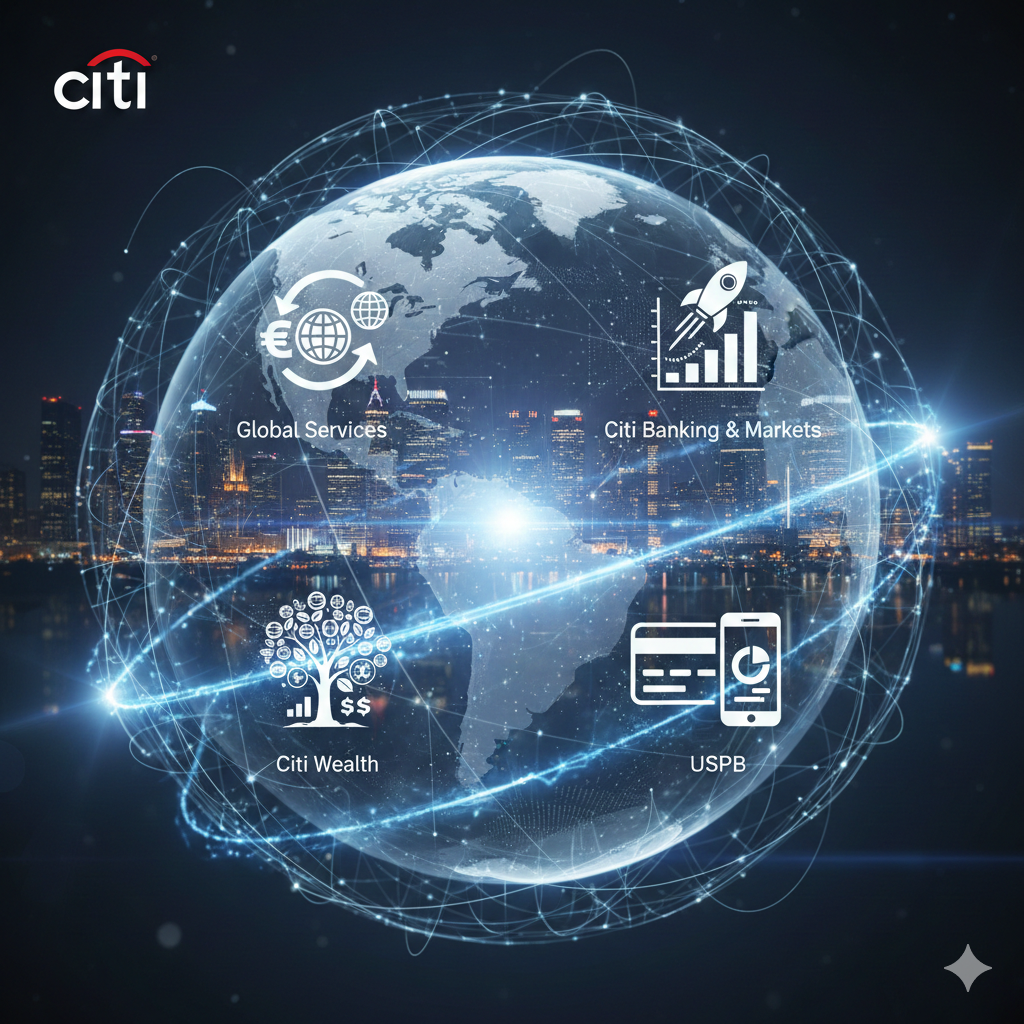
- Revenue Mix: The shift toward the five core interconnected businesses (Services, Markets, Banking, Wealth, and USPB) is now evident. Services and Markets consistently contribute roughly 45% of total revenue, representing the most stable and highest-return segments of the bank.
In summary, the past five years represent a period of deep restructuring. Citigroup has moved from a complex, global footprint to a leaner, more focused entity. While financial ratios have been pressured by divestiture impacts and restructuring charges, the 2025 results suggest the bank is entering a phase of operational stability with a cleaner balance sheet.
Future Outlook for Citigroup Inc.
Based on the 2025Q4 earnings report and management’s guidance, Citigroup has set clear financial and strategic milestones as it moves beyond its multi-year organizational transformation.
Key Financial Targets for 2026
- Profitability Growth: Management is targeting a Return on Tangible Common Equity (RoTCE) of 10% to 11% for 2026. This represents a steady climb toward their long-term goal of 11% to 12% and eventually mid-teens by 2030.
- Revenue Momentum: Net Interest Income excluding Markets (NII ex-Markets) is projected to grow by 5% to 6% in 2026, driven by loan growth and stabilizing deposit costs.
- Efficiency Improvements: The goal is to bring the Efficiency Ratio down toward 60%. With the bulk of transformation-related severance and overlapping costs now in the past, expenses are expected to stabilize at approximately $54.7 billion.
Strategic Focus by Segment
- Services & Banking: Citi plans to leverage its dominant cross-border network. The Banking segment is expected to benefit from a continued rebound in M&A and IPO activity.
- Wealth Management: Through investments in technology and advisor talent, the bank aims for an RoTCE of 12%+ in this segment.
- U.S. Personal Banking (USPB): While credit card delinquency rates are expected to stay within 2025 ranges, the bank will focus on high-margin purchase volumes to maintain double-digit returns.
Capital Allocation and Shareholder Returns
- Strong Capital Position: The CET1 ratio is expected to be maintained at approximately 13%, providing a significant buffer of 160 basis points over regulatory requirements.
- Continued Buybacks: Following a year where Citi returned over $17.5 billion to shareholders (including $13.25 billion in buybacks and dividends), management intends to continue repurchasing shares in 2026.
Key Milestones Ahead
- Transformation Completion: With over 80% of transformation initiatives reaching their target state, 2026 will be the definitive year to prove that a simplified organization leads to sustained higher returns.
- Investor Day 2026: Citi has scheduled an Investor Day for May 7, 2026, where it will provide a deep dive into its long-term strategy and the roadmap to achieving mid-teens RoTCE by 2030.
Here is the updated Price-to-Book (P/B) and Price-to-Tangible Book Value (P/TBV) analysis for Citigroup versus its primary peers as of February 2026.
Peer Valuation Comparison Table (Feb 2026)
| Bank Name | Ticker | P/B Ratio | P/TBV Ratio | 5-Year Avg P/B | Valuation Status |
| Citigroup | C | 0.97 | 1.21 | 0.55 | Value Recovery |
| JPMorgan Chase | JPM | 2.29 | 2.65 | 1.45 | Premium Leader |
| Bank of America | BAC | 1.40 | 1.81 | 1.15 | Core Growth |
| Wells Fargo | WFC | 1.66 | 1.95 | 1.25 | Efficiency Play |
Strategic Valuation Analysis
1. The “Closing Gap” Narrative
Citigroup’s P/B ratio has surged from its historical lows of 0.35 – 0.50 to approximately 0.97. This “re-rating” is the primary driver behind the stock’s recent outperformance. Investors are no longer pricing Citi as a “distressed” asset but as a bank nearing operational normalcy. However, it still trades at a significant discount compared to JPMorgan’s 2.29, representing a “valuation gap” that management aims to close through its 2026 RoTCE targets.
2. Tangible Book Value (P/TBV) Strength
For banking analysts, P/TBV is the “cleaner” metric as it removes goodwill and intangibles.
- Citigroup (1.21x): For the first time in years, Citi is trading consistently above its tangible book value. This indicates that the market now believes the bank’s assets are capable of generating returns above its cost of equity.
- Upside Potential: Analysts (notably Morgan Stanley in Feb 2026) have raised price targets to $152, suggesting that if Citi hits its 10-11% RoTCE goal, the P/TBV could realistically expand toward 1.4x – 1.5x, aligning it closer to Bank of America.
3. Why the Discount Still Exists
Despite the rally, Citi remains the lowest-valued of the “Big Four” for several reasons:
- Regulatory Burden: Citi still carries a higher G-SIB (Global Systemically Important Bank) surcharge than some peers, requiring it to hold more capital.
- Risk Profile: The high exposure to international markets and the U.S. credit card segment (which sees higher volatility than JPM’s diversified consumer base) results in a higher “risk discount.”
- Execution Proof: While the “Simplification” is 80% complete, the market is waiting for the 2026 Investor Day (May 7) to see sustained margin expansion before granting a 1.5x+ P/B multiple.
Summary for Investors
If you are looking for stability, JPMorgan remains the benchmark. However, Citigroup represents a “Multiple Expansion” play. Every 0.1x increase in its P/B ratio provides significantly higher percentage returns compared to peers who are already trading at or above their historical fair value.
Source:
- https://www.citigroup.com/rcs/citigpa/storage/public/Earnings/Q42025/2025prqtr4rslt.pdf
- https://www.investing.com/news/transcripts/earnings-call-transcript-citigroup-q4-2025-sees-eps-beat-stock-dips-93CH-4447932
- https://www.citigroup.com/rcs/citigpa/storage/public/Earnings/Q42025/2025prqtr4rslt.pdf
- https://www.macrotrends.net/stocks/charts/C/citigroup/price-book
- https://www.investing.com/news/analyst-ratings/morgan-stanley-raises-citi-stock-price-target-on-profitability-outlook-93CH-4509128
- https://simplywall.st/stocks/us/banks/nyse-c/citigroup/valuation
Back to Citigroup page