
Novo Nordisk 2025 Annual Report Summary
Strategic Transformation and Organizational Adjustment
2025 marked a period of profound transformation for Novo Nordisk. In response to unprecedented demand in the obesity treatment market, the company refocused its strategic priorities on obesity, diabetes and their related complications, as well as rare diseases including rare blood and endocrine disorders.
Stopping independent expansion in new areas: The company adjusted its strategy, moving away from expanding cardiovascular disease (CVD), chronic kidney disease (CKD), and metabolic dysfunction-associated steatohepatitis (MASH) as independent therapeutic areas. Instead, these fields are now integrated into the core obesity and diabetes treatments.
Organizational restructuring and layoffs: To improve operational efficiency and decision-making speed, the company merged its R&D departments. Following a period of rapid expansion, the company implemented its largest-ever workforce reduction, cutting approximately 9,000 positions globally to maintain financial discipline and redirect resources toward core areas.
2025 Financial Highlights
Despite the transition, the company delivered solid financial results in 2025 and provided significant returns to shareholders:
Revenue and Profit: Total annual sales reached 309.064 billion DKK (a 6% increase in reported currency and 10% in constant exchange rates, CER). Net profit was 102.434 billion DKK, representing a slight 1% growth.
Business Segment Performance: Obesity care sales grew significantly by 31% (CER) to 82.3 billion DKK, while rare disease sales increased by 9% (CER).
Capital Allocation: The company returned a total of 52 billion DKK to shareholders through dividends (11.70 DKK per share) and share buybacks. It also announced a new share buyback program of up to 15 billion DKK for 2026.
R&D Progress and Pipeline Layout
The company continued to drive innovation and actively expand new indications for existing drugs:
Obesity: Wegovy is now available in 52 countries. The R&D pipeline includes higher-dose and oral formulations of Wegovy, as well as next-generation therapies like zenagamtide (amycretin) and CagriSema, which are progressing through phase 3 clinical trials. Additionally, Wegovy received U.S. FDA approval for the treatment of MASH.
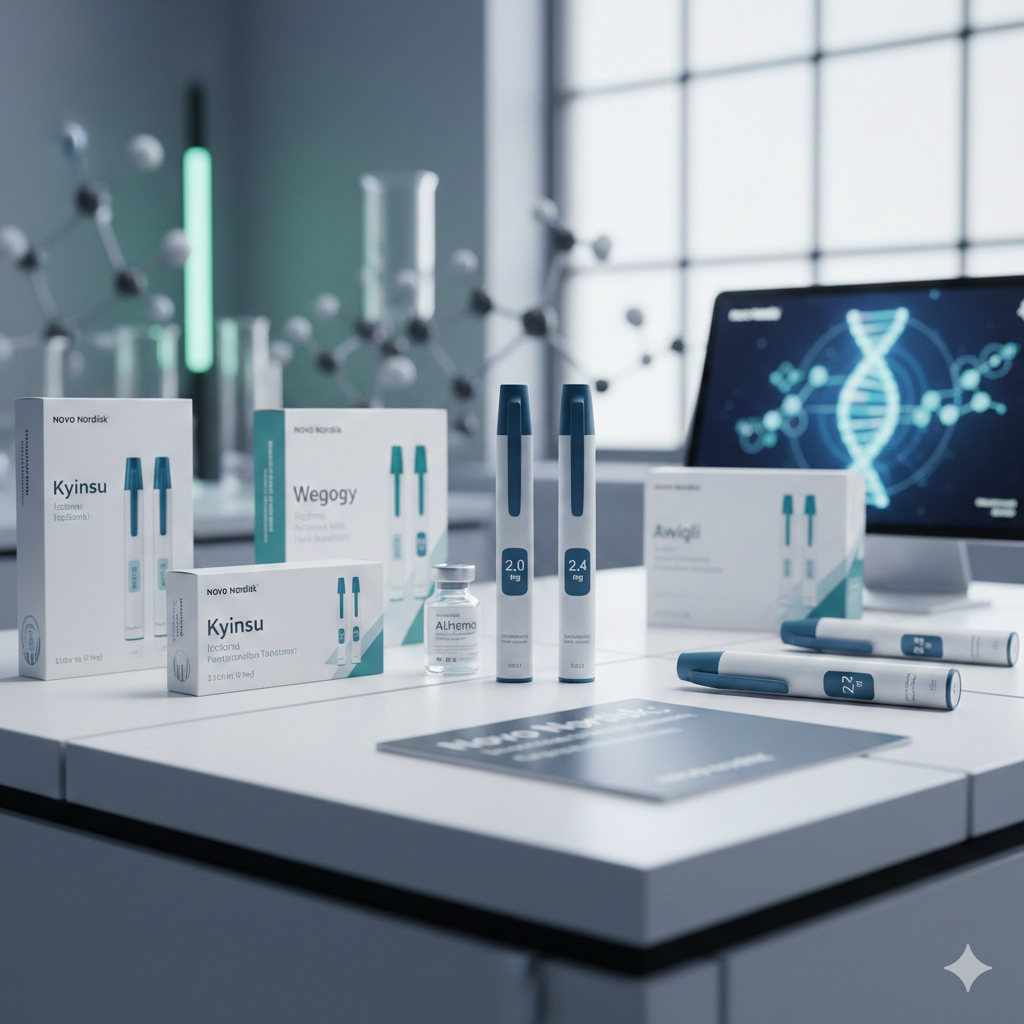
Diabetes: The company continues to promote the once-weekly basal insulin Awiqli and received marketing authorization for Kyinsu (IcoSema) in the EU. The flagship product Ozempic received regulatory recognition for label expansions regarding cardiovascular risk reduction and chronic kidney disease (FLOW trial).
Rare Diseases: The new hemophilia drug Alhemo was approved in the U.S., and the company is preparing to launch denecimig (Mim8) to strengthen its leadership in the rare disease market.
2026 Market Outlook and Challenges
Novo Nordisk signaled a more challenging market environment for 2026, forecasting a decline in sales and operating profit (estimated decrease of 5% to 13% at CER), moving away from the high growth rates of recent years.
Reasons for Decline: The anticipated downturn is primarily due to price decreases in the U.S. market (including Most Favored Nation agreements), the loss of patent exclusivity for the semaglutide molecule in certain international markets, and the non-recurrence of positive one-time sales adjustments seen in 2025.
Response Strategies: The company is working to expand access to Wegovy through a direct-to-consumer (D2C) approach via the NovoCare platform and telehealth partnerships. Simultaneously, the company is taking legal action against unverified compounded GLP-1 generics to protect patient safety and market integrity.
Sustainability and Social Responsibility
While pursuing business growth, Novo Nordisk reaffirmed its commitment to the Triple Bottom Line (financial, social, and environmental responsibility):
Social Responsibility: In 2025, the company’s obesity and diabetes products reached 45.6 million patients worldwide. The company also collaborated with UNICEF to promote programs preventing childhood overweight and obesity in multiple countries.
Five-Year Financial Ratio Analysis
| Year | Revenue Growth | Operating Margin | Net Margin | ROA | ROE |
| 2021 | 10.91% | 41.65% | 33.92% | 28.14% | 71.24% |
| 2022 | 25.68% | 42.28% | 31.38% | 25.48% | 72.00% |
| 2023 | 31.26% | 44.16% | 36.03% | 30.12% | 88.07% |
| 2024 | 25.03% | 44.19% | 34.78% | 25.89% | 80.78% |
| 2025 | 6.43% | N/A | 33.14% | N/A | N/A |
Note: 2025 data is based on the provided report summary; 2021-2024 data represents historical financial performance. As the summary did not include specific balance sheet items for 2025, ROA and ROE for that year are unavailable.
Profitability Analysis
Novo Nordisk has demonstrated exceptional profitability over the past five years. The operating margin remained stable between 41% and 44%, reflecting strong pricing power and cost control in the patent-protected drug market, particularly with the GLP-1 series. The net margin stayed at a high level of 31% to 36%. Although net profit growth slowed to 1% in 2025, the overall profit scale remains substantial, exceeding 100 billion DKK.
Capital Returns and Efficiency
The company’s Return on Equity (ROE) has been outstanding, surpassing 80% in 2023 and 2024. This reflects the company’s ability to convert efficient R&D into significant commercial value without requiring massive retained earnings. Return on Assets (ROA) has remained steady above 25%, indicating high asset utilization efficiency. Despite transformation pressures and layoffs in 2025, the 52 billion DKK returned to shareholders shows that the company maintains robust cash flow and capital allocation policies.
Growth Trends and Outlook
The revenue trend shows that 2022 to 2024 was a peak period for the company, benefiting from the explosive growth in the weight loss and diabetes markets, with growth rates as high as 25% to 31%. However, the growth rate significantly slowed to approximately 6.4% in 2025, aligning with the strategic transformation, organizational restructuring, and increased market competition (such as anticipated price drops and patent expirations in 2026) mentioned in your summary.
Operational Challenges and Strategic Response
The slowdown in profit growth in 2025 was primarily influenced by large-scale organizational restructuring and layoffs. While these incur one-time costs in the short term, they help consolidate resources into core areas for the long term. Looking toward 2026, the key to maintaining high margins amidst expected revenue declines and U.S. price competition (such as MFN agreements) will depend on the clinical progress of next-generation therapies like CagriSema and the optimization of channel costs through the D2C model.
Compared to its competitors, Novo Nordisk’s Price-to-Earnings (P/E) analysis reflects its leadership in the metabolic disease sector, while also factoring in market concerns regarding a growth plateau in the coming year.
The following analysis is based on 2025 financial data and market valuations as of February 2026:
1. Comparative P/E Overview (February 2026 Data)
Based on real-time market data and 2025 earnings estimates, the P/E landscape for major players is as follows:
| Company Name | Ticker | Current P/E (Forward) | 2025 Net Profit Growth | Market Positioning |
| Novo Nordisk | NVO | 32x – 36x | 1.0% | Moderate valuation; reflects a plateau after the obesity drug boom. |
| Eli Lilly | LLY | 45x – 49x | Strong Growth | Highest valuation; high expectations for Zepbound/Mounjaro expansion. |
| AstraZeneca | AZN | ~31x | Steady Growth | Reflects a diversified oncology pipeline. |
| Novartis | NVS | ~22x | Stable | Traditional pharma valuation; focused on rare diseases/immunology. |
| Sanofi | SNY | ~19x | Modest Growth | Value-oriented valuation; lower premium on R&D pipeline. |
2. Deep Dive: Novo Nordisk vs. Eli Lilly
In the “duopoly” battle of GLP-1 weight loss and diabetes medications, Novo Nordisk’s current valuation (~35x) is significantly lower than Eli Lilly’s (~47x).
Growth Expectation Premium
Eli Lilly commands a higher P/E because the market anticipates its U.S. market share expansion will outpace Novo Nordisk in the short term. Additionally, Lilly’s progress in areas like Alzheimer’s disease provides a higher “innovation premium.”
Novo Nordisk’s Pressure Points
Novo Nordisk reported only 1% net profit growth in 2025 and issued guidance for a potential decline in 2026 (5% to 13%). This expectation of negative growth acts as a ceiling, preventing P/E multiple expansion.
3. Key Drivers of P/E Volatility
Pricing and Patent Pressures
2026 is a critical year for pricing. The implementation of Most Favored Nation (MFN) agreements in the U.S. and the loss of patent exclusivity for the semaglutide molecule in several international markets directly impact future Earnings Per Share (EPS) forecasts.
Capacity and Supply Chain
While Novo Nordisk continues to invest heavily in manufacturing, market tolerance for “capacity bottlenecks” has decreased. If capacity cannot be converted into immediate revenue growth, the P/E multiple may face further downward correction.
Success of the D2C Strategy
The company is aggressively pursuing a Direct-to-Consumer (D2C) model via NovoCare. If this model successfully bypasses Pharmacy Benefit Managers (PBMs) to improve margins and accessibility, the P/E could return to the 40x+ high-growth range.
4. Investment Summary
Novo Nordisk’s P/E currently sits at a crossroads between a “High-Growth Biotech” and a “Value Pharma” stock.
If you believe in the potential of next-generation products like CagriSema, the current P/E is attractive as it does not fully price in the next product cycle. However, if you are concerned about the 2026 pricing challenges, the multiple may remain suppressed until the company proves its resilience in a lower-price environment.
Source:
- https://annualreport.novonordisk.com/2025/introducing-novo-nordisk/five-year-overview.html
- https://www.novonordisk.com/content/dam/nncorp/global/en/investors/irmaterial/annual_report/2026/novo-nordisk-annual-report-2025.pdf
- https://www.stocktitan.net/sec-filings/NVO/6-k-novo-nordisk-a-s-current-report-foreign-issuer-32c8f23558dc.html
- https://www.pharmexec.com/view/novo-nordisk-2025-financial-report-2026-sales-operations-profit-outlook
- https://www.sec.gov/Archives/edgar/data/353278/000162828025038087/caq22025.htm
- https://ml-eu.globenewswire.com/Resource/Download/ae93d17e-6c68-433e-ac46-9ea814575af0
Back to Novo Nordisk page