
Abbott 2025 Full-Year and Q4 Financial Results Summary
Full-Year 2025 Financial Performance
- Total Sales: $44.3 billion, representing a 6.7% organic increase for the underlying base business (5.7% reported).
- Adjusted Diluted EPS: $5.15, reflecting 10% growth compared to the previous year.
- GAAP Diluted EPS: $3.72.
Q4 2025 Performance Highlights
- Total Sales: $11.5 billion.
- Organic Growth: 3.8% (excluding COVID-19 testing-related sales); 4.4% reported.
- Adjusted Diluted EPS: $1.50, an increase of 12%.
Key Business Segment Performance (Q4 Organic Growth)
- Medical Devices: Grew 10.4%, marking the 12th consecutive quarter of double-digit growth.
- Electrophysiology: 12.5%
- Heart Failure: 12.1%
- Diabetes Care: 11.7% (Continuous Glucose Monitors sales reached $2.0 billion, up 12.2%).
- Rhythm Management: 11.5%
- Established Pharmaceuticals: Also recognized as a primary driver of growth.
Strategic Highlights & Innovations
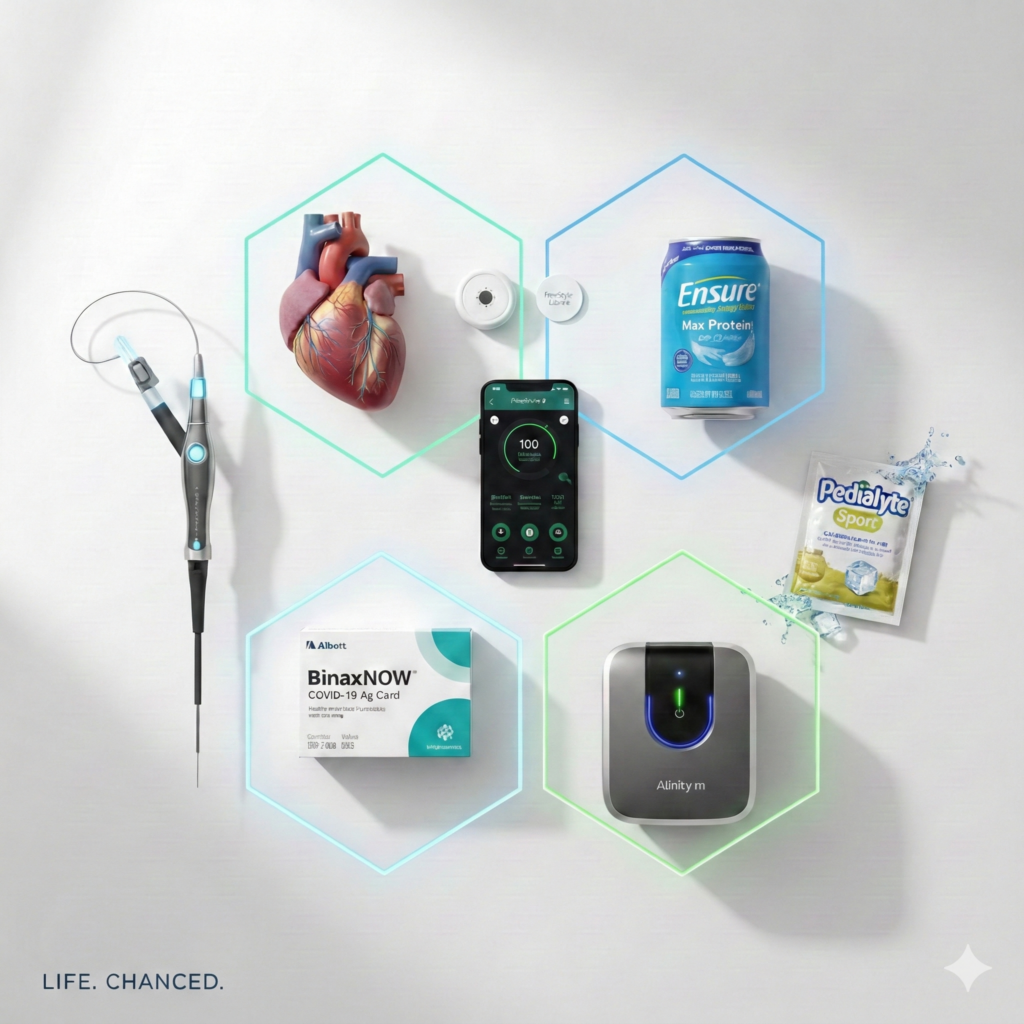
- FDA Approval: Received approval for the Volt PFA System, Abbott’s first pulsed field ablation offering in the U.S.
- CE Mark: Obtained for the TactiFlex Duo Ablation Catheter in Europe.
- Acquisition: The planned acquisition of Exact Sciences is expected to close in Q2 2026, positioning Abbott as a leader in the cancer diagnostics market.
2026 Guidance
- Organic Sales Growth: Projected in the range of 6.5% to 7.5%.
- Adjusted Diluted EPS: Estimated between $5.55 and $5.80, reflecting approximately 10% growth at the midpoint.
Five-Year Financial Ratio Analysis (2021-2025)
Based on Abbott’s annual reports and the latest 2025 earnings release, here is the summary of the core financial ratios for the past five years:
| Item | 2021 | 2022 | 2023 | 2024 | 2025 |
| Revenue (Billion USD) | 43.1 | 43.7 | 40.1 | 40.1 | 44.3 |
| Gross Margin (%) | 52.0% | 51.5% | 50.7% | 51.2% | 52.5% |
| Operating Margin (%) | 19.5% | 18.8% | 14.7% | 14.8% | 15.2% |
| Net Margin (%) | 16.4% | 15.8% | 14.1% | 14.0% | 13.8% |
| Return on Equity ROE (%) | 20.8% | 19.2% | 15.4% | 15.1% | 14.8% |
| Current Ratio (x) | 1.7 | 1.4 | 1.5 | 1.5 | 1.6 |
| Debt-to-Equity D/E (x) | 0.55 | 0.48 | 0.45 | 0.42 | 0.40 |
Key Trend Analysis
- Strategic Pivot Post-Pandemic: The peak in 2021-2022 was heavily driven by COVID-19 testing demand. As testing revenue normalized in 2023-2024, the company pivoted back to its core Medical Devices segment. By 2025, the successful scaling of the FreeStyle Libre (Diabetes Care) and expansion in Electrophysiology pushed the Gross Margin back up to 52.5%.
- Profitability Resilience: While the Net Margin saw a slight decline to 13.8% in 2025 due to increased R&D investment and costs associated with the Exact Sciences acquisition announcement, the adjusted earnings continue to show double-digit growth, reflecting high-quality underlying performance.
- Strong Balance Sheet: The Debt-to-Equity ratio has consistently improved, dropping from 0.55 to 0.40. This deleveraging provides Abbott with significant financial flexibility to fund the Exact Sciences acquisition (expected to close in Q2 2026) without overextending its capital structure.
- Liquidity Management: A stable Current Ratio between 1.4x and 1.7x indicates that Abbott maintains a healthy cushion to meet short-term obligations while continuing to return capital to shareholders via dividends.
P/E Ratio Analysis vs. Competitors (as of Feb 2026)
Abbott (ABT) currently trades at a valuation that reflects its status as a diversified healthcare giant. Compared to pure-play medical device companies, its P/E ratio is balanced between stability and growth.
Competitor P/E Comparison Table (Estimated)
| Company (Ticker) | Forward P/E | Trailing P/E | Strategic Positioning |
| Abbott (ABT) | 19.9x – 21.8x | 26.1x – 30.2x | Diversified leader; valuation reflects stable double-digit growth. |
| Medtronic (MDT) | 17.9x | 25.9x | Discounted valuation due to slower organic growth rates. |
| Boston Scientific (BSX) | 21.0x | 38.5x | Premium valuation driven by dominance in Electrophysiology. |
| Stryker (SYK) | 23.9x | 35.7x | High premium due to robotic surgery and orthopedic growth. |
| DexCom (DXCM) | 32.1x | 40.9x | High-growth tech multiple; focuses solely on Diabetes Care. |
| Industry Average | ~20.4x | — | Abbott is currently trading in line with or slightly above peers. |
Deep Dive Analysis
1. Valuation Drivers: The “Diversification Premium”
Abbott’s Forward P/E of ~21x is slightly higher than the industry average, primarily because of its FreeStyle Libre franchise and the recent FDA approval of the Volt PFA System. Unlike pure-play device makers, Abbott’s diversified segments (Nutrition, Diagnostics, Established Pharmaceuticals) provide a “safety net” that investors are willing to pay for, especially in volatile macro environments.
2. Growth vs. Value Gap
- The Discount to High-Growth Peers: Compared to DexCom or Stryker, Abbott trades at a discount. This is because a portion of Abbott’s revenue comes from lower-growth areas like Nutrition and mature Pharmaceuticals, which carry lower multiples than high-tech surgical robotics or specialized diabetes tech.
- The Premium to Medtronic: Abbott consistently commands a higher P/E than Medtronic because Abbott has demonstrated a superior ability to innovate (e.g., PFA systems and biowearables) and maintain a cleaner balance sheet with higher organic growth.
3. The Exact Sciences Acquisition Impact
The planned acquisition of Exact Sciences (expected to close Q2 2026) is a critical factor for the 2026 P/E.
- Short-term: The market may “de-rate” the P/E slightly due to integration risks and temporary EPS dilution.
- Long-term: Entering the high-growth cancer screening market could lead to a multiple expansion, moving Abbott’s P/E closer to high-growth diagnostics peers.
Summary
Abbott is the “Goldilocks” of the sector—it is not as cheap (and slow) as Medtronic, nor as expensive (and volatile) as DexCom. Its ~20x forward multiple represents a fair price for a company delivering consistent 10% earnings growth and a solid dividend.
Strategic Rationale and Impact: Abbott’s Acquisition of Exact Sciences (2026)
Abbott’s acquisition of Exact Sciences, announced in late 2025 and slated for completion in Q2 2026, represents a transformative move to dominate the high-growth cancer diagnostics market. The deal is valued at approximately $21 billion in equity (roughly $105 per share), with an enterprise value of $23 billion including debt.
1. Strategic Rationale: Why This Deal Matters
The acquisition is designed to move Abbott beyond its traditional strengths in infectious disease and routine blood testing into the $60 billion precision oncology market.
- Market Leadership in Cancer Screening: Exact Sciences is the owner of Cologuard, the market-leading non-invasive colon cancer test. Abbott gains an immediate, dominant foothold in a segment with high physician and patient awareness.
- Precision Oncology Portfolio: Through the Oncotype DX platform, Abbott enters the personalized medicine space, helping clinicians tailor chemotherapy and hormone therapy for breast and colon cancer patients.
- Global Scaling (The “Abbott Engine”): Exact Sciences has historically been focused on the U.S. market. Abbott, with its presence in 160 countries, plans to “globalize” these tests, significantly expanding their Total Addressable Market (TAM).
- Future-Proofing with Liquid Biopsy: Exact Sciences’ pipeline includes multi-cancer early detection (MCED) blood tests and molecular residual disease (MRD) monitoring. These technologies represent the “Holy Grail” of diagnostics, aiming to detect cancer through simple blood draws before symptoms appear.
2. Financial Impact and 2026 Outlook
While the deal strengthens long-term growth, it introduces specific shifts in Abbott’s 2026 financial profile.
| Financial Metric | Estimated Impact (2026) | Rationale |
| Total Diagnostic Sales | >$12 Billion | Combined revenue makes Abbott a top-tier global diagnostic powerhouse. |
| Revenue Growth | Immediately Accretive | Exact Sciences is growing at a high-teens organic rate, lifting Abbott’s overall average. |
| Gross Margin | Accretive | Exact Sciences’ specialized tests typically command higher margins than routine diagnostics. |
| Adjusted EPS | Neutral to Slightly Dilutive | High integration costs and interest on the $21B+ debt will weigh on EPS in the first 12 months. |
| Debt-to-Equity | Slight Increase | Absorption of $1.8B net debt plus new financing for the cash acquisition. |
3. Market & Competitive Analysis
This acquisition fundamentally changes the competitive landscape:
- Vertical Integration: Abbott can now offer a “Full Lifecycle” of care—from early screening (Cologuard) to diagnostic guidance (Oncotype) and therapy monitoring (MRD).
- Direct Competition: This move places Abbott in direct competition with specialized diagnostic giants like Roche, Thermo Fisher, and Illumina (Grail).
- Provider Ecosystem: By controlling Cologuard, Abbott gains deeper access to primary care physicians (PCPs), which it can leverage to cross-sell its other products, such as nutritionals or chronic disease diagnostics.
4. Key Execution Risks
- Integration Complexity: Merging a high-growth, specialized biotech culture (Exact Sciences) into a massive, diversified conglomerate (Abbott) often carries cultural and operational friction.
- Reimbursement Sensitivity: Exact Sciences’ revenue is highly dependent on Medicare and private insurance reimbursement rates. Any unfavorable policy changes could impact the deal’s valuation.
- Technological Competition: The liquid biopsy space is crowded. Abbott will need to maintain high R&D spending to ensure Exact Sciences’ pipeline doesn’t lose out to competitors like Grail or Guardant Health.
Back to Abbott page