
1. Founding and Early Stage (2004-2008): From Snowboards to Software
- Origin (2004): Tobias Lütke, Scott Lake, and Daniel Weinand wanted to sell snowboards online and launched Snowdevil.
- Pivot (2006): Frustrated by the lack of flexible e-commerce tools, Lütke (a programmer) built his own platform using Ruby on Rails. They realized the software was more valuable than the snowboards and officially launched Shopify.
- Technical Foundation: They created Liquid, an open-source template language that remains the backbone of Shopify’s customizable themes today.
Core Technology: Built on Ruby on Rails (Tobias Lütke was a core contributor). Invention of Liquid, a flexible open-source template language that allowed for high customizability of web storefronts.
Core Strategy: Problem-Solution Fit. Pivoting from selling snowboards to providing a lightweight, developer-friendly alternative to the clunky, enterprise-heavy e-commerce software of the early 2000s.
Revenue Level: Under 10M USD. A niche player serving early-adopter hobbyists and small web-savvy entrepreneurs.
2. Ecosystem Building (2009-2013): Creating a Platform
- App Store Launch (2009): This was a turning point. By opening their API and launching an App Store, Shopify allowed third-party developers to build custom features, creating a massive self-sustaining ecosystem.
- Mobile & Payments (2010-2013): They launched a mobile app for merchants and introduced Shopify Payments, eliminating the need for complex third-party payment gateway setups.
- Offline Integration (2013): The launch of Shopify POS (Point of Sale) allowed merchants to sync their physical store inventory with their online shop.
Core Technology: Development of the Shopify API and the Shopify Payments infrastructure. Launch of the mobile management app.
Core Strategy: Platformization. Transforming from a tool into an ecosystem by launching the App Store. This allowed third-party developers to solve specific merchant problems, creating a “moat” through a network of thousands of integrations.
Revenue Level: Fast Growth. Revenue reached approximately 50M USD by 2013, with income beginning to shift from pure subscription fees to transaction-based “Merchant Solutions.”
3. IPO and Enterprise Growth (2014-2018): Scaling Up
- Shopify Plus (2014): They moved beyond small businesses by launching Shopify Plus, a high-end solution for large brands like Tesla, Nestlé, and Red Bull.
- Public Listing (2015): Shopify went public on the NYSE and TSX. Its stock became one of the best-performing tech assets over the following years.
- Social Commerce (2017): Major integrations with Instagram and Facebook allowed “social selling,” turning Shopify into a multi-channel hub.
Core Technology: Shopify Plus high-concurrency architecture (handling massive flash sales) and Omni-channel engines to sync inventory across social media and physical stores.
Core Strategy: Market Up-scaling. Launching Shopify Plus to capture high-volume brands (e.g., Kylie Cosmetics, Allbirds). Strategic partnerships with Facebook, Instagram, and Amazon to position Shopify as the “central command” for all sales channels.
Revenue Level: The 1B USD Milestone.
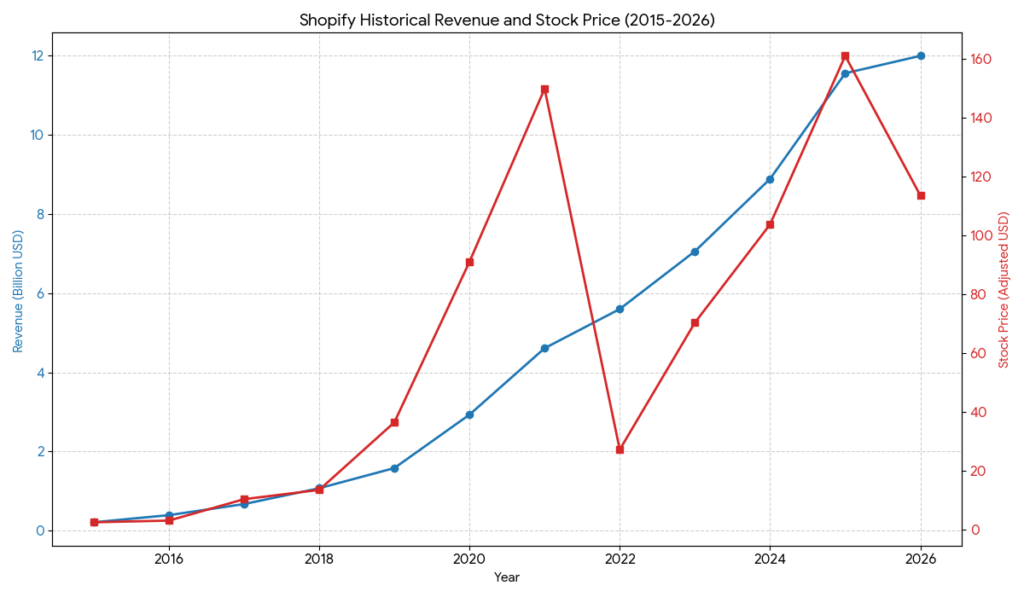
- 2015 (IPO): 205M USD
- 2018: 1.07B USD (First time exceeding 1 billion)
4. Logistics and the Pandemic Surge (2019-2022): The “Anti-Amazon”
- Fulfillment Network (2019): Shopify announced its own fulfillment network (SFN) to compete with Amazon’s FBA, aiming to provide end-to-end logistics for independent brands.
- The COVID-19 Boom (2020-2021): As physical stores closed, Shopify saw explosive growth. It became the second-largest e-commerce platform in the US by market share, trailing only Amazon.
- Shop App (2020): They rebranded their tracking app into Shop, a consumer-facing marketplace app to help users discover Shopify-powered brands.
Core Technology: Shopify Fulfillment Network (SFN) software and the Shop App (consumer-facing discovery and tracking).
Core Strategy: Vertical Integration (The Anti-Amazon). Attempting to build a physical logistics and warehouse network to give independent merchants Amazon-like shipping speeds while allowing them to keep their own brand identity.
Revenue Level: Explosive Growth.
- 2020: 2.93B USD (86% YoY growth due to COVID-19)
- 2022: 5.60B USD
5. Efficiency and AI Revolution (2023-Present): Streamlining for the Future
- Divesting Logistics (2023): In a major strategic shift, Shopify sold its logistics business (Deliverr) to Flexport, refocusing entirely on its core software and global commerce “operating system.”
- AI Integration (2024-2025): The platform launched Shopify Magic and Sidekick, generative AI tools that help merchants write product descriptions, edit photos, and analyze store data automatically.
- Market Position: Shopify now powers roughly 10% of all US e-commerce and continues to expand globally, positioning itself as the essential infrastructure for “unified commerce” (online, offline, and social).
Core Technology: Shopify Magic (Generative AI for descriptions/images) and Sidekick (an AI commerce assistant). High-speed checkout optimization via Shop Pay.
Core Strategy: Asset-Light & Profitability. Divesting the capital-intensive logistics business to Flexport. Refocusing on high-margin software and AI to improve merchant conversion rates. Strengthening the “Unified Commerce” approach (online + offline).
Revenue Level: Heading toward 10B+ USD.
- 2023: 7.06B USD
- 2024: 8.89B USD
- 2025: 11.56B USD (Latest data, 30.1% YoY)
Competitive Landscape Analysis
Shopify competes across three distinct dimensions: Direct SaaS Platforms, Centralized Marketplaces, and Enterprise-Grade Solutions.
1. Strategic Positioning (The Ecosystem War)
- Shopify vs. Amazon (The “Anti-Amazon” Alliance):
- Strategic Difference: Amazon is a discovery engine (they own the customer). Shopify is an enablement engine (the merchant owns the customer).
- Convergence: Recent integrations like Buy with Prime show a strategic truce, where Shopify merchants can use Amazon’s logistics while maintaining their own brand identity on Shopify’s storefront.
- Shopify vs. BigCommerce / Wix (The Feature War):
- Shopify’s Edge: The App Store (8,000+ integrations) and Shop Pay. Shop Pay’s conversion rate is reportedly 10%–50% higher than standard guest checkouts.
- Competitor Edge: BigCommerce offers more native B2B features without needing apps; Wix is more intuitive for “drag-and-drop” design but lacks Shopify’s deep inventory management.
2. Market Share and Capability Comparison
| Competitor | Core Strength | Primary Weakness | Target Segment |
| Shopify | Ecosystem, Shop Pay, Ease of Use | App costs can stack up, Transaction fees | SMBs to High-Growth DTC |
| Amazon | Instant Traffic, FBA Logistics | No brand ownership, High commissions | Transaction-focused sellers |
| BigCommerce | Native B2B features, Multi-storefront | Smaller App ecosystem | Mid-market & B2B brands |
| Adobe (Magento) | Limitless Customization (Open Source) | Extremely high maintenance & IT cost | Global Enterprise / Complex Tech |
| WooCommerce | Free (Software), SEO dominance | Requires manual hosting & security | WordPress power users |
3. Key Competitive Moats (2025-2026)
- Unified Commerce (Online + Offline): Shopify’s POS (Point of Sale) systems have gained massive traction as retail shifts to a hybrid model. This is a weakness for pure-play digital competitors.
- The AI “Sidekick”: While competitors have AI plugins, Shopify has integrated generative AI into the core operating system, automating product photography, SEO descriptions, and customer support natively.
- Checkout Speed: Shop Pay has become a “network effect” asset. With over 150 million users opted-in, a customer can buy from any Shopify store with one click, creating a barrier that smaller SaaS platforms cannot replicate.
Source:
- https://stockanalysis.com/stocks/shop/revenue/
- https://www.macrotrends.net/stocks/charts/SHOP/shopify/revenue
- https://www.macrotrends.net/stocks/charts/SHOP/shopify/stock-price-history
- https://www.perplexity.ai/finance/SHOP.TO/earnings
- https://simplywall.st/stocks/us/software/nasdaq-shop/shopify/past
- https://investing.com/equities/shopify-inc-historical-data
- https://markets.businessinsider.com/stocks/shop-stock
- https://capital.com/en-int/analysis/shopify-stock-split
- https://sherocommerce.com/shopify-history/
- https://craftberry.co/articles/reinventing-e-commerce-the-history-of-shopify-2004-2024
- https://www.iflair.com/the-evolution-of-shopify-how-technology-shaped-its-ecommerce-empire/
- https://matrixbcg.com/blogs/brief-history/shopify
- https://pestel-analysis.com/blogs/brief-history/shopify
- https://brainstation.io/magazine/a-brief-history-of-shopify
Back to Shopify page