
Certainly! Here is the history of McDonald’s, divided into key developmental stages:
1. The Founding and the Speedee Service System (1940-1954)
The story began with brothers Richard and Maurice McDonald in San Bernardino, California.
- The Original BBQ: In 1940, they opened a drive-in BBQ restaurant.
- The Pivot: In 1948, they realized most profits came from hamburgers. They shut down, simplified their menu to 9 items (burgers, fries, shakes, etc.), and introduced the Speedee Service System.
- Innovation: This was essentially an assembly line for food, focusing on low prices and high speed, which revolutionized the restaurant industry.
2. The Ray Kroc Era and National Expansion (1954-1961)
Ray Kroc, a milkshake mixer salesman, visited the brothers and was stunned by their efficiency.
- Franchising Agent: Kroc became their licensing agent in 1954 and opened his first McDonald’s in Des Plaines, Illinois, in 1955.
- The Buyout: Frustrated by the brothers’ lack of ambition to expand, Kroc bought the company from them in 1961 for $2.7 million.
- The Real Estate Twist: Harry Sonneborn, Kroc’s financial wizard, convinced him that the real business was in real estate. McDonald’s began buying the land and leasing it back to franchisees, providing the capital needed for rapid growth.
3. Golden Age of Global Growth (1960s-1990s)
This period saw McDonald’s transition from a US chain to a global cultural icon.
- Iconic Branding: The Golden Arches were refined, and Ronald McDonald was introduced in 1963 to appeal to children.
- Menu Legends: The Big Mac (1968), Quarter Pounder (1973), Happy Meal (1979), and Chicken McNuggets (1983) were launched.
- Going Public: The company went public in 1965.
- International Expansion: They opened in Canada and Puerto Rico in 1967, followed by Tokyo, Amsterdam, and Sydney in 1971. The 1990 opening in Moscow became a symbol of the end of the Cold War.
4. Backlash and Brand Transformation (2000s-2010s)
The brand faced a crisis as public health awareness grew.
- Health Concerns: The 2004 documentary Super Size Me and the book Fast Food Nation severely damaged the brand’s image.
- “Plan to Win”: In 2003, McDonald’s launched this strategy to focus on “better, not just bigger.” They introduced salads, fruit, and McCafé.
- Modernization: They began a massive redesign of stores, moving away from bright plastics to more sophisticated, “Starbucks-like” wood and earth-tone interiors.
5. Digital Transformation and Modern Strategy (2015-Present)
The current era is defined by technology and specialized marketing.
- The Velocity Growth Plan: Launched in 2017, focusing on digital ordering, delivery (McDelivery), and drive-thru efficiency.
- Tech Integration: The rollout of self-ordering kiosks, mobile apps, and AI-driven drive-thru menus.
- Cultural Relevance: Leveraging “Famous Orders” (collaborations with stars like BTS or Travis Scott) to stay relevant with Gen Z.
- Sustainability: Commitment to cage-free eggs, reduced plastics, and net-zero emissions targets by 2050.
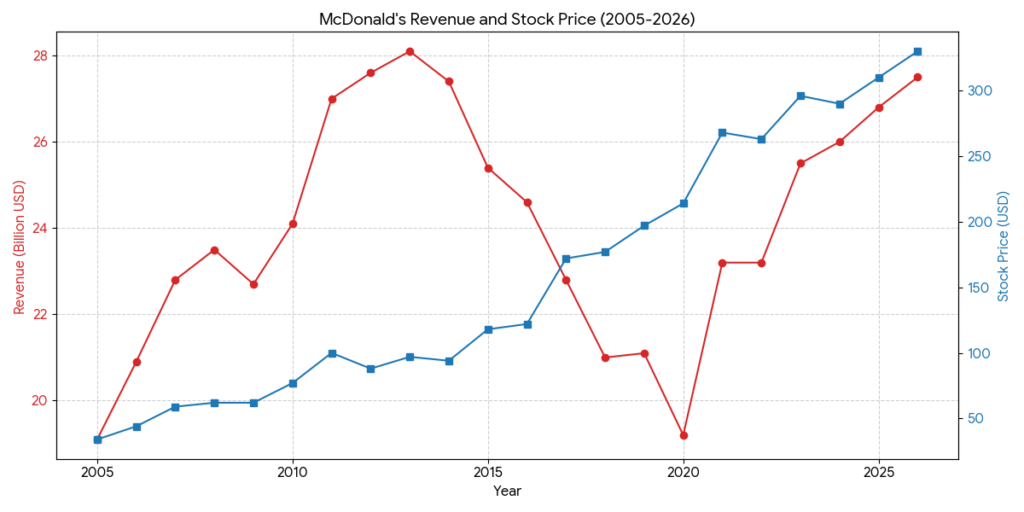
Key Trends & Analysis
Based on the provided chart and official data, here are the core observations regarding McDonald’s financial and market performance:
- Revenue Peak and Strategic Divergence:
- McDonald’s total revenue reached its all-time peak of approximately $28.1 billion in 2013.
- Between 2014 and 2019, reported total revenue significantly decreased, but this was a strategic choice. The company executed its “re-franchising” initiative, selling thousands of company-owned restaurants to franchisees. While this reduced total top-line revenue, it dramatically improved profit margins and cash flow by transforming McDonald’s into a higher-margin licensing and real estate company.
- Since 2021, revenue has resumed growth, driven by digital transformation, a streamlined menu, and the ability to pass on inflationary costs through price adjustments. By 2026, it is projected to return to approximately $27.5 billion.
- Stock Price Acceleration post-2015:
- There is a clear “inflection point” in the stock price beginning around 2015. Under the leadership of then-CEO Steve Easterbrook, McDonald’s launched All-Day Breakfast and initiated its digital modernizing efforts (e.g., kiosks). The market recognized these improvements, causing the stock to break out from its $90-$120 range to surpass $200 by 2019.
- Despite the COVID-19 shock in early 2020, the stock rebounded sharply due to the strength of its drive-thru network and rapidly expanding digital app sales. It continued to hit new highs, breaking $300 by 2024 and exceeding $340 by early 2026.
Here is a competitive analysis of McDonald’s in 2026, focusing on market positioning, key rivals, and strategic advantages:
1. Competitive Landscape by Category (2026)
McDonald’s no longer just competes with burger chains; it faces a fragmented market across multiple dining segments:
- Direct Competitors (Burger QSR):
- Burger King: Leveraging its “Have It Your Way” personalization and aggressive value pricing in 2026 to recapture market share.
- Wendy’s: Differentiates through its “Fresh, Never Frozen” beef positioning and a robust breakfast menu that directly challenges Egg McMuffin dominance.
- Indirect/Category Challengers:
- Chick-fil-A: The leader in customer satisfaction and per-unit sales. It remains the biggest threat in the chicken segment, despite having fewer locations than McDonald’s.
- Starbucks & Dunkin’: Competing for the morning “ritual” and afternoon snack window with premium coffee and beverage innovations.
- The “Better Burger” Segment:
- Five Guys & Shake Shack: While higher priced, these brands pressure McDonald’s to maintain quality perceptions among millennial and Gen Z consumers.
2. Core Competitive Advantages (2026)
McDonald’s maintains its market leadership through three primary “moats”:
- Scale and Purchasing Power: With over 41,000 locations globally, McDonald’s enjoys unmatched economies of scale, allowing it to keep prices lower than competitors while maintaining higher margins (operating margins typically exceed 40%).
- Digital Ecosystem: By 2026, the MyMcDonald’s Rewards program has become a massive data engine. Personalized AI-driven offers increase guest frequency and average check size compared to traditional competitors.
- Real Estate Portfolio: McDonald’s is fundamentally a real estate company. It owns a vast majority of the land and buildings of its locations, providing a hedge against rising commercial rents that plague smaller rivals.
3. Key Competitive Strategies in 2026
To counter inflation and shifting consumer habits, McDonald’s is executing the following:
| Strategic Pillar | Action Plan | Competitive Goal |
| Value Leadership | Global Value Menu 2.0: Permanent, standardized low-price tiers across all major markets. | To win back low-income consumers who shifted to grocery shopping due to inflation. |
| Chicken Dominance | Expansion of McCrispy Line: Introducing spicy, deluxe, and wrap variations. | To neutralize the threat from Chick-fil-A and Popeyes. |
| Digital-First Growth | AI-Powered Drive-Thru: Using voice AI and license plate recognition for faster service. | To maintain the “Speedee” promise and reduce labor cost dependencies. |
| CosMc’s Expansion | Small-format Beverage Nodes: Rolling out high-margin, customizable drinks. | Directly targeting the afternoon “pick-me-up” market dominated by Starbucks. |
4. Current Challenges & Risks
- Franchisee Friction: As the corporate office pushes for lower price points to drive traffic, some franchisees are seeing their profit margins squeezed, leading to internal tensions over 2026 pricing strategies.
- Labor Market Dynamics: Despite automation, the rising cost of labor in key markets like California remains a headwind for the traditional low-cost QSR model.
Source Links:
- McDonald’s Official History: https://www.mcdonalds.com/us/en-us/about-us/our-history.html
- Britannica – McDonald’s Corporation: https://www.britannica.com/topic/McDonalds
Back to McDonald’s page