
L’Oréal 2025 Annual Results: Key Highlights & Analysis
Financial Summary
- Sales: €44.05 billion, up +4.0% like-for-like and +1.3% reported.
- Operating Margin: 20.2% of sales (up +20 bps), reaching a record €8.89 billion in operating profit.
- Gross Margin: 74.3% (up +10 bps), demonstrating strong pricing power and efficiency gains despite currency headwinds.
- Cash Flow: Net cash flow reached €7.2 billion, a robust increase of +7.8%.
- Shareholder Returns: EPS of €12.71 (+0.4%); proposed dividend of €7.20 (+2.9%).
Division & Region Performance
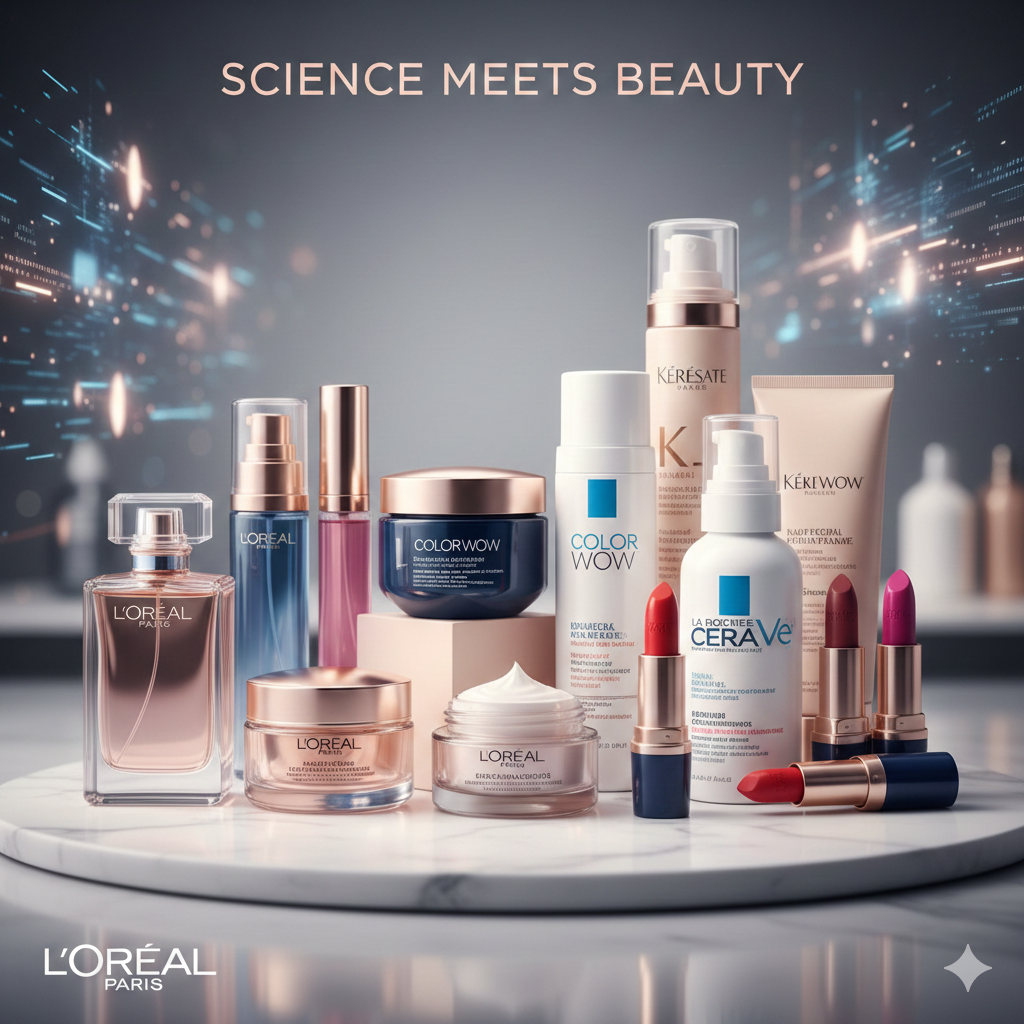
- Professional Products (+7.5% LFL): The top performer, crossing the €5bn milestone. Success was driven by premium haircare (Kérastase) and the integration of Color Wow.
- Dermatological Beauty (+5.5% LFL): Saw a massive acceleration in Q4 (+11.5%), with La Roche-Posay remaining the primary contributor.
- Consumer Products (+3.5% LFL): Gained momentum in H2, led by L’Oréal Paris and NYX Professional Makeup.
- L’Oréal Luxe (+2.8% LFL): Reinforced global leadership, particularly in Fragrances (YSL, Valentino, Prada) and the high-end segment (Aesop).
- Regional Recovery: Significant second-half recovery in the US and China, while Europe remained steady and emerging markets showed double-digit growth.
Strategic Analysis
1. Resilience Through Premiumization
Despite a volatile macro environment, L’Oréal’s focus on “Luxury” and “Dermatological” segments paid off. Fragrances, in particular, acted as a powerful growth engine, proving that consumers are still willing to spend on high-value, “treat-yourself” categories.
2. Strategic M&A and Market Adjacencies
The year was defined by bold moves:
- Kering Beauté: Strengthening the luxury brand portfolio.
- Galderma: Increasing the stake to capture the fast-growing Medical Aesthetics market, aligning beauty with healthcare.
- AI & Tech: Continued investment in AI and IT transformation to support an e-commerce business that now accounts for over 30% of total sales.
3. Operational Excellence
L’Oréal managed to expand margins (both Gross and Operating) while maintaining high investment levels in R&I (3.1%) and Advertising (32.2%). This suggests that the group is successfully using “Value Creation” (efficiency and mix) to offset inflationary pressures and currency fluctuations (-3.6%).
4. 2026 Outlook
The group remains optimistic, betting on a “gradually improving beauty market.” Their “multi-division” strategy allows them to capture growth wherever it happens—whether in mass-market recovery or high-end medicalized beauty.
Based on L’Oréal’s performance from 2021 to 2025, here is a detailed analysis of the company’s Profitability, Operating Efficiency, and Capital Structure.
1. Profitability Analysis
L’Oréal has demonstrated a consistent ability to expand margins despite macroeconomic headwinds, driven by a strategy of “premiumization.”
- Steady Margin Expansion: The operating margin has followed a clear upward trajectory, growing from 19.1% in 2021 to a record 20.2% in 2025. This reflects the group’s success in premiumizing its portfolio and achieving economies of scale.
- High Gross Profitability: Gross margin reached 74.3% in 2025, an all-time high. The ability to maintain margins above 70% during periods of high inflation and supply chain disruption underscores L’Oréal’s immense pricing power and strong brand equity.
- Earnings Quality: EPS grew from €8.82 in 2021 to €12.71 in 2025 (+44% over five years). This bottom-line growth is supported by real operational gains rather than purely financial engineering.
2. Operating Efficiency Analysis
The group optimizes its resource allocation by balancing heavy brand investment with strict control over administrative costs.
- Marketing Efficiency (Brand Fuel): Advertising and promotion (A&P) expenses have consistently been maintained at ~32% of sales. Instead of cutting marketing to boost short-term profit, L’Oréal uses AI and data analytics to increase the ROI of its ad spend, particularly as e-commerce now accounts for over 30% of total revenue.
- Resource Allocation: Research & Innovation (R&I) investment remains stable at 3.1% of sales. This disciplined spending ensures a constant pipeline of high-margin innovations (e.g., medicalized beauty and couture fragrances) that drive future growth.
- SG&A Optimization: Selling, general, and administrative expenses decreased to 18.8% in 2025 (down from 18.9% in 2024), showing that the company is successfully leveraging its digital and IT transformation to streamline operations.
3. Capital Structure & Financial Soundness
L’Oréal maintains a “fortress” balance sheet that provides the agility needed for aggressive M&A.
- Strong Cash Generation: Net cash flow increased significantly to €7.2 billion in 2025 (a 7.8% YoY increase). This strong “self-financing” capability allows the group to fund major acquisitions (such as Aesop, Kering Beauté, and increased stakes in Galderma) without over-leveraging.
- Disciplined Capex: Capital expenditures are typically around 3.8% of sales, focused on industrial capacity, sustainability initiatives, and the digitization of the supply chain.
- Shareholder Returns: The dividend has increased from €4.80 in 2021 to €7.20 in 2025, reflecting a payout policy that balances rewarding shareholders with retaining enough capital for strategic reinvestment.
Summary Table: Five-Year Financial Ratios
| Ratio | 2021 | 2022 | 2023 | 2024 | 2025 |
| Gross Margin | 73.9% | 72.4% | 73.9% | 74.2% | 74.3% |
| Operating Margin | 19.1% | 19.5% | 19.8% | 20.0% | 20.2% |
| A&P % of Sales | 32.8% | 31.5% | 32.4% | 32.2% | 32.2% |
| Net Cash Flow (€bn) | 5.65 | 5.00 | 6.12 | 6.64 | 7.20 |
| Dividend Per Share | €4.80 | €6.00 | €6.60 | €7.00 | €7.20 |
In the beauty and personal care industry, P/E ratios reflect market confidence in a company’s category mix and geographic resilience. L’Oréal consistently commands a valuation premium compared to diversified conglomerates like LVMH, while appearing “cheaper” than Estée Lauder, which is currently undergoing a significant earnings recovery phase.
Comparative P/E Analysis (Estimated 2026)
The following table compares L’Oréal with its primary competitors based on forward-looking market consensus for 2026.
| Company | Forward P/E (2026E) | Primary Focus | Market Sentiment & Rationale |
| L’Oréal | 28.0x – 30.0x | Pure Beauty (All tiers) | The Benchmark. High multiple due to consistent double-digit EPS growth and dominance in the high-margin “Dermatological Beauty” segment. |
| Estée Lauder | 45.0x – 55.0x | Prestige Beauty | The Recovery Play. The P/E is artificially high because earnings (denominator) are still recovering from China and travel retail slumps. It reflects “hope” for a turnaround. |
| LVMH | 22.0x – 24.0x | Luxury Conglomerate | The Diversified Value. Valuation is dragged down by the more cyclical Fashion & Leather Goods divisions, despite strong performance in Sephora and Fragrances. |
| Beiersdorf | 22.0x – 26.0x | Skin Care (Nivea, etc.) | The Defensive Choice. Stable but slower growth compared to L’Oréal; lacks the same aggressive M&A firepower, leading to a lower multiple. |
Key Analysis: Why L’Oréal Earns its Premium
1. “Anti-Fragile” Portfolio Mix
Unlike Estée Lauder, which is heavily weighted toward high-end prestige, L’Oréal’s portfolio spans from Mass Market (Consumer Products) to Medical Aesthetics (Galderma stake). This diversification allows L’Oréal to capture “trading down” behavior during economic slowdowns, making its earnings more predictable—a quality investors pay a premium for.
2. Digital & E-commerce Leadership
Market analysts assign a higher P/E to L’Oréal because of its tech-first approach. With e-commerce exceeding 30% of sales in 2025/2026, the company is viewed as a “Beauty Tech” leader. Its investments in AI for personalized marketing provide a data moat that traditional competitors struggle to match.
3. Strategic Exposure to “Medicalized Beauty”
L’Oréal’s 2025 expansion into medical aesthetics (via Galderma) and its leadership in Dermatological Beauty (CeraVe, La Roche-Posay) place it in a higher-growth category than standard cosmetics. This “Health is the new Beauty” trend is a major driver of the 2026 valuation multiple.
Investment Perspective
- L’Oréal is currently priced for perfection. Any significant slowdown in its H2 2026 organic growth could lead to a “de-rating” (a drop in the P/E multiple).
- Estée Lauder remains a high-risk, high-reward play. If their Profit Recovery Plan (PRGP) exceeds expectations, the P/E will normalize as earnings jump, potentially leading to share price outperformance.
Source:
- 2025 Results: https://www.loreal-finance.com/eng/press-release/2025-annual-results
- 2024 Results: https://www.loreal-finance.com/eng/press-release/2024-annual-results
Back to L’Oreal page