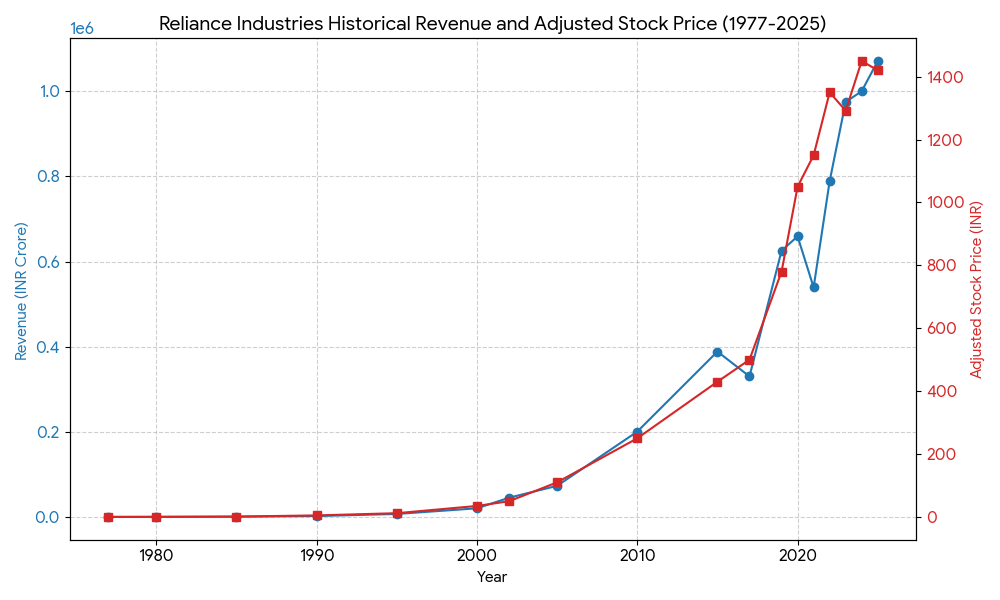
The history of Reliance Industries can be categorized into four distinct phases, reflecting its evolution from a small trading firm to a global conglomerate:
Phase 1: The Trading and Textiles Era (1958–1980)
Founded by Dhirubhai Ambani, this period laid the foundation for the Reliance empire.
- 1958: Dhirubhai returned from Yemen to Mumbai and established Reliance Commercial Corporation, focusing on spice and rayon trading.
- 1966: The first textile mill was established in Gujarat under the brand name Vimal.
- 1977: The company went public. Dhirubhai’s strategy of attracting small retail investors transformed the Indian stock market culture, making Reliance one of the most widely held companies in India.
Core Products: Spices, rayon, Vimal branded fabrics, and polyester yarn.
Core Strategy:
- Mass Market Branding: Established “Vimal” as a household name in India to drive consumer demand.
- Equity Cultivation: Pioneered the practice of attracting small retail investors during the 1977 IPO, creating a loyal shareholder base that bypassed traditional institutional lending.
Revenue Level: Approximately 700 million INR (approx. 80 million USD) at the time of its 1977 listing.
Phase 2: Vertical Integration and Petrochemical Expansion (1981–2001)
Led by Dhirubhai and his sons, Mukesh and Anil Ambani, this phase saw the company move upstream into raw materials.
- 1980s: Entry into polyester fibers and petrochemical feedstocks like PTA and MEG.
- 1990s: Diversification into power and telecommunications began.
- 1999: The Jamnagar Refinery was commissioned. It remains the world’s largest single-location refinery, cementing Reliance’s status as a global energy giant.
Core Products: Spices, rayon, Vimal branded fabrics, and polyester yarn.
Core Strategy:
- Mass Market Branding: Established “Vimal” as a household name in India to drive consumer demand.
- Equity Cultivation: Pioneered the practice of attracting small retail investors during the 1977 IPO, creating a loyal shareholder base that bypassed traditional institutional lending.
Revenue Level: Approximately 700 million INR (approx. 80 million USD) at the time of its 1977 listing.
Phase 3: Leadership Succession and De-merger (2002–2015)
Following Dhirubhai’s death in 2002, a power struggle between the brothers led to a formal split of the group.
- 2005: Under their mother’s mediation, the group was divided:
- Mukesh Ambani: Retained the core energy and petrochemical assets.
- Anil Ambani: Took over telecommunications, power, and financial services.
- 2006: Mukesh launched Reliance Retail, rapidly expanding into supermarkets and convenience stores across India.
Core Products: Refined petroleum products and Reliance Retail (supermarkets, electronics, fashion).
Core Strategy:
- Consumer-Facing Shift: Used the massive cash flows from the energy business to seed Reliance Retail (founded 2006), pivoting from a B2B industrial giant to a B2C powerhouse.
- Organizational Restructuring: Navigated the 2005 de-merger, with Mukesh Ambani consolidating the energy and manufacturing core.
Revenue Level: Reached approximately 4.1 trillion INR (approx. 67 billion USD) by FY2014.
Phase 4: Digital Transformation and Green Energy (2016–Present)
Mukesh Ambani shifted the group’s focus toward “Data” and “Technology,” redefining Reliance as a tech-driven conglomerate.
- 2016: Launched Jio, offering disruptive 4G data pricing. Jio quickly became India’s largest telecom provider and built a massive digital ecosystem.
- 2020: Jio Platforms attracted multi-billion dollar investments from global tech giants, including Google and Meta.
- 2021: Announced a 75 billion USD investment in renewable energy, aiming for net-zero carbon by 2035 and large-scale green hydrogen production.
Core Products: Jio (4G/5G telecommunications & digital ecosystem), e-commerce (Jiomart), and Renewable Energy (hydrogen, solar).
Core Strategy:
- Data Dominance: Launched Jio in 2016 with disruptive pricing to capture the largest telecom user base in India, treating “data as the new oil.”
- Platform Business Model: Attracted strategic investments from Meta and Google to transform from a conglomerate into a tech platform.
- New Energy Vision: Committed 75 billion USD to green energy to transition toward a net-zero carbon footprint by 2035.
Revenue Level: Hit a record high of 10.7 trillion INR (approx. 125 billion USD) in FY2025.
The Oil-to-Chemicals (O2C) segment is the traditional engine of Reliance Industries, characterized by high integration and world-class scale. As of 2026, the competitive landscape is defined by a shift from transportation fuels toward high-value petrochemicals.
1. Core Competitive Advantages
- Complexity and Scale: The Jamnagar complex has a high Nelson Complexity Index, allowing it to process heavy, “dirty” crude (which is cheaper) into high-value products. It is the world’s largest single-location refinery.
- Deep Integration: Unlike traditional refiners, Reliance can divert up to 70% of its refined output toward petrochemical building blocks (Paraxylene, Ethylene, Propylene). This reduces exposure to the volatile gasoline and diesel markets.
- Strategic Location: Situated on the west coast of India, the refinery has a logistical advantage for both importing crude from the Middle East and exporting finished products to Europe and East Africa.
- Cost Efficiency: Through its gasification plants, Reliance converts low-value petroleum coke into synthetic gas (syngas) to fuel its operations, significantly lowering its energy costs compared to peers.
2. Competitive Landscape
Reliance competes with both state-owned giants and global energy majors:
| Category | Key Competitors | Competitive Dynamics |
| Indian PSUs | Indian Oil (IOCL), BPCL | These firms control the domestic retail fuel market. While Reliance is more efficient, PSUs have broader government-backed infrastructure for domestic distribution. |
| Global Majors | Shell, ExxonMobil | Compete in the high-end specialty chemicals and lubricants market. They have a head start in low-carbon technology R&D. |
| Regional Rivals | Nayara Energy | Backed by Rosneft, Nayara operates a high-complexity refinery nearby, directly competing for export quotas in the Asian and Middle Eastern markets. |
| Upstream Titans | Saudi Aramco | Aramco has the advantage of owning the crude supply. Their “Crude-to-Chemicals” initiatives in Saudi Arabia and China represent the most significant long-term threat to Reliance’s margins. |
3. Strategic Challenges (2025–2026)
- Peak Oil Demand: The rise of Electric Vehicles (EVs) in India and globally is flattening the growth curve for transport fuels. Reliance is countering this by increasing the “chemical conversion” ratio of its refinery.
- Global Capacity Glut: Massive petrochemical capacity additions in China have led to thinner margins (spreads) for polymers like Polyethylene (PE) and Polypropylene (PP).
- Carbon Border Taxes: The European Union’s CBAM (Carbon Border Adjustment Mechanism) increases the cost of Reliance’s exports to Europe unless it can prove low carbon intensity in its production.
4. Future Pivot: From O2C to Green Energy
Reliance is currently repurposing parts of the O2C segment to align with its 2035 Net Zero Goal:
- Blue Hydrogen: Using carbon capture at its O2C plants to produce low-emission hydrogen.
- Sustainable Aviation Fuel (SAF): Exploring the conversion of refinery streams into green fuels for the aviation industry.
Source:
- https://www.ril.com/investors/financial-reporting
- https://www.britannica.com/topic/Reliance-Industries-Limited
- https://en.wikipedia.org/wiki/Reliance_Industries
- https://www.researchgate.net/publication/326402460_EFFECT_OF_RELIANCE_JIO_ON_DIGITAL_INDIA
- https://www.nseindia.com/get-quotes/equity?symbol=RELIANCE
- https://www.ril.com/ar2023-24/new-energy.html
- https://www.screener.in/company/RELIANCE/consolidated/
- http://www.primedatabasegroup.com/newsroom/M654.pdf
Back to Reliance Industries page