
Evolution of International Holding Company (IHC.AE)
The transformation of IHC from a local fish farming business into a global investment powerhouse is one of the most significant corporate stories in the United Arab Emirates. Its history can be divided into three distinct phases:
1. The Foundational Phase (1998–2018): Aquaculture and Food
- 1998: Founded in Abu Dhabi as Asmak (Arabic for “fish”). Its primary focus was fish farming, seafood processing, and export.
- 2005: Listed on the Abu Dhabi Securities Exchange (ADX). For the next decade, it remained a relatively small player in the UAE’s non-oil sector.
- Early Diversification: The company began venturing into real estate and basic services, but its market capitalization remained modest compared to today’s scale.
Core Products:
- Aquaculture & Fisheries: Primary focus on fish farming, seafood processing, and trading under the Asmak brand.
- Ancillary Services: Small-scale poultry farming, landscaping, and basic real estate management.
Core Strategy:
- Vertical Integration: Focusing on the domestic food supply chain to support UAE food security.
- Local Focus: Operating as a specialized industrial entity serving the regional market.
Revenue Level:
- Low Scale: Annual revenue typically remained below AED 1 billion. A stable but small-cap enterprise.
2. The Transformation Phase (2019–2021): Hyper-Growth and Restructuring
- 2019: A pivotal year marked by a strategic shift toward becoming an active investment holding company. The company began aggressive equity acquisitions and asset restructuring.
- 2020: Officially rebranded as International Holding Company (IHC) to reflect its multi-sector investment mandate.
- Market Dominance: During this period, IHC utilized the ADX “Second Market” to list several subsidiaries (such as Palms Sports and Zee Stores), unlocking significant value. By 2021, IHC became the most valuable listed company on the ADX, surpassing long-standing giants.
Core Products:
- Healthcare: Strategic entry through assets like Pure Health (COVID-19 testing and lab services).
- Real Estate & Industrial: Consolidation of major developers and infrastructure service providers.
- Consumer Goods: Expansion into supermarket chains and large-scale food distribution.
Core Strategy:
- Aggressive Acquisition: Rolling up high-potential companies across diverse sectors.
- Monetization via IPOs: Listing consolidated subsidiaries on the ADX Second Market to rapidly unlock valuation and liquidity.
Revenue Level:
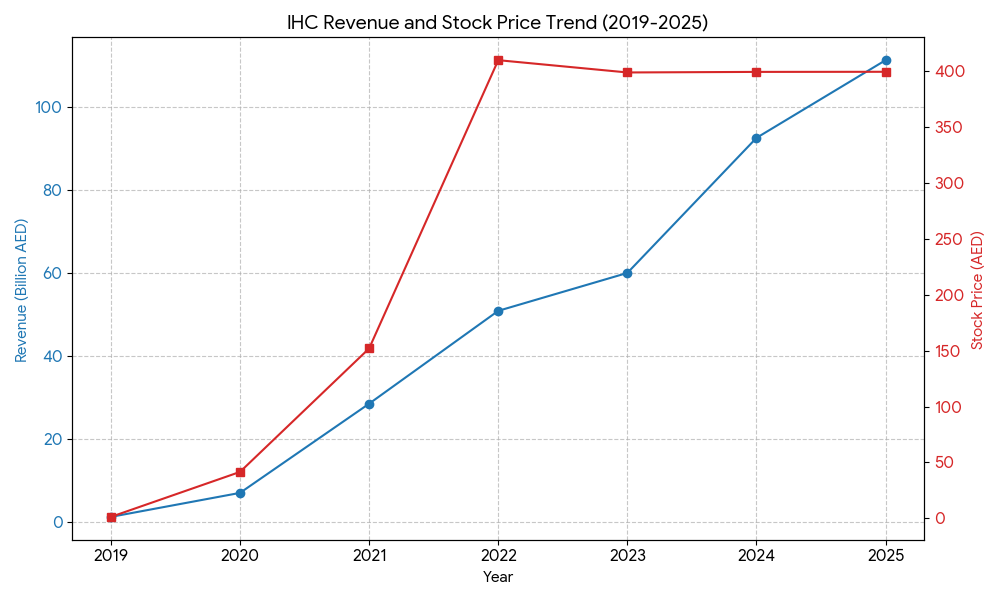
- 2020: Approximately AED 7 billion.
- 2021: Approximately AED 28.5 billion. (Driven by healthcare demand and massive M&A activity).
3. The Global Giant Phase (2022–Present): Consolidation and AI Integration
- Strategic Global Investments (2022-2023): IHC expanded its footprint internationally, including a $2 billion investment in India’s Adani Group and the acquisition of a stake in Turkey’s Kalyon Enerji.
- Asset Consolidation (2024-2025): * In early 2024, IHC established 2PointZero, a massive new holding company with assets exceeding $27 billion.
- By late 2025, IHC announced the merger of 2PointZero, Multiply Group, and Ghitha Holding, creating a next-generation investment platform valued at approximately AED 120 billion ($32.7 billion).
- AI-Driven Future (2026): In early 2026, IHC launched Judan Financial, an AI-powered financial platform managing AED 870 billion in assets, signaling a major shift toward digital transformation and fintech.
Key Pillars of IHC’s Success
- Strategic Leadership: Chaired by H.H. Sheikh Tahnoon bin Zayed Al Nahyan, the company benefits from strong institutional backing and a clear vision for the UAE’s economic diversification.
- The “IHC Model”: A strategy involving rapid acquisition, integration, and subsequent IPOs of subsidiaries to maximize shareholder returns.
- Sector Breadth: Today, IHC operates across nine vertical sectors—including Healthcare, Real Estate, Agriculture, Finance, and Technology—with over 1,300 subsidiaries.
Core Products:
- Global Investment Portfolio: Strategic stakes in energy, mining, renewable energy (e.g., Adani Group, Kalyon Enerji).
- Next-Gen Platforms: 2PointZero (mega-holding) and Judan Financial (AI-powered fintech).
- Technology & Frontier Markets: High-growth tech ventures and international infrastructure.
Core Strategy:
- International Diversification: Shifting focus from domestic growth to global market leadership across continents.
- AI Integration: Utilizing AI for board-level decision-making and operational efficiency across its 1,300+ subsidiaries.
- Ecosystem Synergy: Creating a closed-loop economy between its finance, energy, and construction verticals.
Revenue Level:
- 2023: Approximately AED 60.1 billion.
- 2024: Approximately AED 92.7 billion.
- 2025: Reached AED 111.4 billion (~$30.3 billion). Now one of the world’s largest and most profitable holding companies.
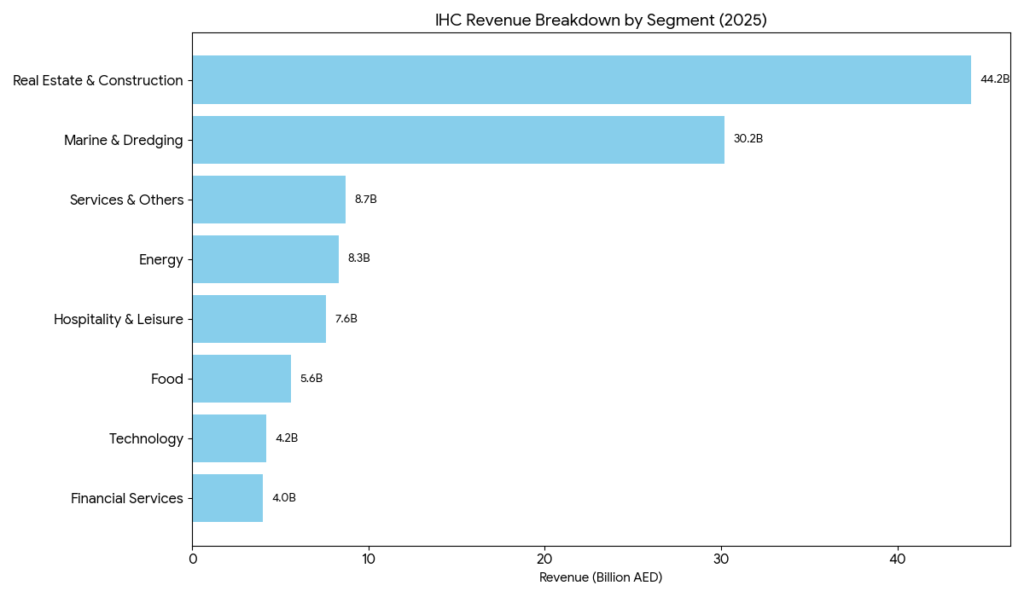
IHC Revenue Breakdown by Segment (2025)
Based on the 2025 audited financial results, International Holding Company (IHC) achieved a total revenue of AED 111.4 Billion. The portfolio has successfully shifted from its origins in aquaculture to a diversified industrial and financial powerhouse.
Revenue Contribution by Vertical
- Real Estate & Construction:AED 44.2B (39.7%)
- The largest contributor, driven by massive project deliveries and pre-sales from major entities like Modon and Aldar Properties.
- Marine & Dredging:AED 30.2B (27.1%)
- Primarily represented by NMDC Group, which saw significant growth through international expansion and large-scale infrastructure contracts.
- Services & Others:AED 8.7B (7.8%)
- A diverse segment including healthcare, education, telecommunications, and general support services.
- Energy:AED 8.3B (7.5%)
- Grown through strategic investments in conventional energy, mining, and renewable energy transitions.
- Hospitality & Leisure:AED 7.6B (6.8%)
- Reflects the post-pandemic tourism boom and the acquisition of luxury hospitality assets.
- Food:AED 5.6B (5.0%)
- Represented by Ghitha Holding, focusing on poultry, agriculture, and food security.
- Technology:AED 4.2B (3.8%)
- Includes digital transformation ventures and AI-driven tech investments.
- Financial Services:AED 4.0B (3.6%)
- Captures the revenue from newer fintech initiatives and asset management platforms.
Competitive Analysis: Real Estate & Construction (IHC’s Largest Segment)
The Real Estate & Construction segment is IHC’s primary engine, contributing AED 44.2 Billion (39.7%) to the 2025 revenue. IHC operates this sector through its powerhouse subsidiaries, primarily Modon Holding and its significant stake in Aldar Properties.
1. Key Market Players & Rivalry
IHC competes in a high-stakes environment dominated by government-backed giants and aggressive private developers.
| Competitor | HQ | Core Strength | Threat Level |
| Emaar Properties | Dubai | Global brand equity; dominates luxury retail (Dubai Mall) and high-rise icons (Burj Khalifa). | High (Direct rival for international investors) |
| Nakheel / Meydan | Dubai | Master-developer of waterfront icons (Palm Jumeirah); strong state backing for urban expansion. | Medium (Geographic competition in Dubai) |
| Damac Properties | Dubai | Rapid execution and high-impact marketing; specializes in branded luxury residences. | Medium (Competes for HNWIs) |
| ROSHN | Saudi Arabia | Backed by Saudi’s PIF; massive land bank and scale. Competitive for regional capital. | Emerging (Regional expansion rival) |
2. Strategic Competitive Advantages (The “IHC Moat”)
- Vertical Ecosystem Integration: Unlike many developers who outsource, IHC owns the entire value chain. It can utilize its own Marine & Dredging (NMDC) for land reclamation and its own industrial subsidiaries for construction materials. This leads to better margin control and shorter delivery cycles.
- Privileged Land Access: Through its relationship with the Abu Dhabi government, entities like Modon Holding receive priority access to strategic land banks (e.g., Hudayriyat Island), which are often inaccessible to private competitors.
- Consolidation Power: IHC has a unique ability to merge smaller entities into mega-platforms (like the formation of Modon Holding), creating economies of scale that few regional players can match.
3. SWOT Analysis
- Strengths: Unmatched capital liquidity; deep integration with Abu Dhabi’s “Economic Vision 2030”; high pre-sales velocity in 2025.
- Weaknesses: High geographic concentration in Abu Dhabi; complex corporate structure which can be difficult for some international analysts to value.
- Opportunities: Expansion into the Saudi Arabian market (Vision 2030 projects); growing demand for “Sustainable/Net-Zero” smart cities; launching REITs (Real Estate Investment Trusts) to monetize completed assets.
- Threats: Rising global interest rates affecting mortgage affordability; potential oversupply in the UAE residential market leading to price corrections.
4. 2026 Competitive Pivot: The AI Edge
The biggest differentiator for IHC in 2026 is the integration of AI-driven decision-making. While Emaar and Damac focus on architectural design and marketing, IHC is utilizing Aiden Insight (their AI board observer) to:
- Predict Demand: Analyze global capital flows to determine which nationalities are buying in Abu Dhabi before launching projects.
- Optimize Yields: Use real-time data to manage occupancy and maintenance in their massive property management portfolio, aiming for higher net margins than the industry average.
Competitive Analysis: Marine & Dredging (IHC’s Second Largest Segment)
The Marine & Dredging segment, operated through NMDC Group (National Marine Dredging Company), is a strategic pillar for IHC, contributing AED 30.2 Billion (27.1%) to 2025 revenue. NMDC is not just a regional player; it has evolved into a global engineering, procurement, and construction (EPC) powerhouse.
1. Key Global Competitors
The dredging industry is a high-barrier, capital-intensive oligopoly. NMDC competes against the “Big Four” European firms and rising Asian giants.
| Competitor | HQ | Core Strength | Threat Level |
| Boskalis | Netherlands | Massive global fleet; leader in complex salvage and heavy lifting. | High (Direct rival for international mega-projects) |
| Jan De Nul | Belgium | Technical leader in offshore wind foundations and subsea cabling. | High (Superior in renewable energy infrastructure) |
| DEME Group | Belgium | Highly specialized in environmental dredging and “green” marine engineering. | Medium (Competes on sustainability and tech) |
| CHEC (China Harbour) | China | Scale and low-cost financing, particularly in “Belt and Road” regions. | Very High (Aggressive price competitor in Africa/Asia) |
2. Strategic “IHC” Advantages
NMDC’s competitive edge lies in its deep integration with the UAE’s sovereign goals and IHC’s internal ecosystem.
- Captive Market Demand: NMDC is the “go-to” contractor for Abu Dhabi’s massive artificial island and port projects. Because IHC also owns the developers (e.g., Modon), NMDC enjoys a guaranteed pipeline of high-value work.
- The Energy Synergy (NMDC Energy): Following the successful IPO of its energy subsidiary in late 2024, NMDC now dominates the offshore oil and gas EPC market in the Middle East. It currently stands as the #1 EPC contractor in the region, surpassing international rivals in backlog size ($40.1B for the energy vertical alone).
- Expansion into “Green” Marine: NMDC is aggressively pivoting toward offshore wind and subsea gas pipelines (e.g., its 2025 contract in Taiwan), reducing its reliance on traditional dredging.
3. Performance Comparison (2025 Data)
| Metric | NMDC Group (IHC) | European Peers (Avg) | Analysis |
| Revenue Growth | +10% to +29% | ~5% to 15% | NMDC is growing faster due to aggressive Middle East expansion. |
| Net Profit Margin | ~13.9% | ~6% to 9% | NMDC enjoys higher margins due to local project dominance and low tax (9%). |
| Backlog Visibility | AED 57.9B ($15.7B) | Varies | High visibility; backlog covers nearly 2 years of revenue. |
4. SWOT Analysis: NMDC Group
- Strengths: Unrivaled regional fleet; strong balance sheet post-IPO; deep integration with ADNOC and Aramco (long-term agreements).
- Weaknesses: 81% of revenue is still generated within the UAE, creating high concentration risk to regional geopolitics.
- Opportunities: The Saudi Vision 2030 projects (NEOM, Red Sea Global) represent a massive multi-decade growth opportunity for land reclamation.
- Threats: Stricter global maritime regulations (IMO 2030) requiring expensive fleet decarbonization; rising competition from Chinese state-owned firms in emerging markets.
5. 2026 Innovation: The Digital Fleet
In 2025-2026, NMDC began the full-scale deployment of AI across its vessels. This includes:
- Autonomous Dredging: Using AI to optimize the “cutting and suction” process, reducing fuel consumption by 15%.
- Predictive Maintenance: Real-time sensor data from vessels to prevent downtime in remote international project sites (like Taiwan or Egypt).
Sources:
- International Holding Company – Official Website
- ADX Listed Companies – IHC Profile
- Reuters – Abu Dhabi’s IHC forms new holding company
- Gulf Business – IHC 2026 Strategy Update
Back to IHC page