The history of Contemporary Amperex Technology Co., Limited (CATL) is a narrative of rapid technological evolution and strategic market positioning. Founded by Robin Zeng, the company transitioned from a mobile battery specialist to the world’s leading power battery manufacturer. Its journey can be divided into four distinct phases:
Phase 1: Technical Foundations and Spin-off (1999–2011)
The DNA of CATL originated from Amperex Technology Limited (ATL), founded in 1899. ATL focused on lithium-ion batteries for consumer electronics like mobile phones and laptops.
- The Pivot: As the electric vehicle (EV) trend emerged, the founding team recognized the massive potential in power batteries.
- Official Founding: In 2011, Zeng and his team spun off the power battery division from ATL to comply with Chinese regulations and founded CATL in Ningde, Fujian.
Core Products: Lithium-ion batteries for consumer electronics (mobile phones, laptops) under the ATL banner.
Core Strategy:
- Technology Transfer: Leveraging electrochemical expertise from consumer electronics to seed EV battery R&D.
- Strategic Spin-off: Establishing CATL as a separate entity in Ningde to focus exclusively on the automotive market and comply with local industry regulations.
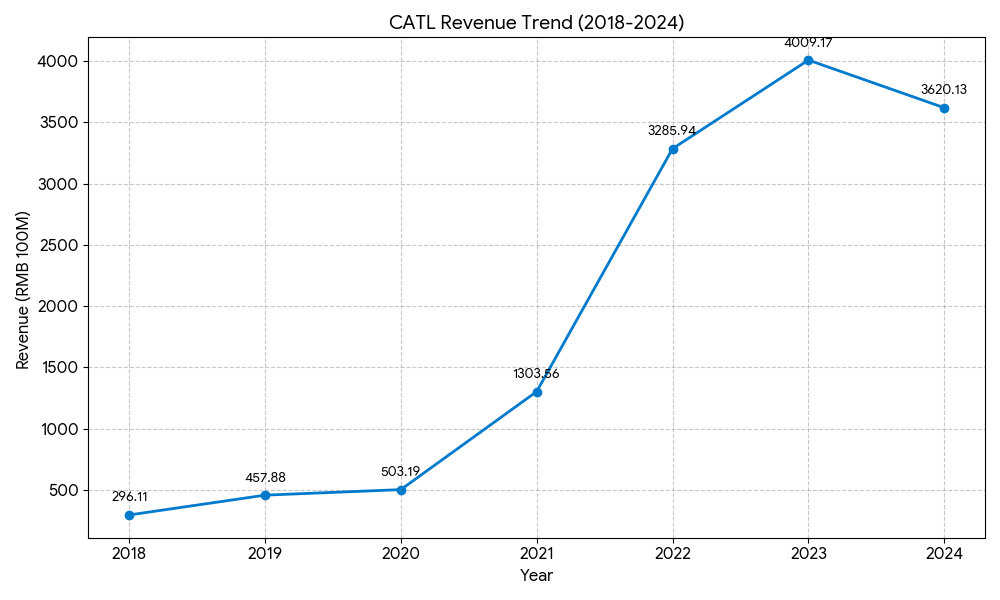
Revenue: Startup phase; revenue was minimal and primarily reinvested into early-stage power battery R&D.
Phase 2: The BMW Partnership and Policy Tailwinds (2012–2015)
This period established CATL’s technical credibility and market dominance within China.
- The BMW Breakthrough: In 2012, BMW selected the newly formed CATL as its battery supplier for the Zinoro 1E. BMW provided over 800 pages of technical specifications, which helped CATL build a world-class production and quality management system.
- The White List Advantage: In 2015, the Chinese government released the “Recommended Enterprise List for Automotive Power Batteries,” effectively excluding Japanese and Korean competitors from subsidies. This allowed CATL to rapidly capture the domestic market.
Core Products: Prismatic Lithium Iron Phosphate (LFP) and Nickel Manganese Cobalt (NMC) batteries.
Core Strategy:
- The BMW Pedigree: Partnering with BMW for the Zinoro 1E, which forced CATL to adopt 800+ pages of German industrial standards, setting a world-class quality benchmark.
- Regulatory Shield: Capitalizing on China’s “White List” policy (2015), which effectively restricted subsidies to domestic battery makers, allowing CATL to dominate the home market.
Revenue: Surpassed RMB5.7 billion by 2015, marking the start of exponential growth.
Phase 3: Global Expansion and IPO (2016–2020)
CATL scaled up massively and began its ascent to the global stage.
- Global Leadership: By 2017, CATL’s shipment volume surpassed Panasonic, making it the world’s largest power battery manufacturer for the first time.
- Public Listing: In 2018, CATL went public on the Shenzhen Stock Exchange (ChiNext), raising capital to further expand its capacity.
- Tesla Partnership: In 2020, CATL officially entered Tesla’s supply chain, providing Lithium Iron Phosphate (LFP) batteries for Model 3 and Model Y produced at the Shanghai Gigafactory.
Core Products: High-energy-density NCM batteries and the introduction of CTP (Cell-to-Pack) 1.0/2.0 technology.
Core Strategy:
- Capital Market Integration: Listing on the Shenzhen Stock Exchange (2018) to fund massive capacity expansion.
- The Tesla Catalyst: Entering Tesla’s Shanghai supply chain in 2020, validating their LFP technology for high-performance global EVs.
Revenue:
- 2017: RMB19.9 billion (First year as world #1).
- 2020: RMB50.3 billion.
Phase 4: Technological Innovation and Vertical Integration (2021–Present)
Facing increased competition and raw material price volatility, CATL shifted toward technological breakthroughs and supply chain control.
- Cutting-edge Tech: Launched the Qilin Battery (CTP 3.0), Shenxing Superfast Charging Battery, and ventured into Sodium-ion and Condensed batteries.
- Going Global: Established manufacturing bases in Germany and Hungary to serve European automakers locally.
- Supply Chain Resilience: Invested heavily in upstream mining (Lithium, Nickel, Cobalt) and downstream recycling through its subsidiary Brunp to secure the entire lifecycle of the battery.
Core Products: Qilin Battery (CTP 3.0), Shenxing Superfast Charging Battery, Sodium-ion batteries, and Condensed batteries.
Core Strategy:
- Vertical Integration: Investing in upstream lithium/nickel mines and downstream battery recycling (Brunp) to stabilize costs.
- Energy Storage (BESS): Diversifying into the energy storage market, which now accounts for over 15% of revenue.
- Global Localization: Opening plants in Germany and Hungary and utilizing the LRS (Licensing, Royalty, Service) model to bypass trade barriers.
Revenue:
- 2023: RMB400.9 billion.
- 2024: RMB362.0 billion (Note: Revenue dip due to falling lithium prices, but profit margins and GWh volume increased).
- 1H 2025: RMB178.9 billion (YoY +7.27%), showing a recovery in growth momentum.
Here is the competitive analysis for Contemporary Amperex Technology Co., Limited (CATL). The market landscape in 2025–2026 has evolved into a “one superpower, many strong contenders” dynamic.
Global EV Battery Market Landscape (2025 Data)
| Company | Global Market Share | Core Advantage |
| CATL | 39.2% | All-rounder: Global leader in energy density, cycle life, scale, and BESS (Energy Storage). |
| BYD | 16.4% | Vertical Integration: Self-supply for its own EV brand; high competitiveness in Blade Batteries (LFP). |
| LG Energy Solution | 9.2% | Global Footprint: Deeply rooted in North America and Europe, specializing in NCM pouch cells. |
| CALB | 5.3% | Cost-Efficiency: Strong penetration in mid-to-low-tier Chinese EVs; tied to GAC and Xpeng. |
| Gotion High-tech | 4.5% | Volkswagen Backing: Backed by VW Group, actively expanding LFP production overseas. |
| Panasonic | 3.7% | Tesla Alliance: Main supplier of 4680 cylindrical and high-end NCA batteries. |
Three-Dimensional Competitive Analysis
1. The Battle of Technology Routes
- CATL vs. BYD:
- LFP (Lithium Iron Phosphate): While BYD’s “Blade Battery” challenged CATL’s dominance in the domestic market, CATL responded with the Shenxing Superfast Charging Battery (4C charging). This solved the traditional LFP pain points of slow charging and poor low-temperature performance.
- NCM (Ternary Lithium): CATL’s Qilin Battery remains significantly superior to South Korean rivals (LG, SK On) in energy density and thermal management, securing the high-end, long-range segment.
- Next-Gen Tech (The 2026 Frontier):
- Sodium-ion Batteries: CATL has moved into mass production, with HiNa Battery as its primary competitor.
- Solid-State Batteries: This is the critical target post-2026. While Toyota aims for commercialization by 2027, CATL is utilizing Condensed Batteries as a bridge technology, maintaining its position in the first tier of R&D.
2. Geopolitics and Global Localization
- The IRA Challenge: To navigate the U.S. Inflation Reduction Act, CATL has shifted to the LRS (Licensing, Royalty, Service) model (e.g., the Ford partnership). This allows them to export technology without direct ownership, bypassing certain trade restrictions.
- European Expansion: With plants in Hungary and Germany operational, CATL competes directly with LG and Northvolt. However, CATL’s manufacturing efficiency—with a cell production time of less than 2 seconds—gives it an estimated 20% cost advantage over local European competitors.
3. Energy Storage: The Second Growth Engine
- CATL’s Energy Storage Systems (e.g., the TENER series) saw a surge in 2025, with market share approaching 40%.
- Competitors: Beyond BYD, CATL faces competition from Tesla (Megapack) and Sungrow. CATL’s edge lies in its “five-year zero-degradation” technology, which currently leads the industry in terms of dollar-per-cycle lifecycle costs.
Summary: CATL’s Competitive Moat
- R&D Barrier: R&D investment remains above 5% of revenue in 2025, with the world’s largest battery-related patent portfolio.
- Supply Chain Control: Through Brunp Recycling, CATL extracts raw materials from old batteries and holds stakes in upstream lithium and nickel mines, providing resilience against price volatility.
- Extreme Manufacturing: Recognized as a “Lighthouse Factory” by the WEF, its automation and yield rates are key weapons against rising labor costs and international tariffs.
Source:
- https://www.catl.com/en/about/profile/
- https://www.catl.com/en/enterpriseinfoEnglish/
- https://www.catl.com/en/research/technology/
- https://www.catl.com/en/news/6091.html
- https://autonews.gasgoo.com/articles/news/catl-posts-1501-yoy-rise-in-2024-annual-net-profit-despite-drop-in-revenue-70036284
- https://cnevpost.com/tag/sne-research/
- https://jonver.cn/newsdetail_109
- https://www.ess-news.com/2025/03/20/catl-reports-profit-growth-despite-revenue-decline-announces-2-8bn-dividend-plan/
- https://source.benchmarkminerals.com/article/charting-the-evolution-of-catls-revenue-streams
- https://companiesmarketcap.com/catl/revenue/
- https://carnewschina.com/2025/04/21/battery-giant-catl-showcases-three-innovations-1500km-range-battery-520km-in-5-minutes-ultra-fast-charging-and-2025-mass-production-sodium-ion-battery/
- https://www.cfr.org/articles/ford-catl-partnership-illustrates-challenge-decoupling-ev-supply-chains
- https://chinaselectcommittee.house.gov/media/press-releases/moolenaar-questions-ford-about-its-chinese-military-company-partnership-and-use-of-federal-tax-credits
- https://www.environmentenergyleader.com/stories/catls-strategic-move-to-the-north-american-ev-battery-market,1073
Back to CATL page