The Evolution of AppLovin: Key Phases
AppLovin (NASDAQ: APP) has undergone one of the most successful strategic pivots in recent tech history, moving from a pure-play ad network to a gaming powerhouse, and finally to a high-margin AI software leader.
Phase 1: The Stealth Startup & Ad-Tech Roots (2012–2017)
- Foundation: Founded by Adam Foroughi in 2012, the company operated in “stealth mode” for its first two years, focusing on building automated tools for mobile app developers to find and retain users.
- Bootstrapping Success: Remarkably, the company reached profitability after raising only 4M USD in seed funding, establishing a culture of extreme operational efficiency.
- Market Entry: It initially focused on the “black box” of mobile user acquisition, helping early mobile game developers monetize their apps through its ad network.
Core Product: AppLovin Ad Network (Mobile advertising network).
Core Strategy: Automated User Acquisition. In the early days of mobile, they focused on building automated tools to help mobile game developers acquire users and monetize efficiently. They achieved profitability early by maintaining a lean, high-efficiency operation.
Revenue Level: Annual revenue grew from tens of millions to approximately 500 million USD. The company was highly capital-efficient, reaching profitability just two years after founding.
Phase 2: Vertical Integration & The Gaming Expansion (2018–2020)
- Strategic Shift: Recognizing that owning the “content” (games) would provide the first-party data needed to feed its ad algorithms, AppLovin began an aggressive acquisition spree.
- Key Milestones:
- 2018: KKR invested 400M USD, valuing the company at 2B USD. AppLovin launched Lion Studios to publish hyper-casual games.
- Acquisitions: It acquired or invested in major studios like Machine Zone, Belka Games, and PeopleFun, building a massive internal library of over 200 games.
- The MAX Acquisition: In 2018, it acquired the header bidding platform MAX, which later became the core of its advertising software stack.
Core Product: MAX (Ad mediation platform) and Lion Studios (In-house game publishing).
Core Strategy: Vertical Integration & Data Harvesting. By acquiring over 15 game studios (e.g., Machine Zone), they created a “content-to-ad” closed loop. They used first-party data generated from their own games to train their ad algorithms, creating a self-reinforcing data flywheel.
Revenue Level: Revenue surged significantly. 2019 revenue was approximately 990 million USD, growing to 1.45 billion USD in 2020, fueled by the pandemic-driven gaming boom and aggressive M&A.
Phase 3: Scaling via IPO and Infrastructure (2021–2022)
- Public Debut: AppLovin went public on the Nasdaq in April 2021 with an initial valuation of approximately 24B USD.
- Consolidating the Ecosystem:
- Adjust Acquisition: Bought mobile attribution leader Adjust (approx. 1B USD) to own the data tracking and fraud prevention layer.
- MoPub Acquisition: Purchased MoPub from Twitter for 1.1B USD and integrated it into MAX, effectively becoming the dominant player in the mobile app mediation market.
- Privacy Headwinds: During this period, the company faced significant challenges due to Apple’s ATT (App Tracking Transparency) privacy changes, which disrupted traditional ad targeting.
Core Product: AppDiscovery (Marketing software), Adjust (Attribution), and MoPub (Ad exchange).
Core Strategy: Monopolizing Infrastructure. By acquiring Adjust and MoPub, AppLovin controlled the entire tech stack—from tracking and mediation to the actual exchange. This was a defensive move to mitigate the impact of Apple’s ATT (App Tracking Transparency) privacy changes.
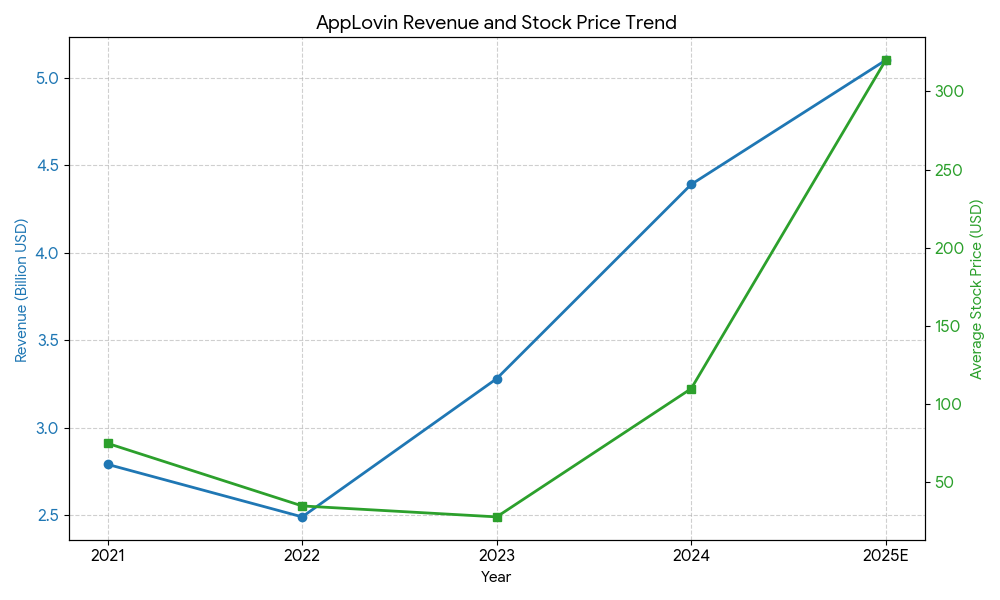
Revenue Level: Entered the multi-billion dollar tier. 2021 revenue reached 2.8 billion USD. While growth slowed in 2022 due to privacy headwinds, revenue remained stable at around 2.5 billion USD.
Phase 4: The AI Pivot & Software Transformation (2023–Present)
- The AXON 2.0 Revolution: In mid-2023, AppLovin released its next-generation recommendation engine, AXON 2.0. This AI engine utilized machine learning to dramatically improve ad matching and ROI for advertisers.
- Financial Explosion: The AI engine led to a massive surge in software revenue and margins, causing the stock price to skyrocket.
- Divesting Gaming: In 2025, AppLovin completed its transformation into a pure software company by transferring its mobile game publishing business (including Lion Studios) to Tripledot Studios for 800M USD, while retaining a minority stake.
- Expansion: The company is now applying its AXON AI technology to new verticals, including E-commerce and Connected TV (CTV).
Core Product: AXON 2.0 (AI-powered recommendation engine) and AppDiscovery (AI-enhanced version).
Core Strategy: AI Efficiency & “De-gaming”. They shifted focus to high-margin software by injecting AI into their core engine, drastically improving ROI for advertisers. In 2025, they divested their game publishing business (Lion Studios) to become a pure-play AI Software Leader, expanding into E-commerce and CTV.
Revenue Level: Explosive profitability. 2023 revenue reached 3.3 billion USD, with 2024 surpassing 4.3 billion USD. Most importantly, the Software Platform segment achieved EBITDA margins exceeding 70%, becoming the primary profit driver.
In 2026, AppLovin has solidified its position as an AI-first software platform, moving far beyond its roots as a gaming ad network. Its competitive landscape now pits it against both legacy gaming tech firms and global advertising giants.
1. Competitor Landscape
| Competitor | Primary Domain | Competitive Dynamics |
| Unity (U) | Engine & Ad Stack | Primary Rival. While Unity owns the development engine, AppLovin’s AXON 2.0 algorithm currently outperforms Unity’s Grow segment in terms of ROAS (Return on Ad Spend) efficiency. |
| Google (AdMob) | Mobile Ecosystem | The Giant. Google dominates non-gaming apps and Android data. AppLovin competes via MAX, the industry-standard mediation platform that often yields higher yields for gaming publishers. |
| Meta (Advantage+) | Social & AI Ads | Strategic Threat. Meta is aggressive in automated UA (User Acquisition). AppLovin’s edge lies in its deep integration within the mobile app and gaming infrastructure. |
| The Trade Desk (TTD) | Open Internet DSP | New Front. As AppLovin expands into E-commerce and CTV (Connected TV), it increasingly vies for the same performance-marketing budgets as TTD. |
2. Core Competitive Advantages (The Moat)
- AXON 2.0 AI Superiority: The proprietary machine learning engine is the “secret sauce.” It predicts user Lifetime Value (LTV) with high precision, allowing advertisers to bid more effectively than on competing platforms.
- Mediation Monopoly (MAX): By controlling the “pipes” through which mobile ads flow, AppLovin enjoys a massive data advantage and significant pricing power over the auction process.
- Best-in-Class Margins: With Software Platform EBITDA margins exceeding 80% in 2026, AppLovin has a superior cash flow profile compared to Unity (which has struggled with profitability) and other ad-tech peers.
3. Challenges & Strategic Risks
- Platform Dependency: Continued reliance on Apple and Google’s OS-level privacy settings remains a systemic risk, despite the company’s successful adaptation to ATT.
- E-commerce Expansion Friction: Moving from gaming to E-commerce requires a different data set. Competing with Amazon’s retail media or Shopify’s ecosystem presents a steeper learning curve.
- Talent War in AI: Sustaining the lead in algorithm efficiency requires constant R&D investment to prevent larger players from “catching up” via brute-force computing power.
2026 Competitive Metrics Comparison (Estimates)
| Metric | AppLovin (APP) | Unity (U) | The Trade Desk (TTD) |
| Revenue Growth | 50% – 55% | 15% – 22% | 20% – 25% |
| EBITDA Margin | ~80%+ | ~20% – 25% | ~40% |
| Key AI Asset | AXON 2.0 | Muse / Sentis | Kokai |
| Market Focus | Performance AI | Creation + Ads | Brand + CTV |
Source:
- https://www.macrotrends.net/stocks/charts/APP/applovin/revenue
- https://investors.applovin.com/news/news-details/2026/AppLovin-Announces-Fourth-Quarter-and-Full-Year-2025-Financial-Results/default.aspx
- https://investors.applovin.com/financials/quarterly-results/default.aspx
- https://simplywall.st/stocks/us/software/nasdaq-app/applovin/past
- https://www.digrin.com/stocks/detail/APP/price
- https://investors.applovin.com/stock-information/stock-quote/default.aspx
- https://www.monexa.ai/blog/applovin-app-ai-driven-surge-margin-inflection-and-APP-2025-08-25
- https://www.marketingdive.com/news/applovin-q3-2024-earnings-report-AI-mobile-advertising/732374/
- https://rockflow.ai/blog/applovin-achieve-7-times-in-2024
- https://mobilegamer.biz/its-official-tripledot-has-acquired-all-of-applovins-studios/
- https://investors.applovin.com/news/news-details/2025/AppLovin-Completes-Sale-of-Mobile-Gaming-Business-to-Tripledot-Studios/default.aspx
- https://www.playwire.com/blog/choosing-your-platform-applovin-vs-competitors
- https://seekingalpha.com/news/4550210-unity-plummets-after-q1-revenue-outlook-falls-below-expectations
- https://intellectia.ai/news/stock/applovin-and-unity-shares-hit-by-new-ai-startup
Back to AppLovin page