
RTX 2025 Financial Results & 2026 Outlook Summary
RTX (formerly Raytheon Technologies) reported strong growth for the full year 2025, driven by a record backlog and robust demand across both commercial aerospace and defense sectors.
Full Year 2025 Key Financials
- Sales: $88.6 billion (Up 10% YoY; 11% organic growth)
- Adjusted EPS: $6.29 (Up 10% YoY)
- Free Cash Flow: $7.9 billion (Up $3.4 billion YoY)
- Backlog: $268 billion (Commercial: $161B / Defense: $107B)
Business Segment Performance (Q4 2025)
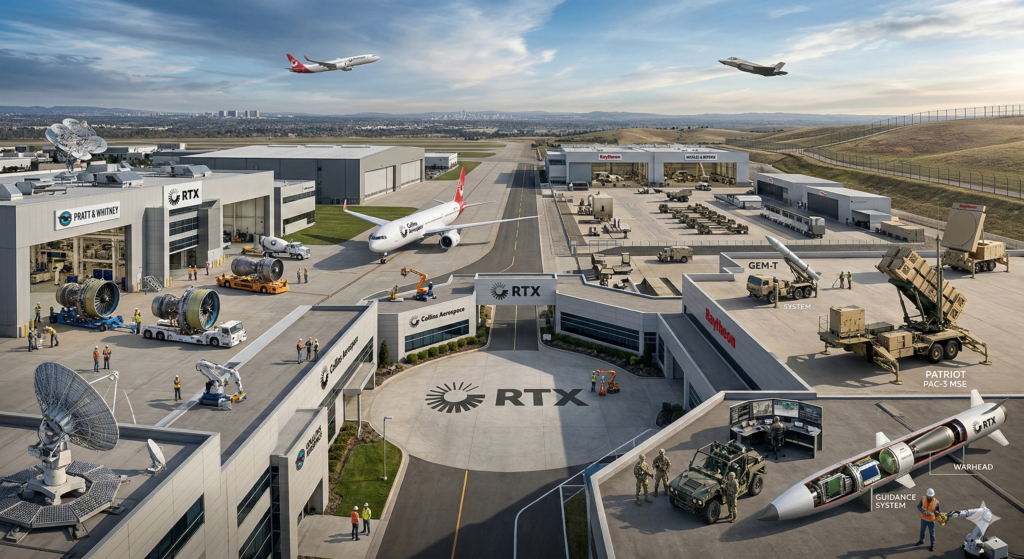
- Collins Aerospace: Sales reached $7.7 billion (Up 3%). Growth was led by a 13% increase in commercial aftermarket and 9% in commercial OE, though partially offset by divestitures.
- Pratt & Whitney: Sales surged to $9.5 billion (Up 25%). This was fueled by a 30% jump in military sales (F135 production) and strong commercial engine demand.
- Raytheon: Sales were $7.7 billion (Up 7%), driven by high volume in land and air defense systems, specifically Patriot and GEM-T programs.
2026 Full Year Outlook
- Adjusted Sales: $92.0 – $93.0 billion
- Organic Sales Growth: 5% – 6%
- Adjusted EPS: $6.60 – $6.80
- Free Cash Flow: $8.25 – $8.75 billion
Based on the financial data from RTX’s 2025 results, here is the Income Statement analysis:
(Units: $ in millions, except for EPS)
| Item | FY 2025 | FY 2024 | YoY | % of Total Rev (2025) |
| Net Sales | 88603 | 80738 | 10.0% | 100.0% |
| Net Income | 6732 | 4774 | 41.0% | 7.6% |
| Adjusted Net Income | 8531 | 7705 | 11.0% | 9.6% |
| GAAP EPS | 4.96 | 3.55 | 40.0% | — |
| Adjusted EPS | 6.29 | 5.73 | 10.0% | — |
Segment Revenue Analysis
| Segment | 2025 Sales | 2024 Sales | YoY | % of Total Rev |
| Collins Aerospace | 30196 | 28284 | 6.8% | 34.1% |
| Pratt & Whitney | 32916 | 28066 | 17.3% | 37.1% |
| Raytheon | 28043 | 26713 | 5.0% | 31.6% |
| (Note: Percentages are based on gross segment totals before intercompany eliminations.) |
Key Insights
- Pratt & Whitney Outperformance: This segment was the primary growth engine in 2025, with a 17.3% revenue jump. The surge was driven by high F135 military engine production and robust commercial aftermarket volume.
- Profitability Normalization: The 41% surge in GAAP Net Income is largely due to the “low base effect” of 2024, which was impacted by significant charges related to the Pratt & Whitney GTF engine powder metal issue. The 11% growth in Adjusted Net Income provides a clearer picture of the company’s steady operational improvement.
- Segment Mix: Pratt & Whitney has surpassed Collins Aerospace as the largest revenue contributor (37.1%). While Raytheon grew more slowly at 5%, its $107 billion defense backlog indicates long-term stability driven by global demand for Patriot and GEM-T systems.
- Margin Expansion: Collins Aerospace saw its reported Return on Sales (ROS) improve to 16.3%, benefiting from a high-margin commercial aftermarket mix and the gain from the sale of its Simmonds Precision business.
Based on the financial reports from RTX, here is the Balance Sheet analysis:
(Units: $ in millions)
| Item | 2025/12/31 | 2024/12/31 | YoY | % of Total Assets (2025) |
| Cash and Cash Equivalents | 7435 | 5578 | 33.3% | 4.3% |
| Accounts Receivable, net | 14701 | 10976 | 33.9% | 8.6% |
| Contract Assets, net | 17092 | 14570 | 17.3% | 10.0% |
| Inventory, net | 13364 | 12768 | 4.7% | 7.8% |
| Total Current Assets | 60332 | 51133 | 18.0% | 35.3% |
| Goodwill | 53343 | 52789 | 1.1% | 31.2% |
| Intangible Assets, net | 31845 | 33443 | -4.8% | 18.6% |
| Fixed Assets, net | 16868 | 16089 | 4.8% | 9.9% |
| Total Assets | 171079 | 162861 | 5.0% | 100.0% |
| Accounts Payable | 15895 | 12897 | 23.2% | 9.3% |
| Contract Liabilities | 21615 | 18616 | 16.1% | 12.6% |
| Total Current Liabilities | 58784 | 51499 | 14.1% | 34.4% |
| Long-term Debt | 34288 | 38726 | -11.5% | 20.0% |
| Total Liabilities | 103941 | 100903 | 3.0% | 60.8% |
| Total Equity | 67102 | 61923 | 8.4% | 39.2% |
Balance Sheet Key Insights
- Strong Liquidity Position: Cash reserves increased by over 33%, reaching $7.4 billion. This build-up reflects the company’s strong free cash flow generation and provides a buffer for upcoming R&D and capital investments.
- Asset Composition: Intangible assets and Goodwill continue to represent nearly 50% of the total asset base. This is typical for a consolidated aerospace giant, reflecting the historical merger between Raytheon and United Technologies.
- Debt Reduction: RTX successfully reduced its long-term debt by $4.4 billion (-11.5%) year-over-year. This aggressive deleveraging demonstrates a commitment to strengthening the balance sheet and reducing interest expenses.
- Backlog Conversion: The 16.1% increase in Contract Liabilities (which often includes customer advances) aligns with the record $268 billion backlog. It suggests strong customer demand and provides upfront cash to support long-cycle production in defense and aerospace.
RTX 2025 Cash Flow Statement & FCF Analysis
Based on the official financial results, RTX demonstrated a significant recovery in cash generation during 2025.
(Units: $ in millions)
| Item | FY 2025 | FY 2024 | YoY |
| Operating Cash Flow | 10567 | 7159 | 48% |
| Capital Expenditures (CapEx) | (2627) | (2625) | 0.1% |
| Free Cash Flow (FCF) | 7940 | 4534 | 75% |
Free Cash Flow (FCF) Analysis
| Metric | FY 2025 | FY 2024 | Change |
| FCF Conversion (FCF / Adj. Net Income) | 93.1% | 58.8% | +34.3 pts |
| FCF as % of Revenue | 9.0% | 5.6% | +3.4 pts |
Key Insights
- Surge in Operating Cash: The 48% increase in operating cash flow was primarily driven by higher segment operating profits across all three divisions (Collins, Pratt & Whitney, and Raytheon) and the absence of the massive one-time cash outlays seen in 2024.
- CapEx Discipline: Despite the 10% revenue growth and increasing production rates (particularly for the F135 engine and Patriot systems), RTX kept capital expenditures flat at $2.6 billion. This discipline allowed nearly all the incremental operating cash to drop straight to the bottom line as FCF.
- Deleveraging Power: The $7.94 billion in FCF provided the necessary liquidity for RTX to reduce its long-term debt by $4.4 billion while still supporting shareholder returns and R&D.
- 2026 Momentum: The company’s 2026 guidance projects FCF to reach $8.25 – $8.75 billion, signaling that the operational “engine” is now fully optimized following the 2024 restructuring and technical challenges.
RTX 5-Year Financial Ratio Analysis (2021-2025)
The following analysis tracks the financial health of RTX (Raytheon Technologies) over the last five years, reflecting its recovery from technical challenges and its current growth trajectory.
| Metric | 2025 | 2024 | 2023 | 2022 | 2021 |
| Net Margin | 7.6% | 5.9% | 4.6% | 7.8% | 6.1% |
| ROE (Return on Equity) | 10.0% | 7.7% | 5.2% | 7.0% | 5.3% |
| ROA (Return on Assets) | 3.9% | 2.9% | 2.0% | 3.3% | 2.4% |
| Current Ratio | 1.03 | 0.99 | 1.04 | 1.09 | 1.19 |
| Debt-to-Equity (D/E) | 0.56 | 0.71 | 0.76 | 0.46 | 0.45 |
Key Observations
- Profitability Peak: 2025 represents a five-year high for both Net Margin (7.6%) and ROE (10.0%). This confirms that RTX has successfully moved past the financial drag caused by the 2023-2024 Pratt & Whitney GTF engine powder metal issues.
- Aggressive Deleveraging: The D/E ratio peaked in 2023 at 0.76 due to the aforementioned technical liabilities. By late 2025, RTX utilized its record free cash flow to pay down approximately $4.4 billion in long-term debt, bringing the ratio down to 0.56.
- Asset Efficiency: ROA improved to 3.9% in 2025, up significantly from 2.0% in 2023. This indicates that the company is generating more profit per dollar of assets, driven by higher production volumes in military defense and commercial aerospace.
- Liquidity Stability: The Current Ratio has remained stable around 1.0. While 2024 saw a slight dip to 0.99, the recovery to 1.03 in 2025 shows a healthy balance between current assets (like increased cash and receivables) and short-term obligations.
As of mid-February 2026, RTX (Raytheon Technologies) continues to trade at a significant valuation premium compared to its peers in the defense sector. This is primarily attributed to its dual exposure to the high-growth commercial aerospace recovery and a robust defense backlog.
P/E Comparison: RTX vs. Major Competitors (Feb 2026)
| Company | Ticker | P/E Ratio (GAAP TTM) | P/E Ratio (Forward FY1) | PEG Ratio (Forward) |
| RTX Corp | RTX | 39.62 | 28.88 | 2.84 |
| Lockheed Martin | LMT | 29.26 | 21.01 | 1.13 |
| Northrop Grumman | NOC | 23.85 | 24.20 | 1.85 |
| General Dynamics | GD | 22.54 | 22.20 | 1.90 |
| The Boeing Co | BA | 95.27 | 85.05 | 1.99 |
Strategic P/E Analysis
1. The “Commercial Premium”
RTX’s TTM P/E of 39.62 is notably higher than pure-play defense contractors like Lockheed Martin (29.26) or General Dynamics (22.54). Investors are placing a premium on RTX’s commercial segments (Pratt & Whitney and Collins Aerospace), which benefit from the ongoing global surge in air travel and high-margin aftermarket services.
2. Forward Growth Expectations
The drop from a 39.62 TTM P/E to a 28.88 Forward P/E indicates that the market expects significant earnings expansion in 2026. This is tied to the resolution of the GTF engine powder metal issues and the ramping up of defense production for programs like the Patriot and GEM-T missile systems.
3. Valuation vs. Growth (PEG Ratio)
RTX’s PEG ratio of 2.84 suggests the stock is currently “expensive” relative to its near-term earnings growth when compared to Lockheed Martin (1.13). This indicates that much of the future growth from its $268 billion backlog is already priced into the current stock price.
4. Boeing as the Outlier
Boeing’s extremely high P/E (95.27) remains skewed due to its ongoing recovery from production and safety challenges. In contrast, RTX is viewed as a more “normalized” but premium-valued play within the aerospace ecosystem.
Source: https://www.rtx.com/news/news-center/2026/01/27/rtx-reports-2025-results-and-announces-2026-outlook-
Back to RTX page