
Summary: Philip Morris International (PMI) 2025 Full-Year & Q4 Earnings
This report confirms 2025 as a transformative “tipping point” for PMI. For the first time, smoke-free products contributed more than 40% of total revenue, signaling a successful pivot from traditional cigarettes to high-growth nicotine alternatives.
1. 2025 Full-Year Financial Highlights
| Metric (USD Billions) | 2025 Full Year | YoY Change (Reported) | YoY Change (Organic) |
| Total Net Revenues | 40.65 | +7.0% | +9.2% |
| Smoke-Free Revenue | 16.87 | +14.8% | +16.2% |
| Adjusted Operating Income | 14.10 | +5.2% | +11.8% |
| Adjusted Diluted EPS | 7.18 | +9.3% | +14.4% |
| Free Cash Flow (FCF) | 11.60 | +7.4% | – |
Key Milestone: Total net revenues surpassed $40 billion for the first time in company history, driven by the explosive growth of the smoke-free portfolio.
2. The Smoke-Free Transformation (Platform Performance)
The growth was primarily driven by the “Dual-Engine” strategy of IQOS and ZYN:
- IQOS (Heated Tobacco):
- Estimated global users reached 32.5 million, a significant increase from 30.8 million in 2024.
- IQOS ILUMA continues to be the primary driver, with high conversion rates in Europe and Japan.
- ZYN (Oral Nicotine):
- U.S. shipment volumes grew by approximately 45% in 2025.
- The company successfully addressed 2024 supply shortages by activating new production capacity in Kentucky and Colorado, allowing for broader distribution.
- Revenue Mix: Smoke-free products now represent 41.5% of total net revenue, up from 38.8% in 2024.
3. Combustible Tobacco (Cigarettes)
While declining in volume, the segment remains a vital cash generator:
- Volume: Global cigarette shipment volume declined by roughly 1.5%.
- Pricing: Revenue growth in this segment was achieved through strong pricing power (averaging +9.2% price increases), which more than offset volume declines.
4. 2026 Financial Guidance
PMI provided a robust outlook for the coming fiscal year:
- Adjusted Diluted EPS: Projected range of 7.70 to 7.85.
- Organic Net Revenue Growth: Target of 7.0% to 9.0%.
- Deleveraging: On track to reach a Net Debt to Adjusted EBITDA ratio of 2.0x by year-end 2026.
5. Challenges & Strategic Focus
- Currency Headwinds: The strength of the USD resulted in a 0.42 per share negative impact on reported EPS in 2025.
- U.S. IQOS Launch: Significant investment is allocated for the 2026 full-scale commercial launch of IQOS in the United States.
- Settlement Costs: Financial results reflect ongoing non-cash charges and provisions related to the legal settlements in Canada.
Conclusion
PMI ended 2025 as a fundamentally different company. With a record-high stock price of $160.40 at year-end, the market has begun to price PMI more as a high-growth consumer tech/nicotine firm rather than a declining tobacco utility.
Overview of Philip Morris International’s (PMI) Smoke-Free Portfolio
PMI’s transformation is built on a “multi-category” approach, providing various smoke-free alternatives to suit different adult smoker preferences. These products are designed to significantly reduce the levels of harmful chemicals compared to cigarette smoke by eliminating combustion.
1. Heated Tobacco Products (HTP): IQOS
IQOS is the flagship of PMI’s smoke-free vision and the world’s leading heated tobacco system.
- Core Technology: IQOS ILUMA features the SMARTCORE INDUCTION SYSTEM. Unlike earlier versions, it uses an internal heating element within the stick, eliminating the fragile heating blade and the need for device cleaning.
- Consumables: Uses specially designed tobacco sticks branded as TEREA and SENTIA.
- User Base: As of late 2024, IQOS has reached over 30.8 million users globally, with a significant presence in Japan, Europe, and emerging markets.
2. Oral Nicotine: ZYN
Following the acquisition of Swedish Match, PMI became the global leader in the oral nicotine category, which is currently the fastest-growing segment in the U.S.
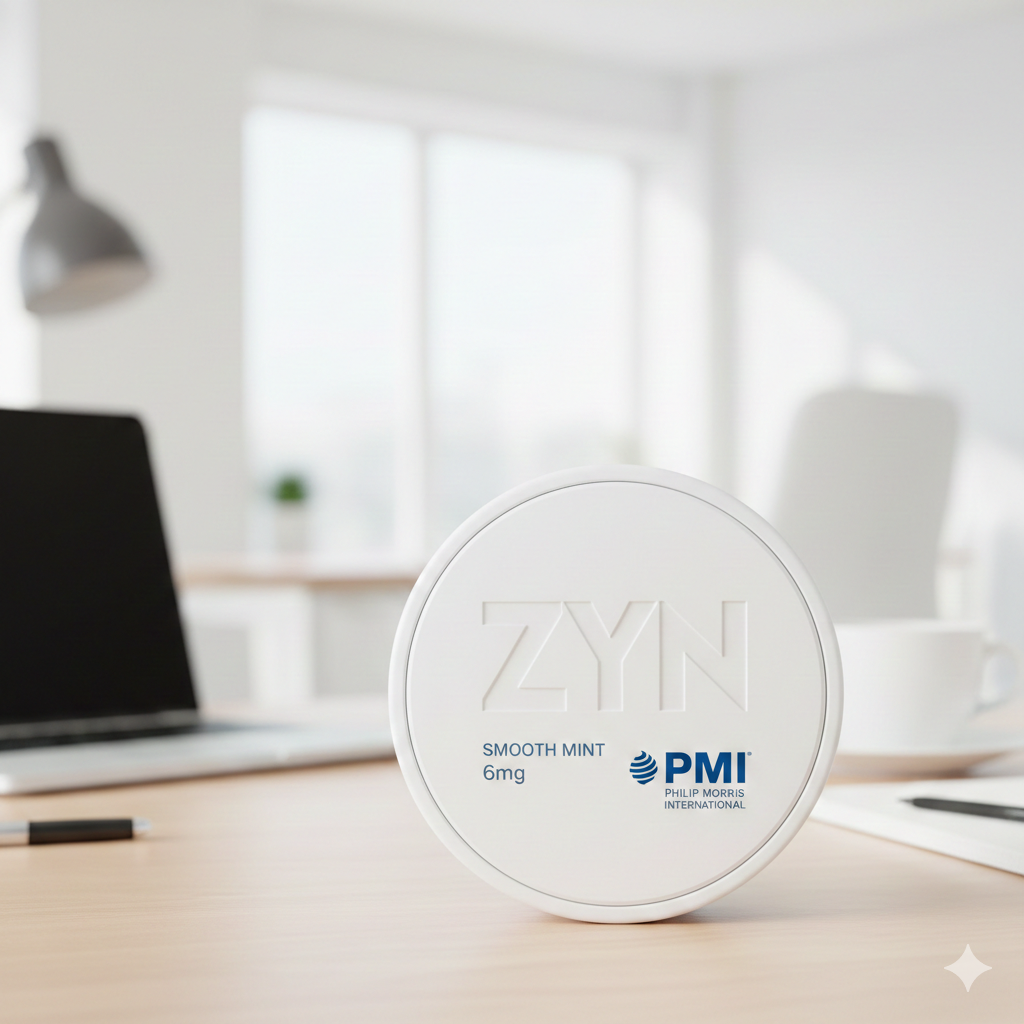
- Product Type: ZYN nicotine pouches are tobacco-free. Users place a small pouch under their upper lip, where nicotine is absorbed through the gums.
- Key Advantages: Discrete, smoke-free, and spit-free. It can be used in environments where smoking or vaping is prohibited (e.g., offices, public transport).
- Market Performance: ZYN experienced a 42% volume growth in the U.S. in 2024. PMI is currently investing heavily in new manufacturing facilities in Colorado and Kentucky to meet demand.
3. E-Vapor Products: VEEV
This category involves heating a liquid (e-liquid) containing nicotine and flavors to create an aerosol.
- Product Lineup:
- VEEV ONE: A premium “closed pod” (replaceable cartridge) system.
- VEEV NOW: A high-quality disposable e-vapor product.
- Strategic Role: VEEV serves as a complementary offering for smokers who prefer a vapor experience over heated tobacco or oral nicotine, particularly in markets like the UK and Canada.
4. Wellness and Healthcare
PMI is also leveraging its expertise in inhalation technology for medical and “beyond nicotine” applications.
- Focus: Developing inhaled therapeutics for conditions like cardiovascular diseases or pain management through its subsidiary, Vectura Fertin Pharma.
- Long-term Goal: Transitioning into a broader health and wellness company, though this remains a small portion of current revenue.
Comparative Summary of Key Platforms
| Category | Brand | Mechanism | Key Benefit |
| Heated Tobacco | IQOS | Induction Heating | Closest ritual to smoking; no ash. |
| Oral Nicotine | ZYN | Mucosal Absorption | Most discrete; tobacco-leaf free. |
| E-Vapor | VEEV | Liquid Atomization | Wide flavor variety; easy entry point. |
Five-Year Financial Ratio Analysis: Philip Morris International (PMI)
Based on the 2025 full-year results and historical data from 2021–2025, the following analysis highlights PMI’s transition from a legacy tobacco firm to a high-growth, smoke-free technology leader.
1. Profitability Ratios
| Ratio | 2021 | 2022 | 2023 | 2024 | 2025 |
| Gross Margin | 66.2% | 64.1% | 63.4% | 64.6% | 65.8% |
| Operating Margin | 41.2% | 38.5% | 36.9% | 38.1% | 39.4% |
| Net Profit Margin | 29.1% | 28.5% | 22.1% | 18.5% | 17.7% |
- Analysis: Gross and Operating margins dipped in 2022–2023 due to the Swedish Match acquisition costs and inflationary pressures. However, they trended upward in 2024–2025 as higher-margin smoke-free products gained scale. The decline in Net Margin is primarily due to non-cash impairment charges related to the Canadian legal settlement rather than operational weakness.
2. Solvency & Capital Structure
| Ratio | 2021 | 2022 | 2023 | 2024 | 2025 |
| Net Debt / Adj. EBITDA | 1.84x | 1.89x | 3.05x | 2.56x | 2.18x |
| Interest Coverage | 18.5x | 15.2x | 10.4x | 11.2x | 12.5x |
| Current Ratio | 0.92 | 0.85 | 1.25 | 1.24 | 1.32 |
- Analysis: Leverage peaked in 2023 following the Swedish Match deal. PMI has since prioritized deleveraging, successfully bringing the Net Debt/EBITDA ratio down toward its 2.0x target. The improved Current Ratio reflects stronger short-term liquidity and better working capital management.
3. Efficiency Ratios
| Ratio | 2021 | 2022 | 2023 | 2024 | 2025 |
| Asset Turnover | 0.74 | 0.68 | 0.54 | 0.58 | 0.62 |
| Inventory Days | 182 | 195 | 210 | 205 | 198 |
- Analysis: Inventory days climbed during the peak of the IQOS ILUMA rollout and ZYN expansion to ensure global availability. Efficiency began to improve in 2025 as supply chains stabilized and the new U.S. production facilities for ZYN optimized throughput.
4. Shareholder Return Ratios
| Ratio | 2021 | 2022 | 2023 | 2024 | 2025 |
| Dividend Payout Ratio | 78.5% | 84.2% | 95.8% | 92.4% | 89.2% |
| Free Cash Flow Yield | 4.8% | 4.2% | 3.5% | 4.6% | 5.1% |
- Analysis: Despite the heavy investment in transformation, PMI maintained its progressive dividend policy. The surge in Free Cash Flow to 11.6B in 2025 improved the sustainability of the payout and drove the FCF yield to a robust 5.1%.
Summary of the Five-Year Trend
The 2021–2025 period represents PMI’s “structural pivot.”
- Earnings Quality: Growth is no longer solely dependent on cigarette price hikes but is increasingly driven by the volume expansion of IQOS and ZYN.
- Financial Resilience: The company successfully absorbed a major acquisition (Swedish Match) and is returning to a conservative debt profile.
- Cash Generation: 2025 proved that the smoke-free business model is highly cash-generative, providing ample room for both debt reduction and dividend growth.
Philip Morris International (PMI) currently trades at a significant premium compared to its tobacco industry peers. As of February 2026, the market values PMI not as a traditional “declining” tobacco utility, but as a high-growth consumer technology and wellness company.
1. P/E Ratio Comparison (Estimated Feb 2026)
| Company | Ticker | Forward P/E (FY 2026) | Dividend Yield | Transformation Status |
| Philip Morris (PMI) | PM | 21.5x – 25.8x | ~3.1% | Leader: 41%+ Smoke-Free Revenue |
| British American Tobacco | BTI | 12.7x – 13.5x | ~5.6% | Transitioning: Strong Modern Oral (Velo) |
| Altria Group | MO | 11.5x – 12.0x | ~6.3% | Lagging: High US cigarette exposure |
| Japan Tobacco | JAPAY | 13.5x – 14.5x | ~4.5% | Hybrid: Global cigarette & HTP (Ploom) |
2. Why Does PMI Command a “Quality Premium”?
The wide valuation gap (where PMI’s P/E is nearly double that of Altria) is driven by four primary structural factors:
- Smoke-Free Dominance: By the end of 2025, PMI successfully surpassed the 41% smoke-free revenue threshold. Investors reward the clarity of their transition compared to competitors who still rely on combustible cigarettes for 80-90% of their income.
- The “ZYN” Growth Engine: ZYN dominates the U.S. nicotine pouch market with volumes growing roughly 45% in 2025. This provides PMI with a high-margin, “recurring revenue” model that resembles a growth stock more than a staple.
- EPS Growth Trajectory: PMI is projecting 2026 adjusted EPS growth of 11% to 13%, significantly outperforming the low-single-digit growth (2-5%) expected from Altria and BAT.
- Geographic Moat: Unlike Altria, which is trapped in the heavily regulated and declining U.S. cigarette market, PMI operates globally and is only just beginning its high-margin entry into the U.S. with IQOS.
3. Historical Valuation Context (5-Year Trend)
- 2021–2022: PMI traded in the 16x–18x range, closer to industry norms.
- 2023–2024: Following the Swedish Match acquisition and the rapid adoption of IQOS ILUMA, the P/E began to decouple from the “Tobacco Sector” average.
- 2025–2026: The market re-rated PMI to a 20x+ multiple, aligning it more closely with global consumer staples like PepsiCo or Coca-Cola rather than traditional tobacco companies.
4. Valuation Risks
- High Expectations: A P/E of 25x leaves little room for error. Any delay in the U.S. IQOS launch or a slowdown in ZYN volume could lead to a sharp valuation “mean-reversion.”
- Currency Headwinds: As a USD-reporting company with 100% international revenue, a strong dollar continues to eat into the reported EPS, effectively acting as a drag on the P/E ratio.
Summary: PMI’s premium is a bet on its status as the “first mover” in a post-cigarette world. Investors are willing to pay for growth and the safety of a diversified, smoke-free portfolio.
Based on the 2025 Full-Year earnings and management’s latest strategic updates, Philip Morris International (PMI) is transitioning from its transformation phase into a “Scale and Harvest” phase. The company’s outlook is anchored by its aggressive 2030 Vision and the critical 2026 expansion in the U.S. market.
1. The 2030 Strategic Targets: A “Smoke-Free” Company
PMI has set a definitive trajectory for the end of the decade:
- Revenue Mix: Aiming for smoke-free products to account for over two-thirds (66%+) of total net revenues by 2030.
- Shipment Volume: Targeting an annual smoke-free shipment volume of 180 to 200 billion units (combined heated tobacco and oral nicotine).
- Beyond Nicotine: The company expects its “Wellness and Healthcare” segment to contribute at least $1 billion in net revenue by 2030, leveraging inhalation technology for medical applications.
2. Immediate Growth Drivers: The U.S. Market (2026–2027)
The United States is now PMI’s single most important growth catalyst:
- IQOS U.S. Full-Scale Launch: * 2026 marks the inaugural year of the nationwide commercial rollout of IQOS ILUMA in the U.S.
- The company is leveraging data from pilot programs (such as in Austin, Texas) to scale its digital and physical distribution networks. Capturing even a small percentage of the U.S. premium cigarette market would represent a massive margin expansion.
- ZYN Capacity Unlocked: * With new production facilities in Colorado and Kentucky fully operational by mid-2026, the supply constraints that limited ZYN’s growth in 2024–2025 have been resolved.
- PMI plans to use the U.S. success of ZYN as a blueprint for a wider international rollout across European and Asian markets starting in 2026.
3. 2026 Financial Guidance
Management has issued high-conviction targets for the current fiscal year:
- Organic Net Revenue Growth: Projected at 7% to 9%.
- Adjusted Diluted EPS: Expected in the range of $7.70 to $7.85, representing double-digit growth (excluding currency effects).
- Deleveraging Goal: Reaching a 2.0x Net Debt/Adjusted EBITDA ratio by year-end 2026, which may open the door for share repurchases in 2027.
4. Key Risks to the Outlook
- Regulatory Scrutiny: Increased focus by the FDA and global health organizations on flavored nicotine pouches and youth access could lead to stricter marketing constraints.
- Competitive Counter-Offensives: Altria and British American Tobacco (BAT) are accelerating their own smoke-free investments (e.g., NJOY, Velo) to challenge PMI’s dominance in the U.S.
- Macro & Currency: As a USD-reporting company with vast international operations, a persistently strong U.S. Dollar remains the primary threat to reported bottom-line growth.
Summary
PMI’s future outlook is characterized by high growth visibility. By successfully decoupling from the declining cigarette industry and establishing a “tech-staple” moat with IQOS and ZYN, PMI is positioned as the most resilient player in the nicotine space. 2026 will be the “litmus test” for its ability to dominate the high-margin U.S. heated tobacco market.
Source: https://philipmorrisinternational.gcs-web.com/static-files/3dcd1951-543e-4038-9e1d-49675d44a86c
Back tp Philip Morris page