
The history of Prosus is inseparable from its South African parent company, Naspers. It represents the evolution of a traditional print media business into a global technology powerhouse.
The following are the key stages of Prosus’s development:
1. The Naspers Foundation (1915–1990s)
Originally founded as De Nasionale Pers in 1915, the company spent decades as a South African publisher of newspapers and magazines. In the 1980s and 90s, under the leadership of Koos Bekker, the firm began pivoting toward electronic media and pay-TV (M-Net), providing the capital needed for future internet bets.
Key Investment: M-Net (1985)
- Significance: This was South Africa’s first pay-TV channel. It was the original “cash cow” that provided the capital and the risk-taking culture necessary for the company to pivot from print newspapers to the global internet.
2. The Tencent “Big Bang” (2001)
In 2001, Naspers made what is often cited as the greatest venture capital investment in history. They invested $32 million for a 46.5% stake in a then-tiny Chinese startup called Tencent. As Tencent grew into a global internet titan, this single stake eventually became worth hundreds of billions of dollars, dwarfing the rest of Naspers’ operations.
Key Investment: Tencent (2001)
- Significance: Naspers invested $32 million for nearly half of the company. Today, this remains the cornerstone of Prosus’s value. It provided the massive balance sheet that allowed Prosus to fail at hundreds of smaller bets while still becoming a global giant.
3. Global Portfolio Diversification (2002–2018)
Using the massive financial tailwinds from Tencent, the company expanded aggressively into emerging markets where they saw high growth potential in the “consumer internet” space:
- Classifieds: Acquired brands like OLX and Avito.
- Food Delivery: Built significant stakes in iFood (Brazil), Delivery Hero (Germany), and Swiggy (India).
- Payments & Fintech: Established PayU as a major player in emerging market transactions.
- EdTech: Invested in platforms like Stack Overflow and Skillsoft.
Key Investment: OLX Group (2010)
- Significance: By acquiring OLX, Prosus became the global leader in online classifieds, particularly in India, Brazil, and Poland.
Key Investment: Flipkart (2012)
- Significance: A major bet on Indian e-commerce. Prosus eventually sold its stake to Walmart in 2018 for a significant profit (approx. $1.6 billion), proving they could successfully exit large-scale investments.
Key Investment: Delivery Hero (2017)
- Significance: This marked their massive entry into Food Delivery, which is now one of Prosus’s largest operational segments.
4. The Birth of Prosus (2019)
By 2019, the value of the Tencent stake had become so large that it exceeded the total market value of Naspers itself, creating a massive “valuation gap.” To solve this and attract more international investors, Naspers spun off its international internet assets into a new entity: Prosus.
- Prosus listed on Euronext Amsterdam in September 2019.
- It became Europe’s largest consumer internet company by asset value overnight.
Key Investment: iFood (Consolidation)
- Significance: While they invested earlier, Prosus spent this period aggressively increasing its stake in the Brazilian food delivery leader. By 2022, they bought out the remaining shares for €1.8 billion, making it a wholly-owned core asset.
5. Active Management and Share Buybacks (2020–Present)
In recent years, Prosus has focused on narrowing the discount between its share price and the value of its underlying assets:
- Tencent Sell-down: In 2022, Prosus/Naspers announced an open-ended program to sell Tencent shares to fund the buyback of their own shares.
- Rationalization: They have moved to simplify the complex cross-holding structure between Naspers and Prosus to make the investment case clearer for shareholders.
- Path to Profitability: The company has shifted focus from pure growth to ensuring its consolidated “non-Tencent” businesses (like food delivery and classifieds) reach profitability.
Key Investment: Stack Overflow (2021)
- Significance: Acquired for $1.8 billion, this was Prosus’s first major move into the EdTech and “Future of Workplace” sector, moving beyond consumer apps into developer communities and AI training data.
Key Investment: Just Eat Takeaway.com (2025)
- Significance: (Based on current 2025/26 data) A massive €4.1 billion deal to consolidate the European food delivery market. This represents a shift from being a “minority investor” to a “market consolidator.”
Key Investment: Despegar (2025)
- Significance: A $1.7 billion acquisition of the leading Latin American travel platform, integrating travel into their existing regional ecosystem (alongside iFood).
Prosus is now essentially a massive global investment vehicle that manages a diverse ecosystem of tech companies across more than 90 countries.
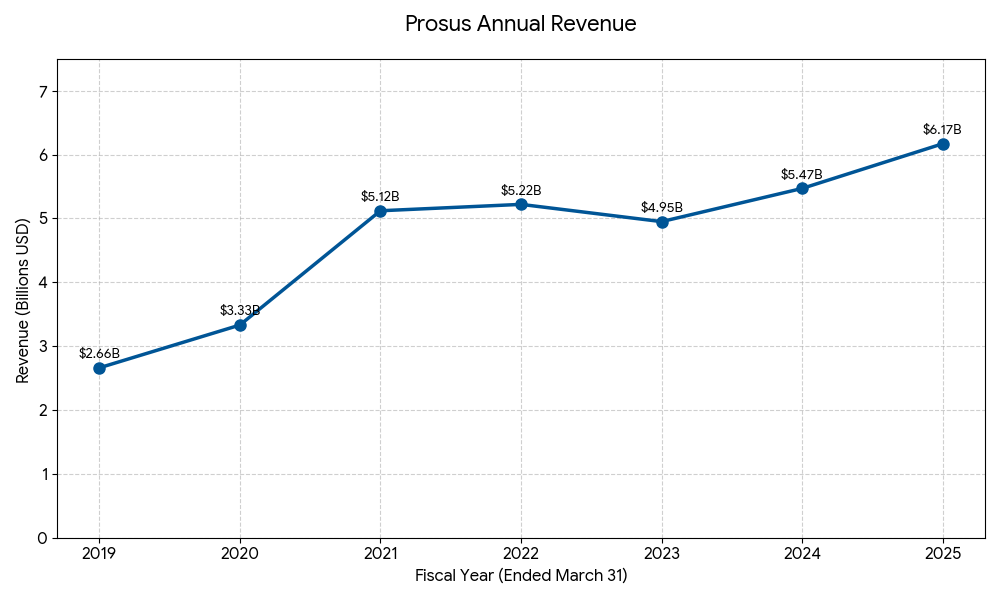
In Prosus’s financial reporting, the Etail (Online Retail) segment is primarily driven by its majority stake in eMAG, the dominant e-commerce player in Central and Eastern Europe (CEE). Following the 2025 acquisition of Despegar, Prosus has also significantly expanded its footprint in Latin American travel e-commerce.
Here is the competitive analysis for the Etail segment:
1. Central and Eastern Europe (Core: eMAG)
eMAG operates as the “Amazon of Romania,” but the landscape is shifting from local dominance to a battle against global giants and regional challengers.
- Primary Competitors:
- Allegro (Poland): The most formidable regional rival. Allegro has been aggressively expanding beyond Poland into Hungary and the Czech Republic, directly challenging eMAG’s borders.
- Amazon: While Amazon was slow to enter CEE, it is now leveraging its German logistics hubs to serve the region, targeting high-spending Prime-eligible customers.
- Temu & SHEIN: These Chinese cross-border platforms have disrupted the market in 2024–2025, putting immense price pressure on eMAG’s electronics and fashion categories.
- Competitive Edge:
- Logistics (Sameday/Easybox): eMAG owns a massive network of automated lockers (Easybox). This local infrastructure allows for faster, cheaper, and more convenient last-mile delivery than international competitors.
- Financial Ecosystem: By integrating “Buy Now, Pay Later” (BNPL) services directly into the checkout, eMAG maintains higher conversion rates than foreign sites.
2. Latin America (Core: Despegar)
The 2025 acquisition of Despegar moved Prosus into a direct rivalry with global travel and local ecosystem giants.
- Primary Competitors:
- Booking.com & Expedia: Global leaders that dominate high-end hotel bookings and international flight segments in Latin America.
- MercadoLibre (MELI): Although primarily a physical goods marketplace, MELI’s “Mercado Pago” fintech ecosystem is a massive threat if they decide to further integrate travel services into their super-app.
- Competitive Edge:
- Hyper-Localization: Despegar excels at managing complex local payment installments (cuotas), which are essential for Latin American consumers but difficult for US-based platforms to manage at scale.
3. Etail Segment SWOT Analysis
| Strengths | Weaknesses |
| Regional Fortress: Near-monopoly status in Romania and strong brand equity in Latin America. | Geographic Concentration: Highly exposed to economic volatility in Eastern Europe and LatAm. |
| Integrated Logistics: Deep physical moats through self-owned delivery networks. | Margin Pressure: High cost of maintaining logistics in inflationary environments. |
| Opportunities | Threats |
| Ecosystem Synergy: Driving traffic between iFood (Food) and Despegar (Travel) to lower customer acquisition costs. | Global E-commerce Regulation: Stricter EU Digital Markets Act (DMA) compliance costs. |
| AI Personalization: Using Stack Overflow’s tech expertise to enhance eMAG’s search and recommendation engines. | The “Temu Effect”: Continued deflationary pressure from ultra-low-cost Chinese retailers. |
4. Strategic Summary
Prosus’s Etail strategy is a “Local Hero” model. Rather than fighting Amazon globally, they build dominant regional hubs where they control the logistics, payments, and consumer data. By owning the “last mile” in places like Bucharest or Buenos Aires, they make it prohibitively expensive for global players to displace them.
In the Food Delivery segment, Prosus has transitioned from a passive financial investor to an active industrial operator. This segment now accounts for approximately 35–40% of Prosus’s consolidated revenue (excluding Tencent).
The 2026 strategy focuses on “Regional Strongholds”—using high-margin markets like Brazil to fund market-share battles in India and Europe.
1. Latin America (Core: iFood)
iFood is the “crown jewel” of Prosus’s operational portfolio, holding a near-monopoly in Brazil.
- Market Share: iFood controls over 80% of the Brazilian food delivery market, processing more than 110 million orders per month.
- Primary Competitor: * Rappi: The only significant rival left. Rappi uses a “Super App” strategy (delivery + banking + travel), but its delivery volume is a fraction of iFood’s.
- Uber Eats: Effectively exited the Brazilian restaurant delivery market in 2022, leaving a vacuum that iFood successfully filled.
- Competitive Edge: * Fintech Integration: Through iFood Pago, Prosus provides credit and payment solutions to restaurants, creating high switching costs.
- Ecosystem Synergy: Cross-promotions with the newly acquired Despegar (Travel) help lower customer acquisition costs.
2. India (Core: Swiggy)
Unlike Brazil’s monopoly, India is a fierce Duopoly battleground.
- Market Share: * Zomato: Currently the slight leader (approx. 54–56% share) and achieved profitability faster.
- Swiggy (Prosus owns ~25%): Holds approx. 44–46% share. Following its late-2025 IPO, Swiggy is using fresh capital to aggressively expand its Quick Commerce (Instamart) division.
- Competitive Focus: The war has moved beyond “hot meals” to Quick Commerce. The winner is now defined by who can deliver groceries and electronics in under 15 minutes.
3. Europe (Core: Just Eat Takeaway & Delivery Hero)
This is the “Consolidation Zone” where Prosus is deploying massive capital in 2025–2026.
- Strategic Move: Prosus completed the €4.1 billion privatization of Just Eat Takeaway (JET) in late 2025.
- Primary Competitors: * Uber Eats: Strong brand presence in London, Paris, and major metros.
- Deliveroo: A high-end competitor focused on premium urban demographics.
- Competitive Edge: JET leads in the UK, Germany, and the Netherlands. By taking it private, Prosus can restructure the business away from public market pressure to compete more aggressively on logistics technology.
4. Food Delivery SWOT Analysis (2026)
| Strengths | Weaknesses & Challenges |
| Proven Profitability: iFood has industry-leading EBITDA margins, proving the model works. | Cash Intensity: High burn rates in India (Quick Commerce) and Europe (Integration). |
| Data Dominance: Massive consumer datasets across 90 countries used for AI-driven logistics. | Regulatory Risk: Rising pressure in the EU and Brazil regarding “Gig Economy” worker rights. |
| Opportunities | Threats |
| AdTech Revenue: High-margin income by selling sponsored listings to restaurants (Amazon model). | Meituan’s Expansion: Chinese giant Meituan (KeeTa) is entering LatAm, potentially sparking a price war. |
| Quick Commerce Pivot: Leveraging existing couriers to deliver pharma, retail, and groceries. | Antitrust Scrutiny: iFood’s dominance in Brazil is under constant watch by regulators (CADE). |
In the Payments & Fintech segment, Prosus operates primarily through PayU. This division has become one of the group’s fastest-growing engines, with revenue growing 34% in FY2025 and Total Payment Volume (TPV) exceeding $110 billion.
Prosus’s strategy is specialized: “Avoid saturated Western markets; dominate the high-growth corridors of India, Turkey, and Southeast Asia.”
1. The Primary Battleground: India (PayU India)
India accounts for over 60% of PayU’s revenue. The competition here is a clash between pure-play fintechs and massive ecosystems.
- Primary Competitors:
- Razorpay: PayU’s most direct rival in the B2B Payment Gateway (PG) space. The two are neck-and-neck in market share for online merchant processing.
- PhonePe (Walmart-backed) & Google Pay: While they dominate consumer UPI payments, they are aggressively moving into business merchant services, threatening PayU’s traditional territory.
- Jio Financial Services (Reliance-backed): A potential “black swan” challenger with access to hundreds of millions of retail users across India.
- PayU’s Competitive Edge:
- Full Licensing: PayU holds Payment Aggregator (PA) and credit licenses from the RBI. This allows them to offer LazyPay (Buy Now, Pay Later), which generates much higher margins than simple transaction fees.
2. Emerging Market Dominance (GPO – Global Payments Operations)
- Turkey (iyzico): PayU owns iyzico, the market leader in Turkey. Its main competition comes from traditional bank-led digital portals and local fintech startups.
- Southeast Asia & LatAm: PayU competes with global giants like Stripe and Adyen. However, PayU’s deep integration with local alternative payment methods (APMs) and complex tax compliance gives it a “localized moat” that Western firms struggle to replicate.
3. Fintech Segment SWOT Analysis (2026)
| Strengths | Weaknesses |
| Hyper-Growth: TPV and revenue growth are significantly outperforming the broader e-commerce market. | Regulatory Sensitivity: Heavy dependence on the Indian central bank (RBI) policy shifts. |
| Credit Data Advantage: Using transaction data from LazyPay to build proprietary AI-driven credit scoring. | Compressed Margins: Government mandates on zero Merchant Discount Rates (MDR) in India limit fee income. |
| Opportunities | Threats |
| PayU India IPO: A planned 2026 listing is expected to unlock a multi-billion dollar valuation. | Digital Sovereignty: Rise of government-backed networks (like India’s UPI) reducing the need for private gateways. |
| Cross-Border Synergy: Integrating PayU into Prosus’s other platforms like eMAG (Etail) and iFood (Food Delivery). | Fraud Sophistication: Increasing AI-driven cybercrime requiring constant, expensive security upgrades. |
4. Strategic Evolution: From “Gateway” to “Banker”
Prosus is pushing PayU to evolve beyond simple payment processing:
- Omnichannel Strategy: Moving from just online payments to integrated in-store (POS) solutions.
- Banking-as-a-Service (BaaS): Providing working capital loans and insurance products to its merchant base.
- AI Implementation: In 2026, PayU scaled its Agentic AI for real-time fraud detection, reducing transaction loss rates to industry-record lows.
Strategic Summary
PayU is currently the “Fintech Fortress” of Prosus, focusing on markets where credit penetration is low but digital adoption is high.
Source:
- https://www.prosus.com/~/media/Files/P/prosus-corp-v2/results-reports-and-events-archive/latest-results/fy-2025/prosus-financial-results-fy25-booklet.pdf
- https://www.prosus.com/~/media/Files/P/prosus-corp-v2/results-reports-and-events-archive/latest-results/hy2026/hy2026-summary-consolidated-financial-statements.pdf
- https://www.macrotrends.net/stocks/charts/PROSY/prosus/revenue
- https://www.prosus.com/news-insights/2025/prosus-to-acquire-just-eat-takeaway
- https://newsroom.justeattakeaway.com/en-WW/255533-final-results-of-prosus-offer-for-just-eat-takeaway-com/
- https://www.kotakneo.com/ipo/payu-ipo/
- https://www.globalbankingandfinance.com/US-PROSUS-INDIA-PAYU-4406cb61-d74c-4758-964a-cd9f15cb8a61/
- https://www.prosus.com/investors/investing-in-prosus/net-asset-value
- https://www.naspers.com/~/media/Files/N/Naspers-Corp-V2/results-reports-and-events-archive/latest-results/fy-2025/naspers-integrated-annual-report-2025.pdf
Back to Prosus page