
Here is the summary of AstraZeneca’s 9M and Q3 2025 results:
Financial Highlights
- Total Revenue: Reached $43,236m for the first nine months, an 11% increase at constant exchange rates (CER). Q3 2025 revenue was $15,191m, up 10% CER.
- Core EPS: Increased 15% CER to $7.04 for the nine-month period. Q3 2025 Core EPS was $2.38.
- Profitability: Core Operating Profit increased by 13% during the first nine months. The Core Operating Margin for Q3 2025 stood at 33%.
- Dividend: The company intends to increase the annual dividend to $3.20 per share for FY 2025.
Therapy Area Performance (9M 2025)
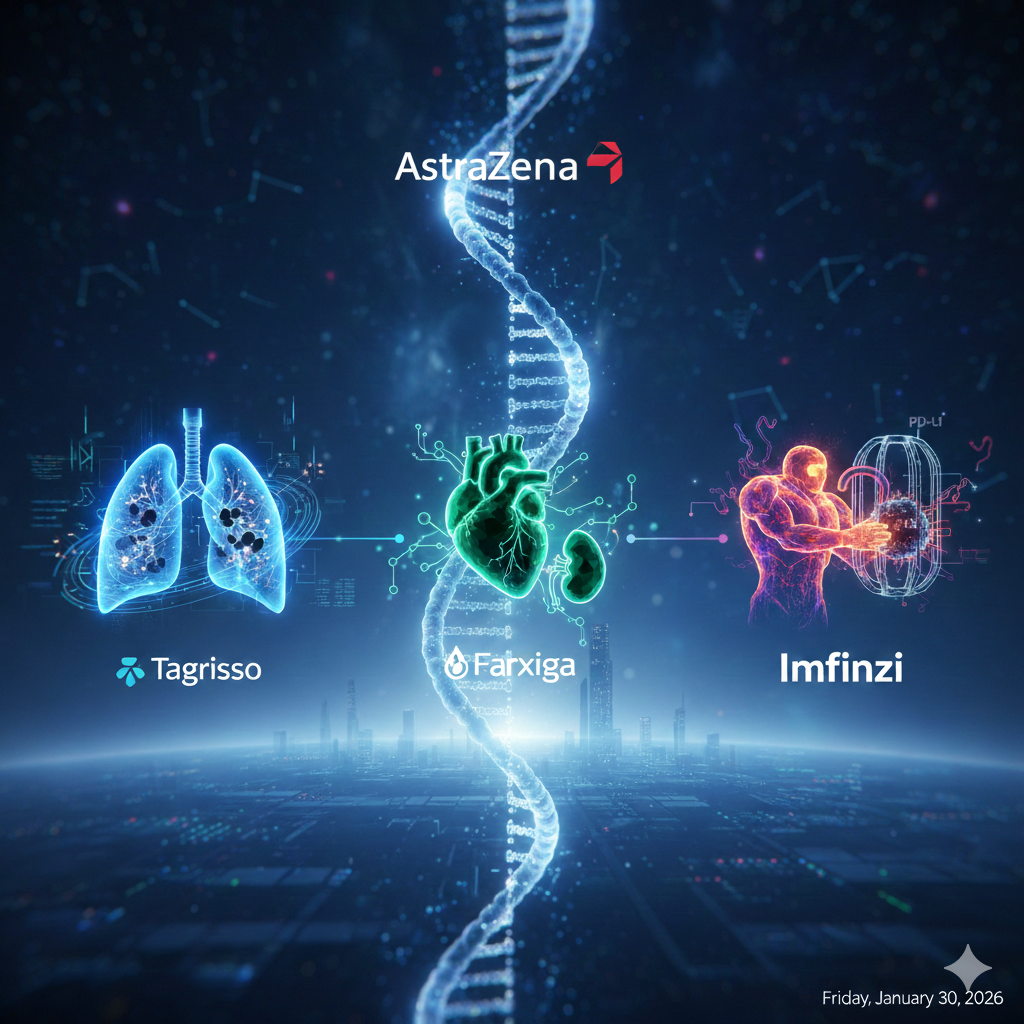
- Oncology: Total Revenue grew 16% to $18,591m, driven by strong performance from medicines like Tagrisso and Imfinzi.
- CVRM: Revenue increased 5% to $9,809m, supported by demand for Farxiga.
- R&I: Revenue rose 13% to $6,493m, fueled by growth in Fasenra and Tezspire.
- Rare Disease: Revenue grew 6% to $6,752m, with Ultomiris seeing 21% growth at CER.
R&D and Strategic Updates
- Pipeline Delivery: Announced a record 16 positive Phase III trial readouts year-to-date.
- Key Trial Successes: Highlights include positive results for Enhertu in high-risk early breast cancer and Datroway in triple-negative breast cancer.
- US Investments: Broke ground on a $4.5bn manufacturing facility in Virginia as part of a $50bn US investment plan through 2030.
- Acquisitions: Completed the acquisition of the remaining share capital of SixPeaks Bio AG to strengthen weight-management therapy development.
FY 2025 Guidance
AstraZeneca reiterated its full-year guidance at CER:
- Total Revenue: Expected to increase by a high single-digit percentage.
- Core EPS: Expected to increase by a low double-digit percentage.
Consolidated Income Statement
| Item | 9M 2025 (Sm) | % of Total Revenue | YoY Change |
| Product Sales | 41,035 | 94.9% | 9% |
| Alliance Revenue | 2,108 | 4.9% | 41% |
| Product Revenue | 43,143 | 99.8% | 10% |
| Collaboration Revenue | 93 | 0.2% | -14% |
| Total Revenue | 43,236 | 100.0% | 10% |
| Cost of sales | (7,515) | 17.4% | 0% |
| Gross Profit | 35,721 | 82.6% | 13% |
| R&D expense | (10,370) | 24.0% | 16% |
| SG&A expense | (14,441) | 33.4% | -1% |
| Operating Profit | 10,765 | 24.9% | 35% |
| Profit after Tax | 7,904 | 18.3% | 43% |
Segment Revenue
| Therapy Area | 9M 2025 (Sm) | % of Total Revenue | YoY Change (CER) |
| Oncology | 18,591 | 43.0% | 16% |
| BioPharmaceuticals | 17,129 | 39.6% | 8% |
| – CVRM | 9,809 | 22.7% | 5% |
| – R&I | 6,493 | 15.0% | 13% |
| – V&I | 826 | 1.9% | 2% |
| Rare Disease | 6,752 | 15.6% | 6% |
Financial and Operational Analysis
Revenue Growth: Total Revenue increased by 11% at CER during the first nine months of 2025. This performance was driven by growth across all Therapy Areas, notably a 16% increase in Oncology and 13% in R&I. Alliance Revenue saw a significant 41% jump, reflecting the rising importance of partnered products like Enhertu.
Profitability: Operating profit grew by 35%, significantly outstripping revenue growth. This resulted in an improved operating margin of 24.9%. Profitability was enhanced by effective cost management, as SG&A expenses decreased by 1% despite business expansion. Gross margin remained stable at 82.6%, benefiting from a favorable geographic mix but partially offset by profit-sharing arrangements in the product mix.
Investment and Pipeline: R&D expenses rose 16% to support an unprecedented 16 positive Phase III readouts year-to-date. This includes high-impact data for medicines such as Enhertu and Datroway. The company also announced a $4.5bn manufacturing facility in Virginia as part of a long-term plan to invest $50bn in the US by 2030.
Balance Sheet
| Item | At 30 Sep 2025(m) | At 31 Dec 2024(m) | % of Total Asset(2025) | YoY Change |
| Property, plant and equipment | 12,083 | 10,252 | 10.6% | 18% |
| Intangible assets | 38,191 | 37,177 | 33.4% | 3% |
| Other non-current assets | 34,242 | 30,779 | 29.9% | 11% |
| Total non-current assets | 84,516 | 78,208 | 73.8% | 8% |
| Inventories | 6,593 | 5,288 | 5.8% | 25% |
| Trade and other receivables | 14,338 | 12,972 | 12.5% | 11% |
| Cash and cash equivalents | 8,143 | 5,488 | 7.1% | 48% |
| Other current assets | 866 | 2,079 | 0.8% | -58% |
| Total current assets | 29,940 | 25,827 | 26.2% | 16% |
| Total assets | 114,456 | 104,035 | 100.0% | 10% |
| Current liabilities | (34,054) | (27,866) | 29.8% | 22% |
| Non-current liabilities | (34,431) | (35,298) | 30.1% | -2% |
| Total liabilities | (68,485) | (63,164) | 59.8% | 8% |
| Net assets | 45,971 | 40,871 | 40.2% | 12% |
Balance Sheet Analysis
Asset Structure: Non-current assets represent 73.8% of total assets, with intangible assets being the largest component at 33.4%.
Liquidity Position: Current assets grew by 16%, significantly driven by a 48% increase in cash and cash equivalents to 8,143m. The group maintains 13.0bn in financial resources, including 4.9bn in undrawn committed bank facilities.
Inventory Growth: Inventories increased by 25% to 6,593m, reflecting preparation for product launches and sustained growth in existing brands.
Capital Expenditure: Property, plant and equipment rose 18% due to investment in major manufacturing projects, such as the 4.5bn facility in Virginia.
Debt Management: Net debt decreased by 605m during the period to 23,965m. Gross debt decreased slightly as current instalments of loans increased to 4,461m from 2,007m at the start of the year.
Solvency: Total equity increased by 12% to 45,971m, driven by strong profit for the period of 7,904m, partially offset by dividend payments of 4,846m.
Cash Flow Statement
| Item | 9M 2025 (Sm) | 9M 2024 (Sm) | YoY Change |
| Net cash inflow from operating activities | 12,233 | 8,954 | 36.6% |
| Net cash outflow from investing activities | (5,362) | (6,799) | -21.1% |
| Net cash outflow from financing activities | (4,262) | (3,325) | 28.2% |
| Net increase/(decrease) in Cash and cash equivalents | 2,609 | (1,170) | n/m |
| Cash and cash equivalents at beginning of period | 5,429 | 5,637 | -3.7% |
| Exchange rate effects | 42 | (32) | n/m |
| Cash and cash equivalents at end of period | 8,080 | 4,435 | 82.2% |
Free Cash Flow (FCF) Analysis
| Item | 9M 2025 (Sm) | 9M 2024 (Sm) | YoY Change |
| Net cash inflow from operating activities | 12,233 | 8,954 | 36.6% |
| Purchase of property, plant and equipment | (1,774) | (1,216) | 45.9% |
| Purchase of intangible assets | (2,844) | (2,415) | 17.8% |
| Free Cash Flow (FCF) | 7,615 | 5,323 | 43.1% |
Cash Flow Analysis
- Operating Cash Flow: Net cash inflow from operating activities grew by 36.6% to 12,233m. This growth was primarily driven by the increased operating profit in 2025.+1
- Investing Activities: The decrease in cash outflow was largely due to a 2,771m reduction in acquisition-related spending compared to 2024, which had included the acquisitions of Gracell Biotechnologies and Fusion Pharmaceuticals.
- Capital Expenditure: Spending on tangible and software assets rose to 2,091m. This was driven by major manufacturing projects, including the 4.5bn facility in Virginia, and technology upgrades.+1
- Financing Activities: Cash outflow increased by 937m. This was mainly because no new long-term loans were issued in 2025, whereas 6,492m was raised in 2024. Dividend payments amounted to 4,968m during the period.+2
- Free Cash Flow Performance: FCF improved significantly by 43.1% YoY. The strong cash generation from operations effectively covered the group’s increased investments in manufacturing expansion and pipeline development.
Profitability Ratio Analysis
| Profitability Ratio | 2020 | 2021 | 2022 | 2023 | 2024 | 9M 2025 |
| Gross Margin | 80.1% | 66.8% | 72.1% | 82.5% | 81.1% | 82.6% |
| Operating Margin | 19.4% | 2.8% | 8.5% | 17.9% | 18.5% | 24.9% |
| Net Profit Margin | 12.0% | 0.3% | 7.4% | 13.0% | 13.0% | 18.3% |
| Return on Assets (ROA) | 4.7% | 0.1% | 3.4% | 5.9% | 6.8% | 9.2% |
| Return on Equity (ROE) | 20.1% | 0.3% | 8.9% | 15.2% | 17.2% | 22.9% |
Profitability Analysis
AstraZeneca experienced a significant dip in profitability in 2021. This was primarily due to the acquisition of Alexion, which brought substantial intangible asset amortization charges and a temporary shift in product mix. Since 2022, all profitability metrics have shown a strong and consistent recovery trend.
Revenue Mix and Efficiency: The Gross Margin reached 82.6% in the first nine months of 2025. This improvement reflects a favorable shift toward high-margin oncology and rare disease portfolios. The Operating Margin surged to 24.9% as the company successfully controlled SG&A expenses, which actually decreased by 1% despite a 10% increase in total revenue.
Bottom-Line Growth and Returns: Net Profit Margin jumped to 18.3% in 9M 2025, driven by operating leverage and a reduction in the reported tax rate from 21% to 19%. This has translated into a significantly higher Return on Equity (ROE) of 22.9%, indicating that the company has effectively integrated its acquisitions and is now delivering superior returns to shareholders.
Operating Efficiency Ratio Analysis
| Item | 2020 | 2021 | 2022 | 2023 | 2024 | 9M 2025 |
| Total Asset Turnover | 0.40 | 0.36 | 0.46 | 0.45 | 0.52 | 0.50 |
| Inventory Turnover | 1.53 | 2.65 | 2.53 | 1.52 | 1.93 | 1.52 |
| Receivables Turnover | 3.51 | 4.47 | 4.79 | 4.13 | 4.17 | 4.02 |
| Days Inventory Outstanding (DIO) | 238 | 138 | 144 | 239 | 189 | 240 |
| Days Sales Outstanding (DSO) | 104 | 82 | 76 | 88 | 88 | 91 |
Efficiency Analysis
Asset Utilization Efficiency: The total asset turnover ratio increased from0.36in2021to0.52in2024, indicating improved integration and asset productivity following the Alexion acquisition. The ratio remained strong at0.50for the first nine months of2025, reflecting robust demand across therapy areas.
Inventory Management: DIO was shorter in2021and2022, primarily due to the rapid distribution of COVID-19 vaccines. It subsequently returned to around200days as the company scaled up production and built stock for new product launches. The240-day level in 9M2025aligns with the strategy to support long-term revenue targets.
Receivables Efficiency: DSO has remained stable between80and90days. Compared to104days in2020, the collection speed has significantly improved and stabilized, demonstrating mature credit management and cash recovery capabilities even during global expansion.
Overall Performance: AstraZeneca has maintained steady operational efficiency while rapidly expanding its business scale. The strong asset turnover, combined with an optimized profit structure, remains a key driver for significant cash flow growth.
Analysis of Inventory Increase
Inventory levels increased from $5,288m as of 31 December 2024 to $6,593m as of 30 September 2025, representing a 25% increase.
Key Drivers for Inventory Growth
- Support for Revenue Growth: Total revenue grew by 11% at CER in the first nine months. The increase in inventory is essential to support the sustained demand for core medicines, particularly in high-growth areas like Oncology and Respiratory & Immunology.
- Pipeline and Launch Readiness: AstraZeneca has achieved a record 16 positive Phase III trial readouts year-to-date. The company is strategically building stock to ensure a seamless supply chain for upcoming product launches and new indication approvals across global markets.
- Manufacturing Expansion: The company is executing a significant global manufacturing investment plan, including the recently announced $4.5bn facility in Virginia. Building strategic inventory helps mitigate supply chain risks during facility upgrades and expansions.
- Geographic Expansion: As the company deepens its presence in emerging markets and expands its global footprint, inventory levels have risen to accommodate longer logistics cycles and local regulatory requirements.
This build-up in inventory reflects management’s confidence in future demand and aligns with the upgraded full-year 2024 financial guidance.
Analysis of Capital Expenditure and Short-term Debt Increase
Analysis of Capital Expenditure (CapEx) Increase
AstraZeneca’s capital expenditure reached $2,091m in the first nine months of 2025, a significant increase from $1,415m in the same period of 2024.
Global Manufacturing Expansion: The company has initiated a large-scale capacity enhancement program, most notably the $4.5bn investment in a state-of-the-art manufacturing facility in Virginia, USA. This is part of a broader $50bn strategic investment plan in the US through 2030 to support the global supply of Biopharmaceuticals and Oncology medicines.
R&D and Technology Upgrades: To support the record 16 positive Phase III trial results, the company has invested heavily in upgrading R&D laboratory equipment and automated production lines. This aims to accelerate the transition of R&D achievements into commercial products.
Sustainability Investments: A portion of CapEx is dedicated to green manufacturing initiatives to reduce carbon emissions, aligning with the company’s long-term environmental, social, and governance (ESG) goals.
Analysis of Short-term Debt Increase
The balance sheet shows that current interest-bearing loans and borrowings increased from $2,337m at the end of 2024 to $6,174m as of September 2025.
Reclassification of Long-term Debt: The primary driver for the sharp increase in short-term debt is reclassification. Several bonds or bank loans previously categorized as long-term liabilities are now due within one year and must be reported as current liabilities according to accounting standards.
Support for Working Capital and Inventory Build-up: As previously analyzed, the company increased its inventory reserves by 25% in 2025. To fund these stocks and the increase in receivables associated with revenue growth, the company utilizes short-term credit instruments to optimize liquidity.
Cash Management Strategy: Despite the increase in short-term debt, cash balances also grew to $8,143m. This indicates a preference for maintaining higher cash reserves to navigate uncertain macro environments while leveraging existing credit facilities, including $4.9bn in undrawn credit, to balance capital needs.
General Observation
The simultaneous rise in CapEx and short-term debt reflects AstraZeneca’s current expansion cycle. The company is utilizing robust operating cash flow and credit markets to fund high R&D conversion costs and global manufacturing builds. Although short-term repayment obligations have increased, the financial risk remains manageable given the 24.9% operating margin and strong free cash flow of $7,615m.
Acquisitions of Gracell and Fusion Pharmaceuticals
Based on the financial reports and transaction details, AstraZeneca’s acquisitions of Gracell Biotechnologies and Fusion Pharmaceuticals in 2024 represent a strategic pivot toward cell therapy and next-generation radiopharmaceuticals.
Gracell Biotechnologies
The acquisition was completed in February 2024, with a total transaction value of up to $1.2bn.
- Core Technology: FasTCAR Platform: Gracell’s primary competitive advantage is the FasTCAR manufacturing platform, which significantly reduces the production time of CAR-T cells from several weeks to just one day. This technology enhances cell fitness and addresses the traditional bottlenecks in cell therapy manufacturing.
- Key Asset: GC012F: This is a clinical-stage, BCMA and CD19 dual-targeting Autologous CAR-T candidate. It is currently being developed for the treatment of Multiple Myeloma and autoimmune diseases like Systemic Lupus Erythematosus (SLE).
- Strategic Rationale: This deal marked AstraZeneca’s official entry into the autologous cell therapy space, strengthening its hematology and immunology portfolios while providing a strategic R&D and manufacturing base in China.
Fusion Pharmaceuticals
Completed in June 2024 for approximately $2bn, this acquisition established AstraZeneca’s presence in the field of next-generation radiopharmaceuticals.
- Core Technology: Targeted Alpha Therapies (TAT): Fusion specializes in TAT, which delivers radioactive isotopes directly to cancer cells via precision targeting. These alpha particles deliver high-energy radiation that causes irreversible DNA damage to tumor cells while minimizing damage to surrounding healthy tissue.
- Key Asset: FPI-2265: A targeted radiopharmaceutical targeting Prostate-Specific Membrane Antigen (PSMA), currently in Phase II trials for patients with metastatic castration-resistant prostate cancer (mCRPC).
- Strategic Rationale: Fusion complements AstraZeneca’s leading oncology portfolio. By combining Fusion’s R&D platform and supply chain with AstraZeneca’s existing Antibody-Drug Conjugate (ADC) expertise, the company aims to transform the standard of care in precision medicine.
Financial Impact Summary
- Cash Flow: The net cash outflow from investing activities in 9M 2024 ($6,799m) was significantly higher than in 9M 2025 ($5,362m) because it included the upfront payments for these acquisitions. The 21% decrease in investing outflows in 2025 reflects the absence of similar-scale M&A activity in the current period.
- Intangible Assets and Goodwill: These acquisitions contributed to the high proportion of intangible assets ($38.2bn) and goodwill ($21.2bn) on the balance sheet. Combined, they represent 51.9% of total assets as of September 2025.
- R&D Expenses: The continued development of programs acquired through these deals contributed to the 16.4% year-on-year increase in R&D expenses for 9M 2025, as the company accelerates these assets toward clinical milestones.
Background and Strategic Rationale for Investment in China
AstraZeneca (AZ) has recently announced a massive commitment to the China market, highlighted by a plan to invest $15bn by 2030. This investment represents a “double-down” strategy, positioning China not just as a sales destination but as a critical node in its global innovation and manufacturing network.
- Localization of the Full Value Chain: The investment is focused on expanding existing manufacturing bases in Wuxi, Taizhou, Qingdao, and Beijing. AZ aims to build the first end-to-end cell therapy supply chain for a multinational pharma company in China.
- Innovation Hub: AZ established its “Global Strategic R&D Center” in Beijing, its sixth-largest globally. By integrating local AI and data science labs, AZ seeks to export Chinese-born innovations to the global market—a strategy often described as “In China, for the Global.”
- Strategic Acquisitions: The acquisition of Gracell Biotechnologies (focused on CAR-T cell therapy) and partnerships with local firms like HK Inno.N and CStone Pharmaceuticals underline AZ’s focus on high-growth areas like oncology and immunology.
Impacts and Operational Risks
- Market Leadership: AZ is currently the largest multinational pharmaceutical company in China by revenue. This investment is designed to cement that lead and contribute toward the company’s global goal of reaching $80bn in revenue by 2030.
- Regulatory and Compliance Challenges: The expansion comes amidst heightened scrutiny. The ongoing investigation into Leon Wang (President of AZ China) regarding medical insurance fraud and data privacy issues highlights the significant compliance risks of operating at such a large scale within China’s regulatory environment.
Relations with the United States: The “Parallel Supply Chain” Strategy
AstraZeneca’s aggressive China expansion is being managed through a calculated de-risking strategy to navigate the increasingly tense US-China geopolitical climate, particularly regarding the BIOSECURE Act.
- Supply Chain Decoupling: AZ is effectively building a “Parallel Supply Chain.” It is investing $4.5bn in a new facility in Virginia, USA, specifically to serve the US market, while the China investments are primarily focused on China and other international markets. This separation ensures that potential sanctions or trade disruptions in one region do not paralyze the other.
- In China for China vs. In US for US: By localizing R&D and manufacturing in both territories, AZ avoids the risk of being caught in the middle of export controls or data sovereignty disputes.
- Strategic Hedge: While many US-based firms are diversifying away from China (friend-shoring), AZ—as a UK-headquartered firm—is leveraging its European identity to maintain deep roots in China, using the country’s lower clinical trial costs and rapid enrollment to speed up global drug development.
Summary Comparison
| Focus Area | China Strategy ($15bn) | US Strategy ($50bn by 2030) |
| Objective | Speed to market, local innovation, and volume. | Cutting-edge manufacturing and high-value biologics. |
| Primary Risk | Regulatory compliance and geopolitical friction. | High operational costs and drug pricing legislation (IRA). |
| Key Function | Exporting R&D to the world; “In China for Global.” | Securing the world’s largest healthcare market. |
Source:
- https://www.astrazeneca.com/media-centre/press-releases/2024/9m-and-q3-2024-results.html
- https://www.astrazeneca.com/investor-relations/results-and-presentations.html
- https://www.astrazeneca.com/media-centre/press-releases/2023/astrazeneca-to-acquire-gracell-to-further-cell-therapy-ambitions.html
- https://www.astrazeneca.com/media-centre/press-releases/2024/astrazeneca-to-acquire-fusion-to-accelerate-radiopharmaceutical-ambitions.html
- https://www.astrazeneca.com/media-centre/press-releases/2024/astrazeneca-announces-plans-for-new-400-million-manufacturing-facility-in-the-us.html
- https://www.astrazeneca.com/media-centre/press-releases/2024/astrazeneca-unveils-ambition-for-80-billion-revenue-by-2030.html
- https://www.bloomberg.com/news/articles/2024-10-30/astrazeneca-china-president-leon-wang-under-investigation
- https://www.reuters.com/business/healthcare-pharmaceuticals/astrazeneca-plans-45-billion-investment-virginia-us-manufacturing-2024-11-12/
- https://www.reuters.com/business/healthcare-pharmaceuticals/astrazeneca-invest-further-china-with-new-partnerships-2024-02-26/
Back to AstraZeneca page