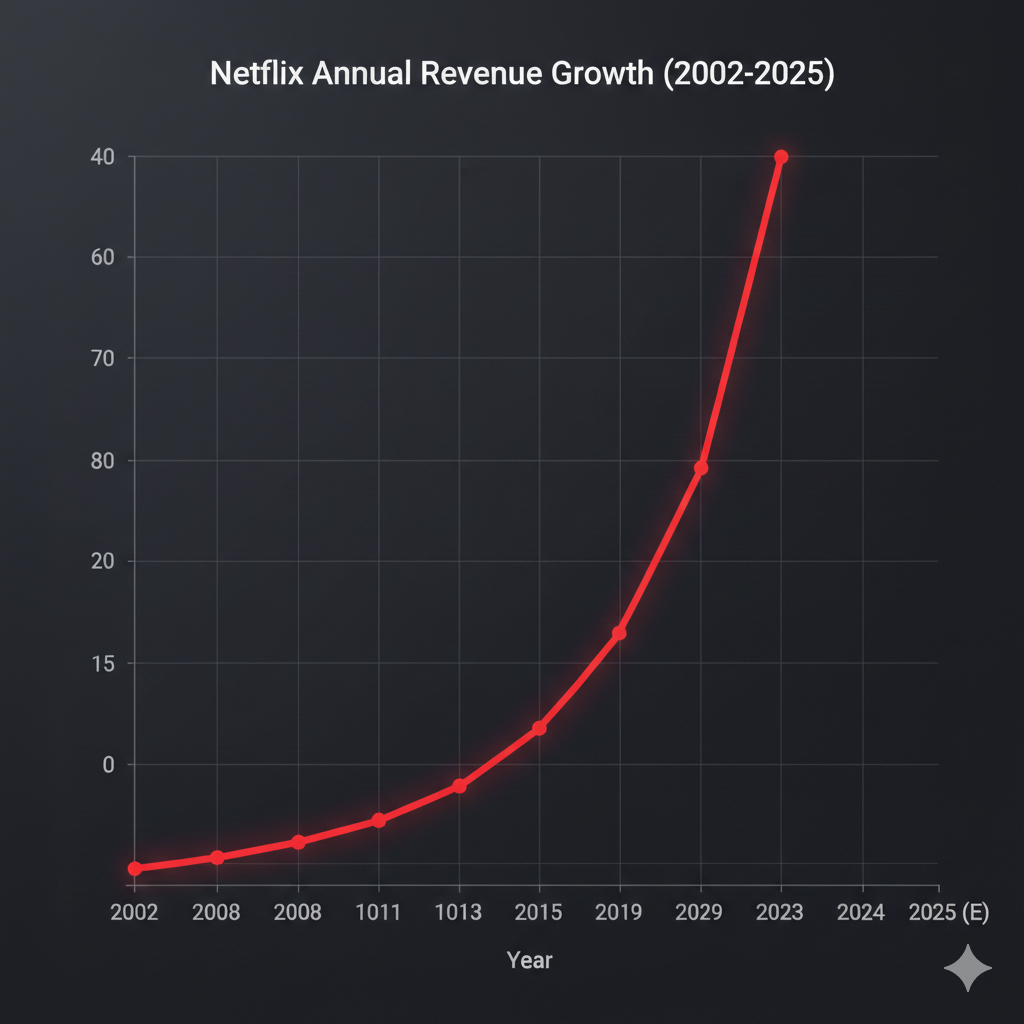
Here is the historical evolution of Netflix, categorized into four distinct strategic phases:
1. The DVD-by-Mail Era (1997 – 2006): Disrupting the Status Quo
Netflix started as a direct challenger to physical rental stores like Blockbuster by leveraging the efficiency of the internet and the postal service.
- 1997: Founded by Reed Hastings and Marc Randolph.
- 1999: Launched the Monthly Subscription Model. This was a game-changer: no due dates, no late fees, and no shipping charges.
- 2000: Developed the Cinematch recommendation system, using data to suggest movies based on user ratings.
- 2002: Initial Public Offering (IPO) on the Nasdaq.
Core Technology: During this phase, the technology was centered on Logistics and Predictive Analytics. The core engine was Cinematch, a proprietary recommendation algorithm. Unlike modern AI, its primary purpose was “inventory smoothing.” It encouraged users to queue less-popular movies that were sitting in warehouses, ensuring high turnover of physical DVDs. The backend relied on a Monolithic Architecture using Oracle databases to manage shipping routes and customer subscriptions across the United States.
Revenue Level: Netflix started with negligible revenue and crossed the $1 billion mark for the first time in 2006. When they went public in 2002, annual revenue was only around $150 million. The business model was capital-intensive due to postage and physical disc costs, resulting in relatively slim profit margins.
2. The Great Pivot to Streaming (2007 – 2012): Digital Transformation
Recognizing that the future was digital, Netflix risked its core DVD business to pioneer the streaming industry.
- 2007: Introduced “Watch Now,” allowing subscribers to stream content directly on their PCs.
- 2010: International expansion began in Canada.
- 2011: The Qwikster PR Crisis. Netflix tried to split DVD and streaming services into two separate brands. While it caused a massive stock drop and lost subscribers initially, it successfully forced the company’s transition to a “Streaming First” identity.
Core Technology: This was the era of Cloud Migration and Microservices. Following a major database failure in 2008, Netflix became a pioneer by moving its entire infrastructure to Amazon Web Services (AWS). They developed the Netflix OSS (Open Source Software) stack, including tools like Chaos Monkey, which intentionally broke parts of their own system to ensure it remained resilient. This shift allowed them to scale rapidly without building their own data centers.
Revenue Level: Revenue grew steadily from $1.2 billion in 2007 to $3.6 billion by 2012. While the top line grew, this was a financially turbulent period due to the high cost of digital licensing and the “Qwikster” PR disaster, which temporarily caused a dip in subscriber growth and stock price.
3. Original Content & Global Dominance (2013 – 2021): Becoming a Studio
To reduce dependency on licensing deals from studios (who were becoming competitors), Netflix pivoted to becoming a content creator.
- 2013: Released “House of Cards,” its first high-budget original series. It popularized “Binge-watching” by releasing all episodes at once.
- 2016: Launched in 130 additional countries simultaneously, making it a truly global network.
- 2017 – 2021: Shifted focus to local-language originals (e.g., Money Heist, Squid Game). Netflix began winning major Academy Awards and Emmys, cementing its place as a Hollywood powerhouse.
Core Technology: The focus shifted to Content Delivery Networks (CDN) and Video Encoding. Netflix built Open Connect, its own global CDN, providing custom hardware to Internet Service Providers (ISPs) so that video data could be stored closer to the user. Technically, they also mastered Per-Title Encoding, a method that optimizes video compression based on the complexity of the visual (e.g., an action movie requires more data than a cartoon), allowing for 4K streaming even on slower connections.
Revenue Level: This phase saw an explosion in revenue, skyrocketing from $4.3 billion in 2013 to nearly $30 billion by 2021. However, the company’s “Free Cash Flow” remained negative for years because they were spending upwards of $15 billion annually to produce original hits like Stranger Things and The Crown.
4. Monetization & Diversification (2022 – Present): The New Playbook
As the “Streaming Wars” intensified and subscriber growth slowed, Netflix moved toward a more traditional media revenue model.
- 2022: Facing its first subscriber loss in a decade, Netflix introduced an Ad-Supported Tier.
- 2023: Implemented a global crackdown on Password Sharing, converting “freeloaders” into paid members.
- 2024 – 2025: Expansion into Live Events and Gaming.
- Signed a 10-year deal with WWE Raw (starting 2025).
- Ventured into live sports (e.g., Mike Tyson vs. Jake Paul).
- Integrated mobile games into the app to increase user retention.
Core Technology: The current tech focus is on Ad-Tech (Advertising Technology) and Low-Latency Live Streaming. To support live sports and events (like WWE or Mike Tyson’s fights), Netflix had to re-engineer its architecture to handle massive, simultaneous “traffic spikes” that differ from traditional on-demand viewing. Additionally, they have built a sophisticated ad-insertion engine that matches commercials to specific user profiles in real-time.
Revenue Level: Netflix has reached a new plateau of financial maturity. Revenue is projected to exceed $43 billion in 2026. Unlike the previous phase, the company is now highly profitable with strong positive Free Cash Flow. They have shifted their focus from pure subscriber counts to ARPU (Average Revenue Per User), driven by the new ad-tier and the successful crackdown on password sharing.